As Amazon Associates, we earn from qualifying purchases. This means we may receive a small commission at no extra cost to you if you click through and make a purchase.
AOC has established a significant presence in competitive PC gaming by producing displays that push refresh rates and panel technology into accessible performance categories. Across its diverse lineup, the brand incorporates Fast IPS, curved Vertical Alignment (VA), Mini-LED backlighting, and Quantum Dot OLED panels into standard 27-inch desktop formats. Gamers routinely gravitate toward these screens for their integrated gaming utilities—such as Shadow Control, custom Game Mode presets, and G-Menu software tuning—paired with synchronization standards like Adaptive-Sync and NVIDIA G-SYNC compatibility. However, discerning buyers must evaluate more than peak refresh figures, as variations in backlighting architecture, pixel response methods, stand ergonomics, and cooling designs directly influence day-to-day longevity, optical comfort, and long-term panel stability.
While all five displays share a 27-inch class diagonal, they diverge significantly across core panel architectures, spanning Full HD esports panels operating up to 280Hz, sharp Quad HD productivity options, multi-zone Mini-LED backlighting, and self-emissive QD-OLED hardware.
AOC Gaming Monitors Compared
| Model | Panel Type & Resolution | Refresh Rate & Response | Brightness & Contrast | Stand Adjustments |
|---|---|---|---|---|
| AOC 27″ Gaming Monitor QHD 260Hz | IPS, 2560×1440 (QHD) | 240Hz, 0.3ms MPRT | 300 nits, 1000:1 | Tilt (-3° to +21°) |
| AOC 27″ Gaming Monitor FHD 260Hz | IPS, 1920×1080 (FHD) | 240Hz (260Hz OC), 0.5ms MPRT | Not listed, Not listed | Tilt (-3° to 21°), VESA 100x100mm |
| AOC Agon Pro 27 Inch Gaming | QD OLED, 2560×1440 (QHD) | 240Hz (Up to 280Hz), 0.03ms GTG | 1000 nits peak, 1500000:1 | Not listed |
| AOC 27 Inch Curved Gaming Monitor | Curved VA (1500R), 1920×1080 (FHD) | 280Hz, 0.3ms | 300 nits, 3000:1 | Height, Tilt, Swivel, VESA |
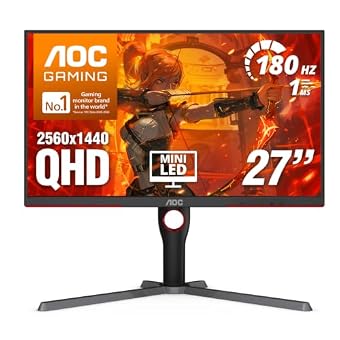
| AOC 27 Inch Gaming Monitor QHD | VA Mini-LED (336 Zones), 2560×1440 (QHD) | 180Hz (OC), 1ms GTG | 450 cd/m² (HDR1000), Not listed | Not listed |
AOC 27" Gaming Monitor QHD 260Hz for Balanced Esports Clarity

Best for: Budget competitive gamers maximizing frame rates
Pros
- 260Hz overclock capability
- Low 22W power consumption
- VESA 100x100mm mounting support
Cons
- Lower 1080p pixel density
- Contrast ratio not listed
Best for: Esports players prioritizing 1440p motion clarity
Pros
- 240Hz refresh rate
- Sharp 2560×1440 IPS panel
- 3ms MPRT blur reduction
Cons
- Tilt-only stand mechanism
- Standard 1000:1 static contrast
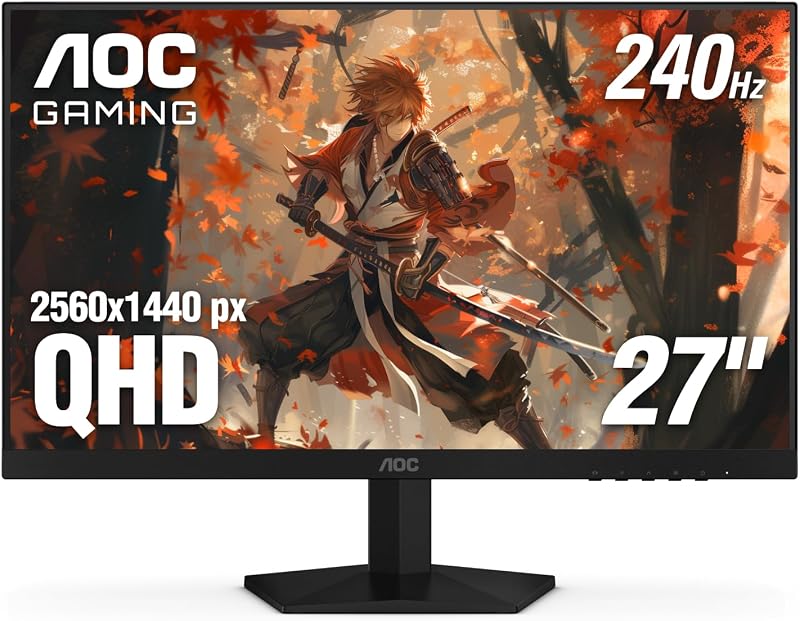
The AOC 27″ Gaming Monitor QHD 260Hz, designated under model code Q27G41ZE, balances high pixel density with fast motion handling on a 2560×1440 Quad HD IPS panel. Operating at a native 240Hz refresh rate across DisplayPort 1.4, this display targets competitive players who demand crisper visual definition than standard 1080p panels can muster. AOC integrates Adaptive-Sync alongside official NVIDIA G-SYNC compatibility to eliminate tearing across varying frame rates. In an objective aoc q27g41ze review context, the panel relies on an advertised 0.3ms MPRT response time via backlight strobing, engineered to minimize visual blur during high-velocity camera sweeps in first-person shooters.
Underneath the glossy screen finish, the display utilizes conventional edge-lit LED backlighting delivering 300 candela per square meter of peak brightness and a standard 1000:1 static contrast ratio. For setup utility, AOC provides two HDMI 2.0 ports, one DisplayPort 1.4 connection, and an audio out jack, supplemented by on-screen software tools like Shadow Control, Game Mode presets, and an updated graphical OSD menu. The physical chassis embraces a three-sided frameless aesthetic with textured black and red trim. However, hardware adjustability is strictly limited to a -3° to +21° tilt mechanism, omitting height and swivel modifications.
This aoc 27 inch qhd gaming monitor suits competitive multiplayer enthusiasts who prioritize sharp 1440p target acquisition without sacrificing high refresh rates. Nonetheless, potential buyers must recognize its ergonomic limitations; gamers needing variable height positioning must rely on aftermarket mounting solutions, where supported, or consider fully adjustable models in the lineup. Furthermore, while the 1000:1 static contrast ratio handles bright room play adequately, users who play primarily in darkened rooms will observe typical IPS glow, making high-contrast alternatives like Mini-LED or OLED more suitable when black depth takes precedence over pure panel speed.
AOC 27" Gaming Monitor FHD 260Hz for High-FPS Competitive Shooters
The AOC 27″ Gaming Monitor FHD 260Hz, cataloged as the aoc 27g51z, prioritizes raw throughput by pairing a 1920×1080 Full HD resolution with a rapid 240Hz native refresh rate that overclocks up to 260Hz across both HDMI and DisplayPort inputs. Built on an IPS panel offering 178-degree wide viewing angles, this display seeks to reduce rendering workloads on the host graphics card, enabling competitive players to sustain maximum frame output without demanding top-tier hardware. Motion performance is bolstered by an advertised 0.5ms MPRT specification and Adaptive-Sync integration to combat frame-pacing stutter.
Physical and operational specifications focus on utilitarian esports needs. The monitor incorporates a three-sided frameless bezel, a glossy screen surface description, and a low-power Eco Mode consuming a typical 22 watts alongside Flicker-Free backlighting to mitigate eye strain over marathon play sessions. AOC supplies an HDMI cable and power cord in the box, and setup customization is managed through their graphical OSD or desktop G-Menu software. Unlike tilt-restricted fixed stands, the 27G51Z includes 100x100mm VESA mount compatibility in addition to its -3° to 21° integrated tilt adjustment, giving players straightforward mounting options on aftermarket monitor arms.
This model serves dedicated esports competitors who value fluid motion tracking over fine visual detail. With a 1080p resolution distributed across a 27-inch diagonal, pixel density sits at roughly 81 pixels per inch, resulting in noticeable edge softness in desktop applications and distant game geometry compared to 1440p displays. Buyers seeking high fidelity for mixed productivity and narrative gaming will find the Q27G41ZE or Q27G3XMN vastly superior in visual definition, whereas the 27G51Z yields strictly to shoppers striving to push budget-tier graphics cards to maximum frame rates in titles like Counter-Strike or Valorant.
AOC Agon Pro 27 Inch Gaming for Premium Motion Fluidity and Contrast
Best for: Enthusiasts demanding elite response and true blacks
Pros
- Instantaneous 0.03ms GTG response
- Infinite 1500000:1 OLED contrast
- Fluid 280Hz maximum refresh
Cons
- Risk of long-term OLED burn-in
- Glossy finish reflects ambient glare
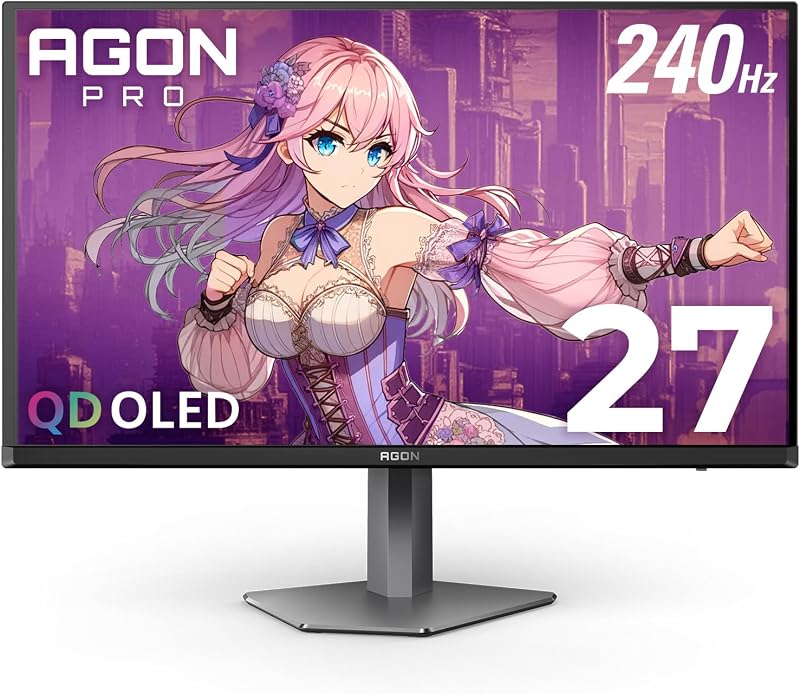
The AOC Agon Pro 27 Inch Gaming monitor, identified by model code aoc ag276qzd2, shifts from standard backlighting to a high-end 26.5-inch Quantum Dot OLED panel with a 2560×1440 Quad HD resolution. Boasting an ultra-fast 0.03ms Gray-to-Gray (GtG) response time, this display practically eliminates trailing artifacts without resorting to aggressive overdrive overshoot. The self-luminous organic subpixels produce infinite static contrast rated at 1,500,000:1, delivering genuine, inky blacks alongside peak brightness capabilities reaching 1000 nits in HDR10 scenarios. Color fidelity is equally expansive, covering 101 percent of DCI-P3 and 136.7 percent of sRGB color spaces.
Engineered for top-tier esports tournaments and immersive single-player campaigns alike, the display supports up to a 280Hz overclocked refresh rate alongside native 240Hz operation and certified G-Sync compatibility. Console players benefit from built-in 120Hz high-frame-rate synchronization at low input latency. On the rear exterior, AOC incorporates customizable RGB ambient lighting that can synchronize color patterns across compatible brand peripherals. The unit also houses six tailored Game Modes and AOC Shadow Control, giving players granular command over shadow visibility. Detailed comparisons on an aoc 27 inch monitor oled highlight the absolute absence of blooming around bright crosshairs.
This monitor represents the apex choice for enthusiasts who demand peerless motion clarity and reference-grade dynamic range. However, careful buyers must account for the inherent operational traits of OLED technology. While liquid crystal displays can display static HUD elements endlessly without degradation risk, organic self-lit panels require deliberate maintenance routines to safeguard against cumulative image retention. Users whose daily usage involves lengthy spreadsheet work or static desktop tasks should weigh this reliability trade-off carefully, recognizing that this display yields to the Mini-LED Q27G3XMN for static luminance endurance while thoroughly outperforming standard IPS alternatives in dark-room fidelity.
AOC 27 Inch Curved Gaming Monitor for Immersive High-Contrast Play
Best for: HDR gaming enthusiasts wanting high sustained brightness
Pros
- 336-zone Mini-LED backlighting
- Peak VESA DisplayHDR 1000
- Sharp 1440p QHD clarity
Cons
- Lower 180Hz maximum refresh
- Contrast ratio not listed

Best for: Sim gamers seeking deep contrast and curvature
Pros
- Deep 3000:1 VA contrast
- Smooth 280Hz refresh rate
- Full height, tilt, and swivel
Cons
- Coarser 1080p pixel density
- Dark-transition response slower than IPS
The AOC 27 Inch Curved Gaming Monitor, cataloged under model number aoc c27g4zh, integrates a 1500R curved VA panel designed to match the natural peripheral arc of human vision. Running at a blistering 280Hz refresh rate with a 0.3ms response time specification, this Full HD 1920×1080 screen targets racing, simulation, and arcade players looking for panoramic depth. The native Vertical Alignment panel technology provides a deep 3000:1 static contrast ratio, offering triple the black-depth capability of traditional IPS alternatives and delivering rich, nuanced shadows in dimly lit gaming environments.
Beyond raw panel specifications, the physical chassis stands out for complete ergonomic adjustability, incorporating tilt, swivel, and height adjustments alongside standard VESA mounting provisions. The monitor is equipped with Flicker-Free backlighting, Adaptive-Sync variable refresh rate handling, HDR readiness, and AOC G-Menu software management. The display shell features a glossy screen finish and 300 nits of brightness. When evaluating chassis dynamics against an acer gaming monitor 27 inch curved, AOC’s fully articulated stand ensures users can dial in a proper optical focal distance without requiring monitor desk mounts.
This curved screen is ideal for flight sim, racing, and casual shooter players who appreciate deep native contrast and wrap-around immersion. However, potential buyers should recognize the inherent trade-offs of fast VA matrices. Although the 0.3ms marketing figure implies instant pixel transitions, dark-to-light state changes on VA panels can exhibit slight black smearing in high-contrast transitions compared to Fast IPS or OLED panels. Additionally, the 1080p resolution on a curved 27-inch panel limits desktop productivity, making flat 1440p options like the Q27G41ZE a more balanced solution for mixed gaming and text-heavy workloads.
AOC 27 Inch Gaming Monitor QHD for Hardware-Calibrated Mini-LED HDR
The AOC 27 Inch Gaming Monitor QHD, designated as the aoc q27g3xmn, bridges the gap between conventional backlights and self-emissive displays by adopting advanced Mini-LED backlight technology. Featuring 336 individually controlled local dimming zones on a 2560×1440 QHD VA panel, this screen achieves official VESA DisplayHDR 1000 certification with a peak sustained brightness of 450 cd/m² in standard modes and significantly higher highlights under active HDR playback. With 134 percent sRGB color gamut coverage and factory color calibration, it reproduces HDR highlights and shadows with striking visual depth that edge-lit monitors cannot replicate.
Motion handling is powered by a 180Hz overclocked refresh rate over DisplayPort 1.4, paired with a reliable 1ms GtG response time specification and Adaptive-Sync synchronization. The panel utilizes a glossy screen finish and a three-sided frameless design. Note that while the listing mistakenly prints cleaning instructions under the contrast ratio specification—leaving the official numerical static contrast ratio unlisted in the data sheet—the combination of an inherent VA substrate and 336 dimming zones delivers deep black performance that rivals far more complex architectures.
This Mini-LED powerhouse is the definitive pick for single-player adventure gamers, visual fidelity enthusiasts, and mixed-use desktop users who want dramatic HDR performance without the burn-in anxieties associated with OLED panels. It delivers far brighter sustained full-field whites than the AG276QZD2 while offering vastly deeper black levels than edge-lit IPS models. It yields, however, to the 240Hz and 280Hz displays in the lineup for ultra-competitive esports players who prioritize maximum frame throughput and millimeter-precise response over high dynamic range visual spectacle.
How to Choose the Right AOC Gaming Monitor
Selecting which aoc gaming monitor to buy requires evaluating panel architecture, refresh ceiling, motion response ratings, and stand versatility against your primary gaming library and room environment. A comprehensive aoc gaming monitor comparison reveals that panel technology dictates visual fidelity far more than resolution alone. For players seeking balanced, all-around color accuracy and dependable viewing angles, an aoc 27 inch qhd gaming monitor equipped with Fast IPS—such as the Q27G41ZE—delivers consistent color rendition without the narrow viewing angles of curved VA screens or the pixel degradation concerns of organic panels.
When analyzing an aoc fast ips vs oled monitor matchup, the core decision centers on contrast fidelity versus operational longevity. The AGON PRO AG276QZD2 utilizes self-luminous QD-OLED hardware that turns individual subpixels completely off, generating infinite contrast, perfect black depth, and an instantaneous 0.03ms GtG response time that completely eradicates motion ghosting. However, OLED panels remain vulnerable to burn-in if subjected to non-stop, static desktop interfaces or unchanging game HUDs at high brightness over several years. For gamers who crave HDR depth with zero burn-in risk, the Mini-LED backlighting on the Q27G3XMN provides an exceptional alternative, utilizing 336 physical dimming zones to achieve VESA DisplayHDR 1000 performance while retaining the enduring stability of an inorganic LED-backlit LCD panel.
Resolution and refresh rate balance represents another critical performance crossroads. Shoppers seeking an aoc 240hz gaming monitor or higher must weigh the demands placed on their computer hardware. A 27-inch 1080p display like the 27G51Z or curved C27G4ZH allows graphics cards to push consistent 240Hz to 280Hz frame rates in fast-paced competitive esports titles, but the modest 81 PPI pixel density reveals noticeable jaggedness during desktop computing and web navigation. Conversely, jumping to 2560×1440 Quad HD on the Q27G41ZE, Q27G3XMN, or AG276QZD2 delivers crisp visual definition and generous screen real estate, making 1440p the sweet spot for modern mid-to-high-tier systems.
Finally, shoppers evaluating an aoc 27 inch qhd gaming monitor 240hz 0.3ms, overclock 260hz, ips, 2560×1440, g-sync compatible, hdr display should look past headline marketing response times and inspect physical ergonomics. Moving Picture Response Time (MPRT) measurements represent strobing backlight states that can introduce visible flicker and restrict brightness, whereas native Gray-to-Gray (GtG) measurements reflect genuine liquid crystal or OLED transition speeds. Furthermore, stand mechanics vary drastically across the AOC catalog. Models like the Q27G41ZE and 27G51Z feature tilt-only mechanisms, which may force users to purchase separate VESA mounting arms for ergonomic height alignment. In contrast, the curved C27G4ZH includes integrated height, swivel, and tilt adjustments out of the box, illustrating why physical adjustability should play an equal role alongside electronic panel specifications in your purchasing decision.
FAQ
What is the difference between MPRT and GtG response times on AOC monitors?
GtG (Gray-to-Gray) measures the time it takes an individual pixel to transition between two distinct gray shades, reflecting the raw physical speed of the liquid crystal or OLED layer. MPRT (Moving Picture Response Time) measures how long a pixel remains visible on the screen, typically achieved by pulsing or strobing the backlight between refresh cycles to diminish perceived motion blur. While an advertised 0.3ms MPRT on an IPS or VA monitor indicates aggressive strobing capability, true GtG figures are generally higher. Only OLED panels, like the 0.03ms GtG AG276QZD2, achieve sub-millisecond physical pixel transitions without requiring backlight trickery.
Can an AOC 1440p 240Hz monitor run at full speed over HDMI?
Connection bandwidth determines your operational limits. On monitors such as the Q27G41ZE, the listing specifies that the 240Hz refresh rate is delivered via DisplayPort 1.4, while the HDMI 2.0 ports are bandwidth-constrained and typically cap 1440p resolution at 144Hz. To achieve maximum refresh rates at 2560×1440 resolution without color subsampling, you should always connect your desktop PC using the provided or certified DisplayPort 1.4 cable.
Does the AOC Mini-LED monitor suffer from haloing or blooming?
The Q27G3XMN utilizes 336 individual local dimming zones to adjust backlight intensity behind specific screen sectors. While this allows for exceptional HDR brightness reaching 1000 nits and deep black levels, small bright elements surrounded by pure darkness—such as white mouse cursors, small subtitle lines, or isolated game crosshairs—may illuminate an entire dimming zone, producing slight blooming or haloing around those edges. This is an inherent physical characteristic of multi-zone local dimming that does not occur on pixel-level self-emissive OLED panels.
Is a 27-inch 1080p monitor sharp enough for everyday desktop use?
A 27-inch monitor featuring 1920×1080 resolution, such as the 27G51Z or C27G4ZH, yields a pixel density of approximately 81 pixels per inch (PPI). While this lower pixel density is well-tolerated in high-speed competitive esports where visual fluidity and extreme frame rates are prioritized, text and fine lines in desktop software, web browsing, and document editing can appear noticeably coarse. Users who divide their time equally between productivity and gaming generally benefit from stepping up to a 2560×1440 Quad HD panel for sharper text rendering.
Do AOC gaming monitors support both NVIDIA and AMD graphics cards?
Yes. The monitors in this lineup feature Adaptive-Sync technology, which is an open VESA standard natively compatible with AMD FreeSync. Furthermore, models across this collection feature NVIDIA G-SYNC compatibility, ensuring tear-free, low-latency variable refresh rate performance whether you are running an NVIDIA GeForce or AMD Radeon graphics card.