


As Amazon Associates, we earn from qualifying purchases. This means we may receive a small commission at no extra cost to you if you click through and make a purchase.
PNY has established a consistent presence in personal computing storage by supplying straightforward, cost-effective solid-state drives designed to replace aging mechanical disks. In consumer solid-state storage, PNY internal ssd reliability centers on functional simplicity—delivering reliable boot drives, silent operation, and lower power consumption without complex software overhead. Because solid-state architecture eliminates rotating magnetic platters and mechanical read-write heads, it removes the vulnerability to physical shock and vibration that often degrades traditional hard disks. For shoppers evaluating a pny ssd 240 option or looking at modern upgrade pathways, understanding how drive capacity, flash endurance, and interface standards interact is essential for choosing dependable hardware.
Across PNY’s internal lineup, models differ primarily by their physical interface, sustained transfer bandwidth, and total write endurance: the CS900 250GB acts as a minimal SATA boot drive for legacy systems, the CS900 500GB doubles the flash cell pool for balanced daily wear leveling, and the CS2241 1TB moves to high-speed PCIe Gen4 NVMe lanes with an extended warranty and dedicated cloning hardware.
PNY SSDs Compared
| Model | Form Factor | Interface | Max Read Speed | Max Write Speed | Warranty |
|---|---|---|---|---|---|
| PNY CS900 250GB 2.5″ SATA III | 2.5-inch | SATA III 6Gb/s | 535 MB/s | 500 MB/s | Up to 3 years |
| PNY CS900 500GB 2.5″ SATA III | 2.5-inch | SATA III 6Gb/s | 550 MB/s | 500 MB/s | Up to 3 years |
| PNY CS2241 1TB PCIe Gen4 x4 | M.2 2280 | PCIe Gen4 x4 NVMe | 5,100 MB/s | 3,200 MB/s | 5-year limited or TBW |
PNY CS900 250GB 2.5" SATA III for Budget System Refreshes
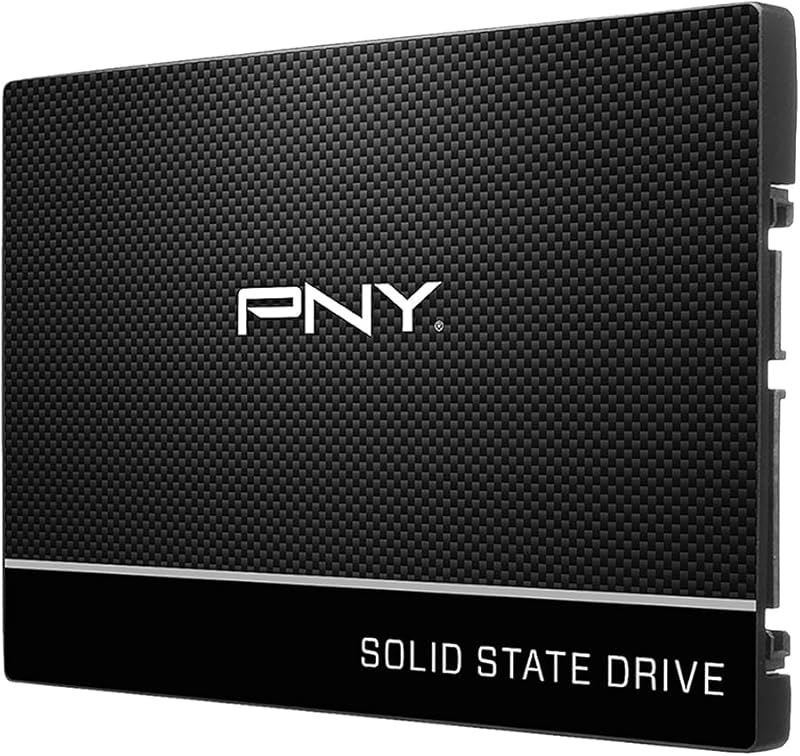
Best for: Budget laptop or desktop boot drive replacements
Pros
- Hardware encryption support
- Ultra-low power draw
- SATA II backward compatibility
Cons
- Limited 250GB capacity
- Slower SATA write ceiling
The PNY CS900 250GB 2.5″ SATA III is an entry-level solid-state drive built to serve as a direct replacement for traditional mechanical hard drives in laptops and desktop PCs. Housing flash memory within a standard 2.5-inch form factor, it connects via the SATA III 6Gb/s interface and supports legacy SATA II 3Gb/s connections. The listing specifies sequential read speeds up to 535MB/s and sequential write speeds up to 500MB/s, delivering a tangible reduction in system boot times and application loading sequences compared to spinning media. With no moving parts, the drive operates silently, consumes minimal power, and resists physical drops and vibrations.
From a hardware reliability perspective, the pny ssd 240gb tier (provided here as a 250GB drive) requires careful operational management. The listing highlights hardware encryption, an installed cache memory size of 250, and up to 3 years of warranty support. However, modern desktop operating systems continuously write background telemetry, update packages, and paging files to the primary partition. Because smaller solid-state drives have fewer spare NAND blocks, operating this drive near full capacity increases write amplification and accelerates cell exhaustion. Buyers selecting this model must monitor available space to maintain stable write speeds and drive health.
This model is ideal for secondary computers, light office workstations, or older family laptops dedicated to web browsing and text processing. It revives sluggish hardware without requiring complex modifications. However, users managing large photo libraries, modern gaming installations, or video files will quickly exceed its capacity. Those seeking more operational headroom or exploring alternatives like a samsung nvme 500gb configuration will find that stepping up to a larger drive offers substantially better long-term durability.
PNY CS900 500GB 2.5" SATA III for Everyday Computing
Best for: Balanced daily computing and mainstream storage
Pros
- Included data recovery service
- Double the flash endurance pool
- Low power consumption
Cons
- Capped at SATA III speeds
- 3-year warranty limit
The PNY CS900 500GB 2.5″ SATA III builds on the entry-level SATA design by doubling the digital storage capacity to 500GB within the same 2.5-inch housing. The listing notes sequential read performance up to 550MB/s (with alternative read speed noted at 500 megabytes per second) and sequential write speeds reaching 500MB/s (media speed listed at 490 megabytes per second). Like the 250GB edition, it is designed for an easy and cost-effective HDD replacement in desktop and laptop computers, lowering power draw, cutting heat generation, and providing instant responsiveness for everyday tasks.
Doubling the storage volume directly enhances internal endurance and write longevity. Solid-state drive endurance depends on having an ample pool of NAND blocks so the controller’s wear-leveling algorithm can distribute program-erase cycles evenly. With 500GB of storage and an installed cache memory size of 512, this model handles system updates and application caching with significantly less wear per cell than a 250GB drive. The listing also highlights data recovery service support as an included feature, and the drive supports up to 3 years of warranty coverage, offering a dependable safety net for daily use.
This model suits home and office users who want a dependable boot drive that can accommodate both an operating system and a modest collection of games or personal media files. When performing a pny ssd comparison across legacy SATA options, the 500GB version provides the best balance of price and cell endurance. However, because it remains limited by the SATA III interface ceiling, users comparing a pny cs900 vs cs2241 setup on modern motherboards will find that PCIe-based alternatives deliver far higher transfer rates.
PNY CS2241 1TB PCIe Gen4 x4 for High-Speed Workloads

Best for: High-performance systems needing rapid Gen4 throughput
Pros
- Up to 5,100MB/s read speeds
- Includes Acronis cloning kit
- 5-year warranty with 24/7 support
Cons
- Requires M.2 NVMe slot
- Incompatible with 2.5-inch SATA bays
The PNY CS2241 1TB PCIe Gen4 x4 transitions to modern solid-state architecture, utilizing an M.2 2280 form factor over the PCI Express 4.0 interface. The listing rates this drive for sequential read speeds up to 5,100MB/s and sequential write speeds up to 3,200MB/s when installed in an NVMe Gen4-enabled desktop or laptop computer. Delivering up to six times the performance of SATA-based SSDs, it eliminates bottlenecks during intensive tasks such as booting modern operating systems, loading massive game assets, or transferring large sequential media files.
Reliability and warranty provisions on the CS2241 represent a notable upgrade over PNY’s SATA drives. The listing specifies a 5-year limited warranty or TBW endurance limit backed by 24/7 US-based technical support. Furthermore, it arrives as a complete upgrade kit containing a USB 3.0 to NVMe transfer adapter and Acronis cloning software, allowing users to clone their system smoothly. The drive is also backwards compatible with Gen3 motherboards, maintaining its 5,100MB/s read and 3,200MB/s write throughput ratings within compatible Gen3 hardware configurations.
This drive is built for enthusiasts, gamers, and professionals who own modern motherboards with open M.2 slots and require high-speed performance for demanding workflows. Its 1TB capacity provides an expansive wear-leveling reserve, protecting cells against premature wear during sustained write sessions. While shoppers reviewing external solutions like a western digital nvme setup may evaluate various market offerings, the CS2241 stands out within PNY’s catalog as the premier choice for modern system responsiveness and extended warranty protection.
How to Choose the Right PNY SSD
Determining which pny ssd to buy begins with evaluating your system’s hardware interfaces. The PNY CS900 series uses a traditional 2.5-inch form factor with SATA connectivity, making it suitable for older desktops, legacy laptops, and machines that lack modern expansion slots. The PNY CS2241 requires a dedicated M.2 2280 slot with PCIe NVMe support. Installing an M.2 drive into a system that only features 2.5-inch SATA bays is physically impossible, so verifying motherboard compatibility before purchasing is essential.
Capacity and write endurance should be your next priority when comparing models. Operating systems continuously write background data, which quickly consumes cell lifespan on small drives. A pny ssd 240 or 250GB unit functions well for lightweight tasks, but keeping it near full capacity increases write amplification. In contrast, stepping up to 500GB or 1TB provides a substantially wider pool of NAND blocks, allowing wear-leveling algorithms to spread erase cycles across more silicon. For massive secondary file storage, some users pair an internal boot SSD with options like a sandisk hard drive 2tb drive, but ensuring your primary boot SSD has sufficient capacity is vital for long-term health.
Sequential throughput requirements also dictate the best drive for your workload. SATA III drives are hardware-capped at roughly 550MB/s, which provides rapid responsiveness for daily computing but lags behind modern storage standards. The CS2241 PCIe Gen4 x4 drive reaches speeds up to 5,100MB/s, making it vastly superior for rendering video, running high-end creative applications, and loading game levels. If your work involves sustained data transfers, PCIe NVMe offers clear performance advantages over legacy SATA buses.
Finally, examine the warranty terms and bundled software provided with each drive. The entry-level CS900 drives support up to 3 years of warranty protection, which is standard for consumer SATA replacements. The CS2241 provides a 5-year limited warranty or TBW threshold with 24/7 US-based technical support. In addition, the CS2241 complete upgrade kit includes Acronis data transfer software and a USB 3.0 to NVMe adapter, simplifying the operating system migration process without requiring extra hardware purchases.
FAQ
How does a PNY SSD 240GB or 250GB drive hold up as an operating system drive?
A 240GB-class or 250GB solid-state drive functions reliably as an operating system boot drive for basic office PCs and older laptops. It delivers significantly faster boot times and program launches compared to mechanical hard drives. However, because modern operating systems constantly write background files, running a 250GB drive near full capacity accelerates cell wear and increases write amplification. To protect drive reliability, keep at least 15 to 20 percent of the drive unallocated or free.
What is the difference between PNY CS900 vs CS2241?
The PNY CS900 and CS2241 differ in form factor, interface, read-write speed, and warranty length. The CS900 is a 2.5-inch SATA III drive reaching up to 550MB/s read speeds with a 3-year warranty, designed primarily as a mechanical hard drive replacement. The CS2241 is an M.2 2280 NVMe Gen4 drive achieving up to 5,100MB/s read speeds with a 5-year limited warranty, 24/7 US technical support, and an included Acronis cloning adapter kit.
What coverage does the standard PNY SSD warranty provide?
PNY SSD warranty coverage depends on the drive series. The entry-level CS900 SATA III lineup supports up to 3 years of warranty protection against manufacturing defects. The performance-focused CS2241 includes a 5-year limited warranty or TBW endurance threshold backed by 24/7 US-based technical support. The warranty covers factory defects and component failures under normal operating conditions, but does not cover wear resulting from exceeding TBW limits.
Can the PNY CS900 2.5 SATA III drives work in older laptops?
Yes, the PNY CS900 2.5-inch drives work in older laptops equipped with standard 2.5-inch SATA bays. They feature backward compatibility with SATA II 3Gb/s interfaces, allowing them to install easily in older platforms. Their ultra-low power consumption and lack of moving parts help reduce heat, improve battery life, and eliminate drive failures caused by physical drops or vibrations.
Why does SSD capacity affect long-term drive reliability?
Solid-state drive reliability is directly linked to capacity because flash memory cells have a finite number of program-erase cycles. In larger drives like 500GB and 1TB models, the drive controller distributes daily operating system writes across a much larger pool of NAND flash cells. Smaller 250GB drives concentrate write operations across fewer cells, which can exhaust the drive’s endurance faster when subjected to continuous read-write workloads.


