


As Amazon Associates, we earn from qualifying purchases. This means we may receive a small commission at no extra cost to you if you click through and make a purchase.
KingSpec has established an extensive presence across the consumer storage upgrade market by offering direct solid-state replacements for older mechanical storage drives alongside high-speed M.2 modules for modern computing platforms. Catering primarily to system builders and budget-conscious upgraders, the brand prioritizes expansive device compatibility, standard firmware-level cell preservation protocols, and standardized three-year manufacturer warranty terms across its portfolio. When evaluating options for a king spec 1tb ssd, buyers routinely look to KingSpec to balance basic hardware protection routines, such as dynamic wear leveling and bad-block management, against entry-tier solid-state storage demands.
While all six solid-state drives reviewed here deliver a 1TB storage footprint under the KingSpec label, they diverge fundamentally across bus interfaces, maximum read speeds ranging from 550 MB/s to 7400 MB/s, memory cell architectures spanning TLC and QLC, and dedicated thermal dissipation designs.
KingSpec 1TB SSDs Compared
| Model | Interface | Stated Max Read Speed | NAND Flash Type | Warranty Term |
|---|---|---|---|---|
| KingSpec 1TB 2.5 SSD SATA III | SATA III 6Gb/s | 550 MB/s to 570 MB/s | 3D NAND | 3-Year Limited |
| KingSpec NX Series 1TB Gen3x4 NVMe | PCIe Gen3 x4 NVMe | 3500 MB/s | 3D NAND | 3-Year Limited |
| KingSpec SSD 1TB | PCIe Gen3 x4 NVMe | 2400 MB/s | 3D NAND TLC/QLC | 3-Year Limited |
| KingSpec XG7000 1TB NVMe SSD PCIe | PCIe Gen4 x4 NVMe 1.4 | 7400 MB/s | 3D TLC NAND | 3-Year Limited |
| KingSpec 1TB 2.5″ SATA SSD | SATA III 6Gb/s | 550 MB/s to 570 MB/s | 3D TLC NAND | 3-Year Limited |
| KingSpec 1TB M.2 NVMe Gen3 SSD | PCIe Gen3 x4 NVMe | 3500 MB/s | 3D NAND | 3-Year Limited |
KingSpec 1TB 2.5 SSD SATA III for Legacy Upgrades
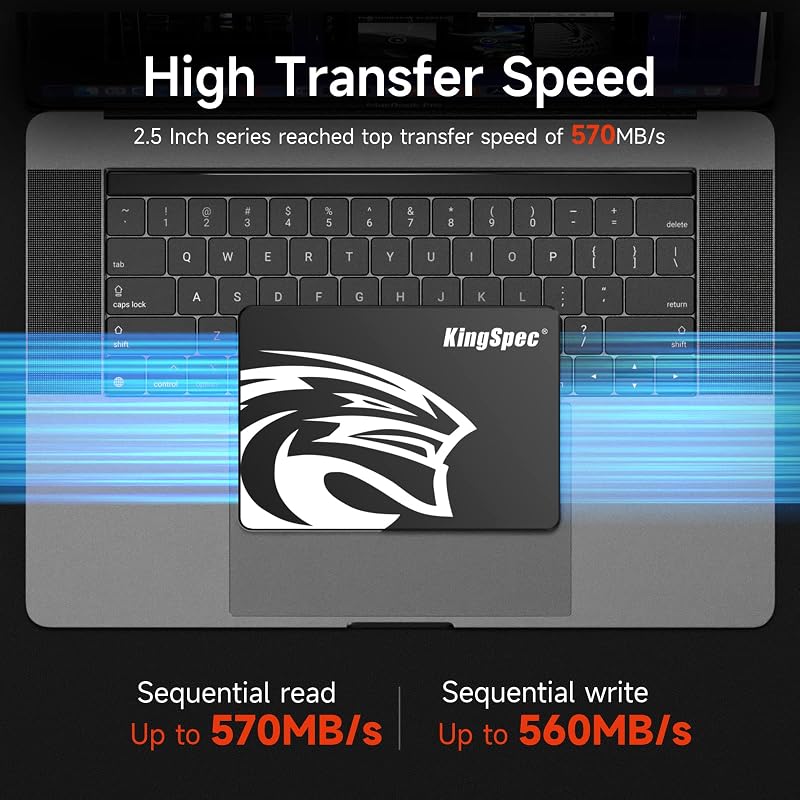
Best for: Aging desktop and legacy laptop upgrades
Pros
- Shockproof semiconductor construction
- Up to 570 MB/s read speeds
- SATA 2.0 backward compatible
- Broad operating system support
Cons
- Limited to SATA III speeds
- Controller details not listed
The KingSpec 1TB 2.5 SSD SATA III is engineered primarily as a physical drop-in upgrade for spinning mechanical hard drives inside older laptops, desktop towers, and all-in-one desktop platforms. Communicating via a Serial ATA Revision 3.0 channel capped at a 6Gb/s data transfer rate, this model claims maximum sequential read speeds of 550 MB/s to 570 MB/s and write speeds reaching 520 MB/s. Because it relies entirely on solid-state semiconductor components, it delivers inherent shockproof and anti-drop resilience compared to fragile spinning platters. Shoppers reviewing options against standard 2.5-inch alternatives like a sandisk ssd 1tb will appreciate this form factor for vintage hardware lacking modern M.2 card slots.
On the firmware side, this kingspec 1tb sata ssd incorporates essential maintenance algorithms, including native wear leveling, garbage collection, over-provisioning space, Native Command Queuing, TRIM optimization, and S.M.A.R.T. monitoring telemetry. KingSpec certifies the drive across diverse operating environments including DOS, Unix, Linux, and Windows systems from Windows 7 onward, alongside full backward compatibility for older SATA 2.0 host ports. However, the listing does not specify the underlying flash controller model or discrete DRAM cache configurations, meaning sustained high-volume writing will rely purely on internal flash write buffering.
This unit is ideally suited for consumers seeking an uncomplicated, quiet boot drive replacement to breathe new life into older home or office computers. Readers who handle massive 4K media files or intensive gaming libraries will find this model giving way to KingSpec’s NVMe product line, which completely eclipses SATA bandwidth limits.
KingSpec NX Series 1TB Gen3x4 NVMe for Everyday Fast Storage

Best for: Budget-focused desktop and laptop productivity
Pros
- Up to 3500 MB/s read performance
- Compact M.2 2280 Gen3x4 interface
- Built-in wear leveling firmware
- 3-year limited warranty protection
Cons
- No integrated heatsink layer
- TBW endurance not specified
The KingSpec NX Series 1TB Gen3x4 NVMe represents the manufacturer’s standard entry into high-speed M.2 2280 architecture, operating across a Gen3x4 PCIe interface. Delivering sequential read speeds rated up to 3500 MB/s and media operating rates between 1900 MB/s and 3100 MB/s, this kingspec nx series 1tb gen3x4 nvme drive offers a clear performance leap over traditional SATA bus bottlenecks. Designed for direct insertion into desktop and laptop motherboards, it operates without requiring external data cables or supplementary power leads.
To ensure long-term operation, the NX Series incorporates 3D NAND flash memory paired with standard reliability protections like S.M.A.R.T. diagnostics, TRIM instructions, dynamic wear leveling, and factory-set over-provisioning to guard against data corruption. Operating system compatibility encompasses Windows 7 through Windows 11 as well as Unix platforms. Cautious buyers should observe that the listing does not specify an explicit terabytes written endurance rating or the precise NAND generation used in production. Furthermore, because it lacks a heat spreader, thermal dissipation relies entirely on ambient airflow inside the host computer chassis.
This drive is best suited for general computing tasks, light workstation duties, and everyday personal computer upgrades where responsive operating system navigation is desired. When sustained high-bandwidth write tasks or intensive PlayStation 5 gaming enter the equation, this model defers to KingSpec’s PCIe 4.0 storage tier.
KingSpec SSD 1TB for Modest Workstation Demands
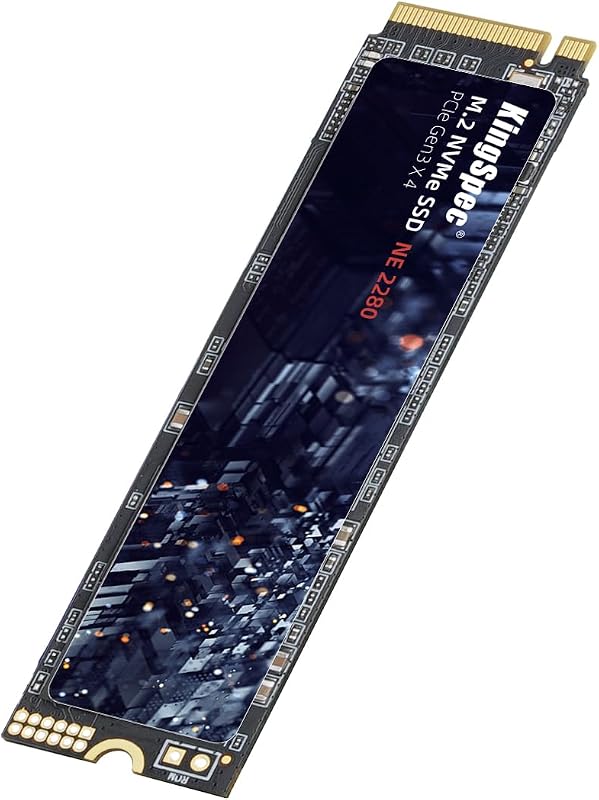
Best for: General computing and secondary storage
Pros
- LDPC ECC and E2E data protection
- Up to 2400 MB/s read speeds
- Cable-free M.2 form factor
- Native Command Queuing support
Cons
- Possible QLC flash mixture
- Modest Gen3 transfer rate
The KingSpec SSD 1TB is an M.2 2280 NVMe Gen3x4 solid-state drive tuned for dependable, mid-range throughput. It achieves sequential read speeds up to 2400 MB/s, with media speeds listed at 1900 MB/s and transfer rates reaching 2200 MB/s over its PCIe x4 connection. Designed to eliminate operating system lag during system boots and program launches, this king spec ssd 1tb storage drive acts as an affordable solid-state option for personal desktop setups and modern mobile PCs.
In terms of component composition, the listing indicates that this drive adopts a main controller utilizing 3D NAND TLC/QLC flash technology, suggesting that memory cell arrangements may encompass quad-level cells depending on manufacturing batch allocation. To mitigate cell wear risks, KingSpec integrates Low-Density Parity-Check Error Correction Code, End-to-End Data Protection, Native Command Queuing, garbage collection, and wear leveling algorithms. The listing confirms broad platform compatibility covering Windows 7 through 10, Red Hat Enterprise Linux, CentOS, and Ubuntu. Nevertheless, the listing does not specify a distinct TBW endurance threshold, so users handling nonstop write operations must monitor write cycles vigilantly.
This drive is best suited for secondary document storage, basic multimedia playback, and entry-level home office desktop setups. Users who routinely transfer uncompressed multimedia or compile large software packages will benefit more from KingSpec’s dedicated TLC models with higher guaranteed endurance.
KingSpec XG7000 1TB NVMe SSD PCIe for High-Performance Gaming and Consoles

Best for: PS5 consoles and heavy gaming rigs
Pros
- 7400 MB/s PCIe 4.0 throughput
- Industrial TLC with 600TBW rating
- Graphene thermal cooling technology
- Verified PlayStation 5 compatibility
Cons
- Exceeds legacy motherboard bandwidth
At the technological summit of the brand’s solid-state lineup sits the KingSpec XG7000 1TB NVMe SSD PCIe, an advanced M.2 2280 storage card engineered for high-bandwidth environments via the PCIe 4.0 bus and NVMe 1.4 protocol. It achieves blistering transfer benchmarks, providing sequential read speeds up to 7400 MB/s and write speeds reaching 6600 MB/s. These metrics make the kingspec xg7000 1tb nvme ssd pcie model fully compliant with the high-speed storage standards demanded by gaming PCs and current-generation console expansion slots.
Unlike lower-tier offerings, the XG7000 listing provides explicit durability and thermal specifications that cautious buyers look for. It utilizes industrial-grade 3D TLC NAND flash memory, securing an endurance rating of 600 TBW and avoiding the reduced endurance limits associated with QLC silicon. To combat high controller temperatures, the drive incorporates specialized graphene cooling tech, which KingSpec states maintains temperatures 25% lower than uncooled drives to sustain 6600 MB/s write speeds under heavy 3D rendering or AAA gaming loads. It is backed by full TRIM, SMART, and wear leveling support, along with testing claims spanning over 100 quality inspections per unit.
This drive is unequivocally the top pick for PlayStation 5 owners seeking internal storage upgrades, as well as creative professionals handling 4K video editing rigs. For legacy motherboards limited strictly to PCIe Gen3 or SATA connectivity, this drive’s elite transfer capabilities would be restricted by older hardware interfaces.
KingSpec 1TB 2.5" SATA SSD for Resilient TLC Storage
Best for: Durable 2.5-inch secondary drive setups
Pros
- Guaranteed 3D NAND TLC flash
- 1 million hours MTBF rating
- Up to 570 MB/s read speeds
- Universal 2.5-inch SATA compatibility
Cons
- Constrained by SATA III limits
- Listing does not specify cache size
The KingSpec 1TB 2.5″ SATA SSD, referenced in manufacturer details as the P3-1TB, is a 2.5-inch internal solid-state drive that operates across the SATA III 6Gb/s interface. Providing sequential read speeds up to 570 MB/s and write speeds up to 540 MB/s (with baseline specifications noting 550 MB/s read and 500 MB/s media speeds), it provides a standard replacement for traditional mechanical hard drives. Users upgrading laptop systems such as an asus vivobook 16gb ram 1tb ssd or traditional business computers frequently choose this 7mm drive profile for its direct mechanical compatibility.
A significant highlight of this specific drive is its verified use of 3D NAND TLC flash memory, which delivers substantially better write longevity than budget QLC cells. KingSpec specifies a Mean Time Between Failures rating of up to 1 million hours, demonstrating clear architectural stability for standard business operations. The drive supports comprehensive backward compatibility across earlier SATA standards and functions seamlessly under Windows, Mac OS, and Linux platforms. The listing does not specify whether a dedicated onboard DRAM cache chip is present, which remains an important consideration for sustained multi-gigabyte folder copying.
This model is best suited for budget-conscious consumers seeking guaranteed TLC flash memory inside a dependable 2.5-inch format for older office computers or secondary desktop storage. Shoppers desiring high-speed transfer rates for gaming or high-resolution video manipulation should look instead to KingSpec’s NVMe lineup.
KingSpec 1TB M.2 NVMe Gen3 SSD for Media Streaming Systems
Best for: Home theater and media streaming PCs
Pros
- 3500 MB/s sequential throughput
- 5 million hours MTBF rating
- Active thermal throttling technology
- Firmware bad-block management
Cons
- NAND cell tier not specified
- Incompatible with PS5 expansion slot
Engineered for compact desktop towers and home theater setups, the KingSpec 1TB M.2 NVMe Gen3 SSD delivers high-throughput storage over an M.2 2280 PCIe Gen3 x4 interface. Rated for sequential read speeds up to 3500 MB/s and matching 3500 MB/s media rates, this kingspec 1tb m.2 nvme gen3 ssd facilitates rapid file access and responsive media library navigation. Designed for straightforward tool-free installation into standard M.2 expansion sockets, it frees system interiors from cluttered data and power cabling.
Reliability architecture on this kingspec ssd 1tb nvme model includes built-in thermal throttling technology driven by a low-power controller, intended to prevent thermal spikes during extended media streaming or gaming sessions. KingSpec rates the drive with a Mean Time Between Failures of up to 1.5 million hours, backed by bad-block management algorithms, dynamic wear leveling, Native Command Queuing, and TRIM instructions. Despite these strong hardware protections, the listing does not specify whether the NAND flash utilizes TLC or QLC memory cells, nor does it publish a definitive TBW endurance figure. Systems like an hp laptop 17 inch 32gb ram platform can easily house this compact format for daily computing tasks.
This model serves as a practical choice for living room home theater PCs, general desktop upgrades, and media server workstations requiring quiet, fast file transfers. For console installations or intensive workstation rendering, users will need to step up to the PCIe 4.0 XG7000 to meet required hardware thresholds.
How to Choose the Right KingSpec 1TB SSD
Executing an effective kingspec 1tb ssd comparison begins by identifying the physical drive bays and data bus connections supported by your computer’s motherboard. If you are upgrading an older laptop, a basic office desktop, or a compact all-in-one system that only houses traditional drive caddies, you must select one of KingSpec’s 2.5-inch SATA models. Both the KingSpec 1TB 2.5 SSD SATA III and the KingSpec 1TB 2.5″ SATA SSD operate within the structural speed boundaries of the SATA III interface, maxing out at roughly 570 MB/s. Choosing between them comes down to flash type preference, with the 1TB 2.5″ SATA SSD explicitly guaranteeing TLC flash for superior write longevity.
When determining which kingspec 1tb ssd to buy for an M.2 2280 expansion slot, interface speed and thermal design become the primary deciding factors. The KingSpec NX Series 1TB Gen3x4 NVMe and the KingSpec 1TB M.2 NVMe Gen3 SSD offer balanced 3500 MB/s read speeds, making them ideal for everyday productivity, rapid system boot times, and casual desktop usage without generating extreme heat. Meanwhile, the baseline KingSpec SSD 1TB provides a lower 2400 MB/s ceiling with a potential TLC/QLC cell mix, positioning it strictly as a secondary storage option for light office workflows.
If your workload involves intense AAA gaming, high-resolution video production, or expanding the storage of a PlayStation 5 console, the KingSpec XG7000 1TB NVMe SSD PCIe is the definitive choice. Operating across PCIe 4.0 with read speeds reaching 7400 MB/s, industrial-grade TLC memory, and an integrated graphene cooling layer, it provides the required bandwidth and thermal resilience that standard Gen3 drives cannot match.
Evaluating overall kingspec ssd reliability also requires reviewing the brand’s uniform three-year limited warranty and lifetime technical support. While these consumer-tier drives provide solid baseline firmware features such as wear leveling and S.M.A.R.T. monitoring, warranty execution requires direct correspondence via manufacturer email support. As with any value-tier solid-state storage solution, maintaining a disciplined external backup schedule is vital to safeguard your important data against unexpected hardware anomalies.
FAQ
What is the difference between TLC and QLC NAND on KingSpec SSDs?
Triple-Level Cell (TLC) flash memory stores three bits of data per cell, whereas Quad-Level Cell (QLC) packs four bits into each cell. TLC flash delivers significantly greater write cycle durability and sustains faster write speeds when moving large files. In KingSpec’s lineup, drives like the XG7000 and the 1TB 2.5″ SATA SSD explicitly designate TLC flash, making them superior for write-heavy workloads compared to models with unspecified or mixed TLC/QLC configurations.
Can I install a KingSpec NVMe SSD into a PlayStation 5 console?
Only the KingSpec XG7000 1TB NVMe SSD PCIe is compatible with the PlayStation 5 internal expansion bay. Sony mandates an M.2 NVMe drive that operates over a PCIe 4.0 interface, achieves read speeds around 5500 MB/s or higher, and includes efficient thermal cooling. The XG7000 delivers up to 7400 MB/s read speeds and includes graphene cooling tech, whereas KingSpec’s PCIe Gen3 and SATA drives do not meet Sony’s structural requirements.
How does the 3-year warranty work for KingSpec solid-state drives?
Every KingSpec 1TB solid-state drive featured in this guide is backed by a 3-year limited warranty alongside lifetime technical support. To file a warranty inquiry or obtain technical troubleshooting, KingSpec advises customers to email their customer service department directly with proof of purchase. Keeping your original electronic receipt is critical to ensure prompt warranty validation.
Do KingSpec 1TB NVMe drives require an aftermarket heatsink?
Standard PCIe Gen3 drives, such as the NX Series and the KingSpec SSD 1TB, generally operate within safe temperature parameters under normal chassis airflow, though installing a motherboard heatsink can help during extended read and write tasks. The PCIe Gen4 XG7000 comes equipped from the factory with a specialized graphene cooling layer designed to reduce operating temperatures by 25%, allowing it to handle intensive transfers without mandatory third-party coolers.
Are KingSpec 2.5-inch SATA SSDs backward compatible with older computers?
Yes, KingSpec’s 2.5-inch SATA III drives are fully backward compatible with older motherboards running SATA Revision 2.0 (3Gb/s) or SATA Revision 1.0 (1.5Gb/s). While maximum data transfer speeds will be capped by the slower host connection, the drive will deliver dramatically faster boot times and system responsiveness than any traditional mechanical hard disk drive.


