

As Amazon Associates, we earn from qualifying purchases. This means we may receive a small commission at no extra cost to you if you click through and make a purchase.
Acer established the Predator lineup to deliver high-performance hardware engineered specifically for sustained gaming workloads, distinguished by aggressive thermal architectures and metal chassis engineering. Known primarily for proprietary thermal systems like custom 5th Gen AeroBlade 3D fans, vector heat pipes, and factory-applied liquid metal, the brand targets gamers and power users who prioritize raw compute power and sustained clock speeds over minimalist office aesthetics. Within this category, Acer balances high-wattage silicon against aggressive cooling assemblies to mitigate the thermal throttling that frequently degrades mobile gaming hardware over extended sessions.
While sharing a focus on thermal performance and gaming utility, these five configurations differ significantly across chassis volume, processor generations ranging from 12th Gen Intel Core to Core Ultra 9 HX series, graphics tiers spanning RTX 3080 Ti to RTX 50-series Blackwell architecture, and seller warranty structures between factory-sealed units and professionally customized builds.
Acer Gaming Laptops Compared
| Model | Processor | Graphics Coprocessor | Memory & Storage | Display Specs |
|---|---|---|---|---|
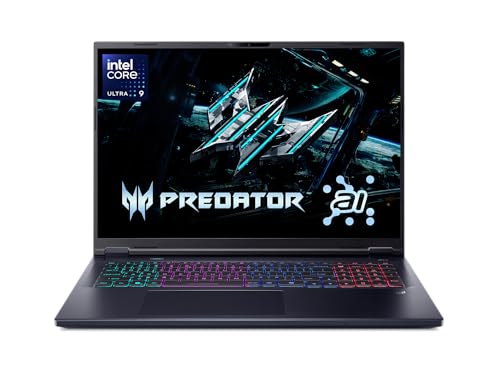
| Acer Predator Helios Neo 18 AI | Intel Core Ultra 9 275HX | NVIDIA GeForce RTX 5070 Ti (12 GB) | 32GB DDR5 / 2TB PCIe Gen 4 SSD | 18-inch WQXGA 240Hz G-SYNC IPS |
| Acer Predator Helios Neo 14 AI (RTX 5070) | Intel Core Ultra 9 285H | NVIDIA GeForce RTX 5070 (8 GB) | 32GB RAM / 1TB SSD | 14.5-inch WQXGA 165Hz G-SYNC Matte |
| Acer Predator Helios Neo 14 AI (RTX 5060) | Intel Core Ultra 7 255H | NVIDIA GeForce RTX 5060 (8 GB) | 16GB RAM / 1TB SSD | 14.5-inch WQXGA 165Hz G-SYNC Matte |
| Acer Predator Helios Neo 16S AI | Intel Core Ultra 9 275HX | NVIDIA GeForce RTX 5060 | 16GB DDR5 / 512GB SSD | 16-inch WQXGA 240Hz OLED |
| acer Predator Triton 500 SE Gaming | Intel Core i7-12700H | NVIDIA GeForce RTX 3080 Ti (16 GB) | 16GB LPDDR5 / 2TB PCIe SSD | 16-inch WQXGA 240Hz IPS |
Acer Predator Helios Neo 18 AI for Maximum Thermal Headroom

Best for: Visual artists wanting an ultra-thin OLED chassis
Pros
- 240Hz WQXGA OLED panel
- 2ms response time HDR500
- Slim build under 19.9mm
- 24-core Ultra 9 processor
Cons
- Third-party upgraded and opened box
- Modest 512GB initial SSD capacity

Best for: Students and mobile gamers wanting balanced efficiency
Pros
- Efficient Core Ultra 7 255H
- Durable metal chassis build
- Vector heat pipes and liquid metal
- 165Hz G-SYNC matte panel
Cons
- Limited to 16GB system RAM
- Modest RTX 5060 graphics tier

Best for: Frequent travelers needing compact high-tier compute power
Pros
- Intel Core Ultra 9 285H
- Sturdy 4.2-pound metal chassis
- Generous 32GB system memory
- 165Hz WQXGA matte screen
Cons
- Higher fan noise under load
- 8GB VRAM ceiling on GPU

Best for: Stationary gamers wanting maximum thermal performance and screen
Pros
- 18-inch 240Hz DCI-P3 display
- RTX 5070 Ti with 12GB VRAM
- Liquid metal and AeroBlade cooling
- Expandable DDR5 memory to 64GB
Cons
- Zero open M.2 storage slots
- Bulky chassis limits portability
The Acer Predator Helios Neo 18 AI represents the upper boundary of Acer’s mobile gaming engineering, packaging an Intel Core Ultra 9 275HX processor alongside an NVIDIA GeForce RTX 5070 Ti with 12GB of dedicated VRAM. The massive 18-inch form factor provides an expansive internal volume, allowing the dual-fan cooling system—anchored by a custom-engineered 5th Gen AeroBlade 3D Metal Fan and precision-applied liquid metal thermal compound—to exhaust heat far more efficiently than smaller chassis can manage. This substantial physical footprint translates directly into consistent clock speeds during extended sessions, making it a definitive predator gaming laptop for buyers who prioritize thermal stability over travel convenience.
Visual output is handled by an 18-inch WQXGA 16:10 display running at 240Hz with a 3ms overdrive response time, complete coverage of the DCI-P3 color space, and integrated NVIDIA G-SYNC alongside Advanced Optimus. Internally, the machine is equipped with 32GB of DDR5 6400MHz Clocked Small Outline (CSO) DIMM memory across two dual-channel slots, which can be expanded to a maximum of 64GB. Storage is configured with a 2TB PCIe Gen 4 SSD occupying both available M.2 slots, leaving zero open slots for internal drive expansion. Network connectivity includes Intel Killer Ethernet E3100G 2.5 Gbps and Killer Wi-Fi 6E AX1675, with peripheral expansion supported by a high-bandwidth Thunderbolt 4 USB-C port alongside standard USB 3.2 Gen 2 ports.
This unit is specifically tailored for stationary competitive gamers, technical developers, and content creators seeking desktop-grade performance without managing a traditional tower setup. Because both internal storage slots are occupied from the factory, future storage expansion requires swapping existing drives rather than adding secondary modules. Buyers seeking high sustained wattage who rarely move their machine will appreciate the structural stability, though those needing portability should look toward the smaller 14-inch alternatives.
Acer Predator Helios Neo 14 AI for High-Performance Portability
Engineered to deliver high compute density within a compact footprint, the Acer Predator Helios Neo 14 AI combines an Intel Core Ultra 9 processor 285H with an NVIDIA GeForce RTX 5070 laptop GPU rated at 798 AI TOPS. Weighing in at 4.2 pounds, the laptop incorporates a rugged metal-built chassis intended to survive frequent transport without structural flex. In smaller enclosures, heat concentration poses a major challenge to longevity, which Acer addresses using Vortex Flow technology, a 5th Gen AeroBlade 3D fan, vector heat pipes, and liquid metal thermal grease to move thermal energy away from the core silicon.
The display is a 14.5-inch matte WQXGA screen running at a 165Hz refresh rate in a 16:10 aspect ratio with 100% sRGB color coverage, 3ms overdrive response time, and NVIDIA G-SYNC compatibility. The system configuration includes 32GB of RAM and a 1TB SSD, delivering ample capacity for intensive multitasking and contemporary game installations straight out of the box, similar to the hardware profile seen on a lenovo gaming laptop 32gb ram configuration. Real-time hardware telemetry and fan curve management are controlled via the built-in PredatorSense utility, which also governs the customizable 3-zone RGB keyboard lighting.
This configuration suits traveling professionals, university students, and LAN participants who require substantial graphics processing and 32GB of system memory in a travel-ready form factor. It delivers a balanced middle ground between raw thermal dissipation and everyday mobility, though the smaller fan assembly operates at higher acoustic levels under load compared to the 18-inch Neo chassis.
Acer Predator Helios Neo 14 AI for Everyday Mobile Gamers
Sharing the identical 4.2-pound metal chassis and 14.5-inch form factor of its higher-tier sibling, this version of the Acer Predator Helios Neo 14 AI adjusts the internal processing components to an Intel Core Ultra 7 processor 255H paired with an NVIDIA GeForce RTX 5060 laptop GPU offering 572 AI TOPS. The thermal management array remains completely intact, utilizing the proprietary 5th Gen AeroBlade 3D fan, liquid metal thermal compound, and vector heat pipes. Because the RTX 5060 and Core Ultra 7 generate a lower total thermal load than the Ultra 9 configuration, this model exhibits stable acer predator thermal performance with slightly less strain on the cooling fans.
The machine retains the crisp 14.5-inch WQXGA 165Hz matte IPS display with a 3ms response time, 100% sRGB gamut, and G-SYNC support, ensuring that fast-paced competitive gameplay remains free of tearing. Memory is set at 16GB, backed by a 1TB SSD, which handles contemporary gaming titles and general productivity with ease. Physical features include the 3-zone RGB backlit keyboard, an integrated memory card slot, and PredatorSense software control, providing an experience comparable in utility to an entry or midrange notebook hp gamer setup.
This model is ideal for budget-conscious gamers, secondary system buyers, and students who want the durability of an aluminum chassis and modern Blackwell graphics architecture without overpaying for compute headroom they may not utilize. It cedes peak multi-threaded rendering performance to the Ultra 9 tier, but operates with predictable temperatures and excellent day-to-day reliability.
Acer Predator Helios Neo 16S AI for Thin Chassis Visual Fidelity
The Acer Predator Helios Neo 16S AI focuses on slimline design and premier panel technology, featuring an ultra-slim aluminum top and bottom build measuring under 19.9mm in thickness and weighing 4.4 pounds. It houses a 24-core Intel Core Ultra 9 275HX processor and an NVIDIA GeForce RTX 5060 graphics card. The standout feature is its 16-inch WQXGA 240Hz OLED display, which delivers an ultra-fast 0.2ms response time, VESA Certified True Black HDR500, and 100% DCI-P3 color coverage. Gamers who also utilize an external acer 240hz monitor will recognize the extreme clarity and absence of motion blur delivered by this panel speed.
Cooling an HX-series 24-core chip inside a chassis under 20mm thick requires efficient engineering. Acer integrates dual fans, including a 5th Gen AeroBlade 3D metal fan, alongside precision liquid metal thermal paste to maintain thermal conductivity. For connectivity, the system utilizes Killer DoubleShot Pro, combining Intel Killer E3100 wired Ethernet with Wi-Fi 6E AX1675. The laptop also includes a 4-zone RGB backlit keyboard, numeric keypad, memory card slot, and Windows 11 Pro.
A critical consideration for buyers is that this specific listing is professionally upgraded and customized by an authorized distributor, meaning the original factory packaging is opened for customization, component installation, and hardware testing prior to shipment. The seller provides a 12-month warranty to cover the unit. This configuration is best suited for visual creators and competitive players who prioritize OLED contrast, rapid response times, and slim aesthetics, while understanding the third-party warranty terms that govern the upgraded 512GB SSD and 16GB DDR5 memory modules.
acer Predator Triton 500 SE Gaming for Massive VRAM Capacity
Best for: Power users needing massive 16GB GPU memory
Pros
- RTX 3080 Ti with 16GB VRAM
- Spacious 2TB PCIe storage
- Fast 240Hz WQXGA IPS screen
- Extensive external port selection
Cons
- Older 12th Gen Intel CPU
- Third-party upgraded limited warranty
The acer Predator Triton 500 SE Gaming pairs an Intel Core i7-12700H processor featuring 14 cores and 20 threads with an NVIDIA GeForce RTX 3080 Ti graphics card sporting a massive 16GB of dedicated GDDR6 memory. Encased in a refined Steel Gray clamshell, the Triton line historically emphasizes an understated aesthetic compared to the aggressive styling of the Helios family. The 16-inch WQXGA display delivers a 240Hz refresh rate across a 16:10 IPS panel, matching modern high-refresh standards for fluid visual tracking during high-speed gameplay.
The internal configuration features an upgraded 16GB of high-bandwidth LPDDR5 RAM and an upgraded 2TB PCIe SSD, ensuring fast boot times and ample space for large software libraries. Port selection is exceptionally thorough, offering two USB 3.2 Gen 2 Type-C ports, two USB 3.2 Gen 2 Type-A ports, an RJ-45 Ethernet jack, HDMI output, an audio line out, and a dedicated headphone jack. Wireless communication is handled via IEEE 802.11 a/b/g/n/ac/ax Wi-Fi 6 standards, and the unit comes running Windows 11 Home.
Shoppers evaluating this machine should note that it features upgraded components and carries a limited warranty. The inclusion of an RTX 3080 Ti with 16GB of dedicated VRAM provides a major asset for texture-heavy modern titles, complex 3D rendering, and local machine learning tasks that overflow smaller 8GB frame buffers. It serves users who need substantial graphics memory and mature, stable architecture over the latest Blackwell AI TOPS features found on newer Neo models.
How to Choose the Right Acer Gaming Laptops
Selecting the best acer predator laptop requires understanding how chassis dimensions interact directly with heat dissipation, component power limits, and long-term component survival. Gaming laptops operate under strict thermal constraints; choosing the appropriate configuration depends on whether the unit will remain stationary or travel frequently.
- Chassis Size and Thermal Dissipation: Larger chassis volumes, such as the 18-inch frame on the Acer Predator Helios Neo 18 AI, provide superior thermal dissipation. The larger surface area allows dual fans and metal AeroBlade components to exhaust hot air without requiring the extreme fan RPMs necessary in 14-inch chassis. If sustained acoustic comfort and minimal thermal throttling are your top priorities, choose the larger chassis.
- Display Technology and Refresh Rates: Acer deploys several distinct panel types across this lineup. The Acer Predator Helios Neo 16S AI features an OLED display with near-instantaneous 0.2ms response times and deep black levels, ideal for visual clarity and dark-scene gaming. Conversely, the IPS panels on the 14-inch and 18-inch Neo models provide matte anti-glare surfaces and 3ms response times, which are better suited for brightly lit rooms and static work environments where OLED burn-in prevention requires extra caution.
- Portability vs. Compute Class: Travelers should focus on the 4.2-pound Acer Predator Helios Neo 14 AI variants or slim machines like the kaiger light gaming laptop category. However, compact designs compromise on total memory slots and thermal overhead. The Neo 18 AI represents an uncompromising desktop replacement, whereas the 14-inch models prioritize mobility at the cost of screen real estate and thermal volume.
- Factory Configurations vs. Custom Upgraded Hardware: Buyers must carefully examine the warranty and assembly origin of their specific listing. Factory-standard models (such as the Neo 18 AI and Neo 14 AI) carry standard manufacturer coverage, whereas customized units (such as the Helios Neo 16S AI and Triton 500 SE) involve third-party modifications, opened packaging, and distributor-backed limited warranties. Review the seller terms to ensure you are comfortable with third-party technical support.
- GPU VRAM Demands: While the RTX 5060 and RTX 5070 in the Neo 14 and Neo 16S offer 8GB of VRAM and modern Blackwell AI features, users working with large datasets, high-resolution textures, or intensive creative suites may find the 12GB VRAM on the RTX 5070 Ti (Neo 18) or the 16GB VRAM on the RTX 3080 Ti (Triton 500 SE) far more capable of preventing memory allocation bottlenecks over several years of use.
FAQ
How does Acer predator cooling reliability hold up over long gaming sessions?
Acer predator cooling reliability relies heavily on custom hardware engineering, specifically their 5th Gen AeroBlade 3D metal fans, vector heat pipes, and factory-applied liquid metal thermal compound. Liquid metal provides significantly higher thermal conductivity than traditional silicone pastes, reducing hot spots on the CPU die. However, because metal fans feature ultra-thin blades, regular cleaning with compressed air is necessary to prevent dust accumulation from impeding airflow and raising internal operating temperatures over time.
What should buyers know about third-party upgraded Acer Predator laptops?
Certain listings, such as the Helios Neo 16S AI and Triton 500 SE, state that the original manufacturer box is opened by professional engineers to upgrade components like RAM and SSD storage. While these sellers perform quality checks and provide their own 12-month or limited warranties, the original factory seal is broken. Buyers should confirm whether warranty claims must be directed to the third-party seller or directly to Acer before purchasing an upgraded unit.
Can the internal memory and storage be upgraded on the Acer Predator Helios Neo 18 AI?
The Acer Predator Helios Neo 18 AI features two DDR5 memory slots supporting up to 64GB of 6400MHz CSO DIMM memory, leaving room to upgrade beyond the included 32GB. For storage, the laptop contains two M.2 PCIe Gen 4 slots, but both are occupied by the factory 2TB configuration (structured across the slots). Expanding storage capacity requires replacing one or both existing drives, as there are zero unpopulated M.2 slots remaining.
Which Acer Predator model is best for content creators needing color accuracy?
Both the Acer Predator Helios Neo 18 AI and the Acer Predator Helios Neo 16S AI are exceptionally well-suited for color-critical work. The Neo 18 AI provides 100% DCI-P3 coverage on an expansive 18-inch WQXGA canvas, while the Neo 16S AI incorporates an OLED panel featuring VESA Certified True Black HDR500 and 100% DCI-P3 coverage with an ultra-fast 0.2ms response time. The 14.5-inch Neo models target 100% sRGB, which is sufficient for web work but less comprehensive than the DCI-P3 standard.
What is the benefit of the PredatorSense software on these laptops?
PredatorSense is Acer’s proprietary system management utility integrated across the Helios lineup. It allows users to monitor real-time CPU and GPU temperatures, adjust cooling profiles between quiet, balanced, and turbo modes, fine-tune fan RPM curves, and customize RGB backlighting zones on the keyboard. Using PredatorSense to set aggressive fan profiles before launching demanding workloads helps maintain lower core temperatures and avoid thermal throttling.


