


As Amazon Associates, we earn from qualifying purchases. This means we may receive a small commission at no extra cost to you if you click through and make a purchase.
Sony has long maintained a formidable reputation in the home theater sector, distinguished primarily by proprietary video processing algorithms, accurate out-of-the-box color reproduction, and durable chassis designs. In large display formats, specifically when selecting a sony 75inch 4k tv, panel engineering must balance intense light output against thermal regulation to ensure continuous long-term operation. Sony manages this balance by deploying distinct backlight configurations across its portfolio, scaling from cost-conscious direct-lit arrays to densely packed Mini LED matrices governed by sophisticated luminance management systems.
While every display in this lineup provides a substantial 75-inch screen size and integrated smart connectivity through Google TV, they diverge significantly in backlight architecture, panel refresh capabilities, anti-reflective surface coatings, and processing chipsets that separate entry-level casual viewing from reference-grade mastering monitors.
Sony 75-Inch 4K TVs Compared
| Model | Backlight Configuration | Native Refresh Rate | Processing Engine | HDR Support |
|---|---|---|---|---|
| SonyAnti-Glare (K-75XR30M2) | LED (Specific configuration not listed) | 120Hz | XR Processor with AI Technology | Dolby Vision |
| Sony 75 Inch BRAVIA 2 II (K-75S20M2) | Direct LED with Dimming | 60Hz | 4K Processor X1 | HDR10, HLG |
| Sony 75 Inch BRAVIA 3 LED (K-75S30) | Direct LED with Dimming | 60Hz | 4K HDR Processor X1 | Dolby Vision, HDR10, HLG |
| Sony 75 Inch BRAVIA 5 Mini (K-75XR50) | Direct LED with Local Dimming (Mini LED) | 120Hz | XR Processor with AI Technology | Dolby Vision, HDR10, HLG |
| Sony 75 Inch BRAVIA 7 Mini (K-75XR70) | Direct LED (Mini LED QLED) | 120Hz | XR Processor | Dolby Vision, HDR10, HLG |
| Sony 75 Inch BRAVIA 9 Mini (K-75XR90) | Direct LED (Mini LED QLED) | 120Hz | XR Processor | Dolby Vision, HDR10, HLG |
SonyAnti-Glare for High-Frame-Rate Media Rooms

Best for: Gamers needing anti-glare screens and high refresh rates
Pros
- Native 120Hz panel
- XR Processor with AI
- Dolby Vision and Atmos
- Four HDMI 2.1 inputs
Cons
- Sparse technical listing details
- Backlight zone count unlisted
The SonyAnti-Glare (model K-75XR30M2) occupies a distinct operational position within the lineup, pairing a high-speed panel with dedicated glare mitigation. Because the retail data for this model is restricted solely to its primary listing title, detailed internal specifications such as contrast ratios, chassis dimensions, and discrete dimming zone numbers are not listed. What the listing verifies is an advanced hardware foundation driven by Sony’s XR Processor with AI Technology, delivering real-time scene analysis alongside native 120Hz refresh rate hardware to eliminate motion blur during fast action.
Connectivity on this unit is built around four dedicated HDMI 2.1 ports, accommodating multiple contemporary source components that demand uncompressed bandwidth for high-frame-rate rendering. It also integrates Dolby Vision and Dolby Atmos decoding, ensuring spatial audio and dynamic HDR playback directly from smart streaming platforms. Software management is handled by the Google TV operating system with Gemini integration, while bundled 4K movie credits offer immediate high-bitrate streaming out of the carton.
This television is suited for media enthusiasts and gamers who require fluid 120Hz motion control and anti-glare panel properties in spaces exposed to daylight. However, shoppers who need explicit technical confirmation regarding full-array local dimming or precise chassis measurements may prefer to step into models with fully documented manufacturer specification sheets like the BRAVIA 5.
Sony 75 Inch BRAVIA 2 II for Basic Streaming Reliability
Best for: Bright wide living rooms requiring maximum glare suppression
Pros
- 1000 nit display brightness
- X-Anti Reflection and Wide Angle
- Multi-directional speaker system
- 24-month Sony Pictures Core
Cons
- Substantial power requirements
- Large physical chassis footprint
Best for: Cinematic purists demanding high brightness and quantum colors
Pros
- Bright Mini LED QLED panel
- Rapid 2ms response time
- Studio Calibrated picture modes
- XR Motion Clarity 120Hz
Cons
- Flat finish reflects glare
- Narrower viewing angles than 9

Best for: Home theater enthusiasts wanting high-contrast Mini LED gaming
Pros
- Mini LED local dimming
- XR Backlight Master Drive
- Smooth 120Hz gaming playback
- IMAX Enhanced and DTS:X
Cons
- Matte screen finish only
- Heavy rear thermal output
Best for: Everyday movie watchers wanting wide color and Dolby
Pros
- Triluminos Pro billion colors
- Dolby Vision and Atmos support
- Included Sony Pictures Core credits
- 4K HDR Processor X1
Cons
- Native 60Hz refresh rate
- No local dimming zones

Best for: Casual viewers prioritizing basic streaming and simple reliability
Pros
- Simple direct LED reliability
- Matte anti-glare finish
- Dedicated PS5 gaming assist
- 4K X-Reality PRO upscaling
Cons
- Limited to 60Hz refresh
- Lacks Dolby Vision support
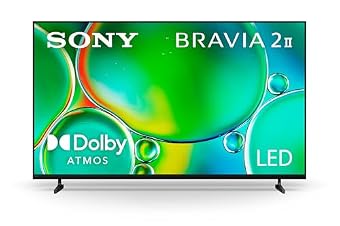
Serving as the baseline for large-format displays, the Sony 75 Inch BRAVIA 2 II (model K-75S20M2) utilizes a Direct LED backlight configuration paired with frame-based dimming. Processing duties are handled by the proven 4K Processor X1, working in unison with 4K X-Reality PRO to upscale lower-resolution broadcasts, dynamic contrast enhancers, and Live Color circuitry. Operating at a native 60Hz refresh rate, it relies on Motionflow XR 240 processing to reduce perceived tracking blur across sports and action movies. Panel finish is listed as matte, supporting a contrast ratio between 1000:1 and 3000:1 to keep reflections diffuse across moderately illuminated rooms.
From an advocate perspective, simpler Direct LED architectures exhibit fewer failure points than complex high-zone local dimming arrays, as standard backlights generate less localized heat stress across the underlying diffuser layers. Software integration includes Google TV with Apple AirPlay 2, Google Cast, and access to SONY PICTURES CORE. Gamers utilizing current-generation consoles gain exclusive PlayStation 5 automation features, specifically Auto HDR Tone Mapping, Auto Genre Picture Mode, and a consolidated Game Menu for adjusting display parameters on the fly. Shoppers weighing smaller room sizes can cross-reference our analysis of a sony tv 65 inch to evaluate whether display footprint or backlight density matters most for their layout.
This model suits casual viewers who prioritize everyday reliability, broadcast television, and simple streaming without the complexity of zone-based illumination hardware. Its capabilities give way to higher-tier models for shoppers wanting Dolby Vision dynamic mastering or 120Hz variable refresh rate gaming, both of which are omitted from this unit’s hardware specification.
Sony 75 Inch BRAVIA 3 LED for Balanced Color Accuracy
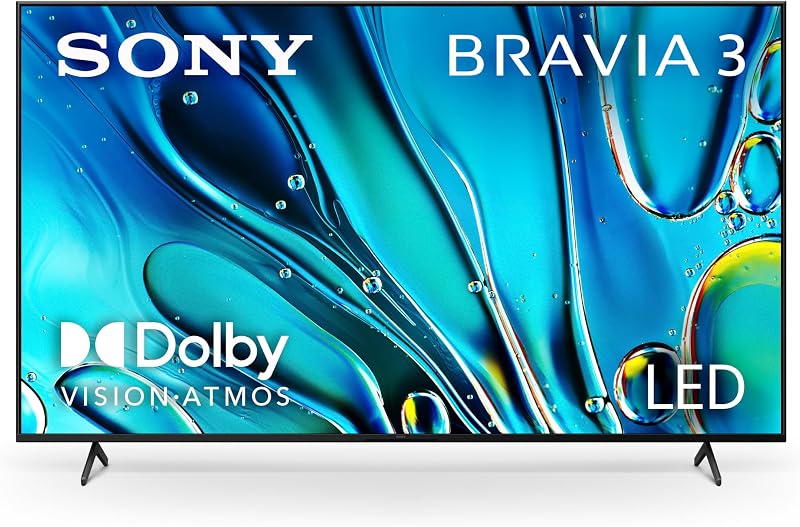
Representing an evolutionary refinement over entry hardware, the Sony 75 Inch BRAVIA 3 LED (model K-75S30) integrates the 4K HDR Processor X1 alongside Triluminos Pro color mapping. This inclusion expands the panel’s palette to over one billion accurate colors, rendering smooth gradients that resist harsh color banding. The screen utilizes a flat finish over a Direct LED backlight with dimming settings, delivering listed contrast metrics ranging from several thousand to one up to tens of thousands to one depending on source illumination.
The display expands dynamic range support beyond standard HDR10 and HLG by adding Dolby Vision processing and Dolby Atmos acoustic decoding. The smart interface operates via Google TV with built-in Google Assistant, allowing voice-directed media searches and direct integration with Chromecast built-in and Apple AirPlay 2. Consumers evaluating this screen in a detailed sony k-75s30 review context will note the inclusion of SONY PICTURES CORE with five redeemable movie credits and a 12-month classic film subscription. For secondary spaces or compact bedrooms, comparing these specs against a 4k sony 55 screen helps illuminate the baseline processing benefits standard across this tier.
The BRAVIA 3 is best suited for movie enthusiasts who desire Dolby Vision cinematic compliance and wide color reproduction without stepping into complex multi-zone backlights. It cedes performance ground to the Mini LED series when viewing deep black scenes in pitch-dark rooms, as its global Direct LED dimming cannot isolate pinpoint highlights without raising floor black levels.
Sony 75 Inch BRAVIA 5 Mini for High-Contrast Gaming
Stepping firmly into premium illumination engineering, the Sony 75 Inch BRAVIA 5 Mini (model K-75XR50) introduces a dense array of thousands of miniaturized light-emitting diodes regulated by the XR Backlight Master Drive. This setup enables genuine local dimming across an undisclosed number of zones, augmented by the XR Contrast Booster 10 circuit to maintain deep black levels alongside sparkling highlights. Picture processing is elevated through the XR Processor with AI technology, which simultaneously optimizes XR Clear Image filtering, XR Motion Clarity, and XR Triluminos Pro wide color gamut calibration.
Constructed with a matte screen finish over a native 120Hz panel, this display targets severe glare environments while delivering high temporal clarity. Gaming functionality is complete, supporting HDMI 2.1 bandwidth, Auto HDR Tone Mapping, Auto Genre Picture Mode, and the dedicated Game Menu. Studio Calibrated picture modes provide tailored mastering profiles for Netflix, Prime Video, and SONY PICTURES CORE, while multi-channel audio feeds can leverage Dolby Atmos, DTS:X, and IMAX Enhanced pass-through. Readers investigating compact secondary panels can contrast this with a sony 43 inch smart tv to see how processing features scale between series tiers.
This television suits dedicated gamers and cinephiles seeking authentic black levels, low blooming artifacts, and fluid 120Hz refresh handling. It yields to the BRAVIA 7 and 9 for viewers seeking the absolute maximum in daylight-piercing peak brightness or quantum-dot-infused color volume.
Sony 75 Inch BRAVIA 7 Mini for Demanding Home Theaters
Engineered for higher luminance thresholds, the Sony 75 Inch BRAVIA 7 Mini (model K-75XR70) merges Mini LED backlighting with QLED quantum dot architecture. Regulated by the XR Backlight Master Drive, Sony bills this configuration in its listing documentation as its brightest 4K TV tier. The panel is driven by the XR Processor with XR Clear Image upscaling, delivering a rapid 2-millisecond response time across its native 120Hz refresh framework. The listing outlines a flat screen finish, a 3000:1 contrast specification, and an ultrawide 2.35:1 aspect ratio capability suited to native anamorphic theater content.
The BRAVIA 7 incorporates full studio calibration compliance, offering dedicated rendering profiles for Netflix, Prime Video, and SONY PICTURES CORE. Media packages include five redeemable movie credits and a 12-month subscription window to classic theatrical releases. Audio handling accommodates Dolby Atmos, DTS:X, and IMAX Enhanced playback, ensuring seamless pairing with external acoustic systems. Complete PlayStation 5 integration remains standard, automatically synchronizing HDR mapping upon console detection.
This model is the ideal choice for home theater purists who run expansive surround setups and desire extreme HDR contrast with quantum-dot color intensity. It steps aside only for the BRAVIA 9, which adds proprietary off-angle optical layers and specialized anti-reflective surface coatings to combat extreme architectural glare.
Sony 75 Inch BRAVIA 9 Mini for Wide Seating and Bright Rooms
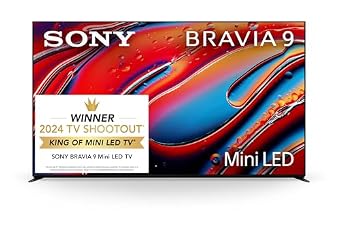
Representing the peak of Sony’s engineering in this category, the Sony 75 Inch BRAVIA 9 Mini (model K-75XR90) combines an ultra-dense Mini LED matrix with specialized physical panel treatments. Driven by the flagship XR Processor and XR Backlight Master Drive, it reaches a certified 1000 nit maximum display brightness while maintaining deep black uniformity. To resolve common limitations found in large-format LCD structures, this unit integrates X-Wide Angle compensation for consistent color saturation across off-axis seating, alongside X-Anti Reflection surface filters that disperse harsh ambient light reflections.
Acoustic performance is upgraded over lower-tier models through an array of multi-directional speakers designed to emit sound directly from the screen area, reinforcing spatial placement. The software suite includes Google TV with Google Assistant, Studio Calibrated picture profiles, and an elevated SONY PICTURES CORE bundle providing 10 movie credits and a 24-month streaming subscription. PlayStation 5 assist tools and HDMI 2.1 gaming support operate over its native 120Hz flat display, ensuring input latency remains negligible during high-speed competitive play.
The BRAVIA 9 is tailored for expansive, sunlit living rooms with sectional seating arrangements where viewers sit far off to the sides. It stands as the flagship choice, yielding to no other model in this lineup for brightness, glare control, or viewing angles.
How to Choose the Right Sony 75-Inch 4K TV
Navigating a comprehensive sony 75 inch 4k tv comparison requires examining structural differences across backlighting, surface treatments, and underlying processors rather than superficial aesthetic trims. Deciding which sony 75 inch tv to buy depends directly on room acoustics, ambient light exposure, and how sensitive your household is to motion judder and panel blooming.
- Backlight Longevity and Architecture: In evaluating a sony 75 inch mini led vs direct led setup, buyer advocates must weigh long-term thermal loads against black-level performance. Basic Direct LED configurations, found on the Sony 75 Inch BRAVIA 2 II and Sony 75 Inch BRAVIA 3 LED, utilize widely spaced diodes with global dimming. These assemblies run cooler and have simpler power boards, promoting extended backlight life. Conversely, Mini LED arrays on the Sony 75 Inch BRAVIA 5 Mini, BRAVIA 7, and BRAVIA 9 pack thousands of micro-diodes running at high voltages under the XR Backlight Master Drive. While they deliver extraordinary dynamic contrast and HDR impact, they rely heavily on internal thermal dissipation to prevent premature LED phosphor degradation over years of heavy daily use.
- Panel Glare and Room Placement: Surface coatings dictate viewing comfort in brightly lit spaces. The SonyAnti-Glare and Sony 75 Inch BRAVIA 5 Mini utilize matte surface treatments to diffuse light across the screen, reducing concentrated reflections from windows. The flagship Sony 75 Inch BRAVIA 9 Mini incorporates both X-Anti Reflection filters and X-Wide Angle optical layers, making it the premier option for rooms with unavoidable reflections and wide seating layouts. Standard flat finishes, such as those on the Sony 75 Inch BRAVIA 3 LED and BRAVIA 7, perform best when light sources can be controlled using blinds or dimmers.
- Refresh Rates and Processing Tiers: Processing separates casual panels from high-fidelity displays. The 4K Processor X1 in the BRAVIA 2 II and BRAVIA 3 operates at 60Hz with Motionflow XR 240, which is sufficient for streaming scripted dramas and cable broadcasts. Moving up to the XR Processor found in the SonyAnti-Glare, BRAVIA 5, BRAVIA 7, and BRAVIA 9 brings native 120Hz panels, XR Motion Clarity, and AI-driven scene enhancement. This elevated processing is essential for artifact-free sports viewing and uncompressed 4K gaming on modern consoles.
- Long-Term System Stability: Hardware longevity also depends on system processing headroom. Displays powered by the cognitive XR Processor handle Google TV background tasks and app memory allocation more effortlessly than basic processing chipsets, reducing interface lag as smart platform updates accumulate over time.
FAQ
What is the main difference in sony bravia 2 ii vs bravia 3?
While both models share a 60Hz Direct LED panel with frame dimming and the 4K X-Reality PRO upscaling engine, their primary divergence lies in color reproduction and HDR compatibility. The Sony 75 Inch BRAVIA 2 II uses the standard 4K Processor X1 with Live Color and supports HDR10 and HLG formats. The Sony 75 Inch BRAVIA 3 LED steps up to the 4K HDR Processor X1 with Triluminos Pro, expanding its palette to over one billion colors, and adds native support for Dolby Vision and Dolby Atmos decoding.
How does backlight heat affect sony bravia 75 inch reliability over time?
Overall sony bravia 75 inch reliability is heavily influenced by how heat from the backlight array is managed within the chassis. Basic Direct LED models generate moderate heat because their light output is distributed among fewer LEDs operating under global frame dimming. Advanced Mini LED models, including the sony bravia 5 mini led 75 inch and sony bravia 7 mini led, concentrate thousands of diodes driving high peak brightness levels. Sustained heat from these compact diodes puts greater thermal stress on power supply capacitors and optical diffuser sheets, underscoring the importance of operating them with adequate rear ventilation.
Which sony 75 inch tv to buy for bright living rooms with reflection issues?
For rooms with severe ambient light and uncovered windows, the Sony 75 Inch BRAVIA 9 Mini stands out due to its integrated X-Anti Reflection layer, X-Wide Angle technology, and 1000 nit maximum brightness capability. If that flagship option exceeds your requirements, the SonyAnti-Glare or the matte-finished Sony 75 Inch BRAVIA 5 Mini offer capable reflection diffusion that softens direct glare across daytime viewing sessions.
Is a 120Hz panel necessary when choosing the best sony 75 inch 4k tv?
A native 120Hz panel is not mandatory for standard 24p movies or 60Hz streaming content, but it becomes indispensable for high-frame-rate gaming and high-speed sports broadcasts. Choosing a 120Hz model like the SonyAnti-Glare, BRAVIA 5, BRAVIA 7, or BRAVIA 9 ensures complete compatibility with HDMI 2.1 gaming sources and allows XR Motion Clarity processing to insert black frames with minimal brightness loss, keeping rapid motion sharp without artificial motion smoothing artifacts.
What makes the sony bravia 9 k-75xr90 distinct from other Mini LED models?
The sony bravia 9 k-75xr90 is distinguished from the BRAVIA 5 and BRAVIA 7 by its higher peak luminance rating of 1000 nits, an advanced acoustic system featuring multi-directional screen speakers, and the inclusion of both X-Wide Angle and X-Anti Reflection optical films. It also includes an expanded SONY PICTURES CORE package providing 10 movie credits and 24 months of streaming access, making it Sony’s most complete and bright large-format LED display.


