


As Amazon Associates, we earn from qualifying purchases. This means we may receive a small commission at no extra cost to you if you click through and make a purchase.
LG is widely recognized across the consumer electronics sector for its display engineering, proprietary webOS operating system, and extensive panel manufacturing infrastructure. In the compact screen segment, buyers searching for an lg tv 40 inch display typically evaluate sets ranging between 42 and 43 inches, as panel fabrication standards have standardized around these dimensions rather than an exact 40-inch cut. When choosing a television in this smaller footprint, long-term dependability hinges on how well the hardware manages thermal output, backlighting stress, and processing demands across successive software cycles. Evaluating an lg 40 inch smart tv requires a critical look beyond initial specifications, prioritizing durable componentry, stable backlights, and responsive chipsets capable of handling multi-year firmware updates.
Across this lineup, the three models diverge significantly in their underlying illumination architecture, processing engines, and refresh rates: one utilizes a dense Mini-LED backlight paired with an Alpha 7 Gen9 processor, another relies on a conventional Direct LED array driven by an Alpha 7 Gen8 chip, and the flagship features self-luminous OLED evo pixels powered by an Alpha 11 Gen3 processor capable of reaching up to 165Hz.
LG 40-inch TVs Compared
| Model | Display Technology | Processor | Refresh Rate | HDR Support |
|---|---|---|---|---|
| LG 43-Inch QNED AI 4K QNED73B | Mini-LED | a7 AI Processor 4K Gen9 | 60 Hz | HDR10, HLG |
| LG 43UA7700P 43 inch Class UA77 | Direct LED | Alpha 7 AI Processor Gen8 | 60 Hz | HDR10, HLG |
| LG 42-Inch Class OLED evo AI | Self-Luminous OLED | Alpha 11 AI Processor Gen3 | 120 Hz | Dolby Vision, HDR10, HLG |
LG 43-Inch QNED AI 4K QNED73B for Bright-Room Longevity
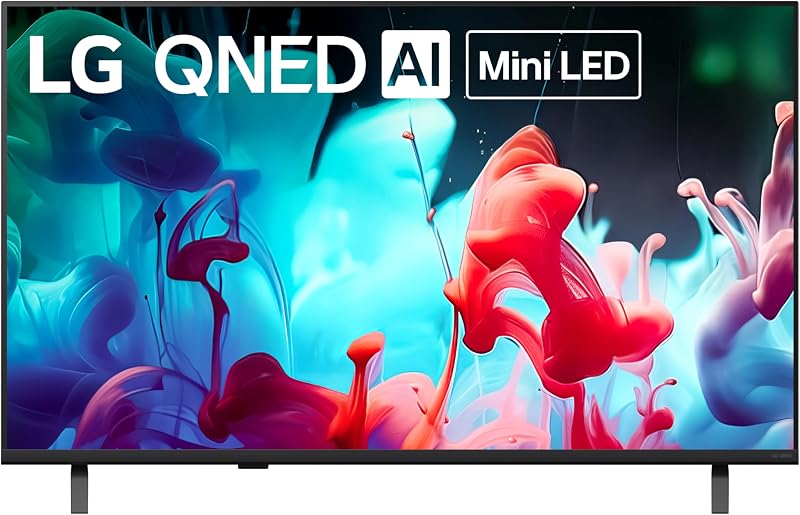
Best for: Sunlit rooms needing vibrant color and longevity
Pros
- Inorganic Mini-LED prevents burn-in
- 100% Color Volume with QNED
- Alpha 7 Gen9 AI processor
- AMD FreeSync Premium support
Cons
- Limited to 60Hz refresh rate
- Lacks Dolby Vision support
The LG 43-Inch QNED AI 4K QNED73B represents a resilient approach to small-screen viewing by pairing a 43-inch 4K panel with Mini-LED backlighting technology. Unlike conventional edge-lit or standard direct-lit designs, Mini-LED relies on thousands of microscopic inorganic light-emitting diodes that deliver superior luminance without the degradation concerns associated with organic compounds. This architecture is coupled with Dynamic QNED Color, which achieves certified 100% Color Volume for rich, accurate tones in environments with significant ambient daylight. While entry-level platforms like a tcl roku tv offer basic streaming utility, this QNED model emphasizes advanced hardware-level panel construction and dedicated local backlight control designed to maintain uniform luminance across thousands of operating hours.
Processing is handled by the a7 AI Processor 4K Gen9, an engine that coordinates 4K Super Upscaling, AI Brightness Control, Dynamic Tone Mapping, and Filmmaker Mode with Ambient Light Technology. For high dynamic range content, the set supports HDR10 Pro and HLG, dynamically balancing contrast to prevent backlight clipping in bright scenes and crushed detail in dark areas. The smart interface runs on the webOS platform integrated with Google Gemini, granting direct access to over 400 free channels via LG Channels and an on-demand library exceeding 10,000 titles. Gamers are supported with AMD FreeSync Premium, Auto Low Latency Mode (ALLM), the LG Game Dashboard, and Game Optimizer, operating at a stable 60Hz refresh rate. Physically, the set measures 7.9 inches deep, 37.8 inches wide, and 24.3 inches high on its stand, weighing 14.1 pounds without the stand.
From an advocacy and reliability perspective, the QNED73B is best suited for shoppers who demand high visual punch in sunlit spaces and prioritize inorganic component longevity over absolute pixel-level black levels. Because its Mini-LED array uses durable inorganic semiconductors, it eliminates the risk of permanent static image burn-in, making it an excellent candidate for news broadcasts, office monitoring, or all-day background television. It yields ground to the OLED evo model when viewing in light-controlled home theaters where infinite contrast is paramount, but for general daylight endurance, it stands as a remarkably stable investment.
LG 43UA7700P 43 inch Class UA77 for Everyday Utility

Best for: Pragmatic secondary room and bedroom viewing
Pros
- Direct LED array runs cool
- Four HDMI 2.0 ports
- Personalized Picture and Sound Wizard
- AirPlay 2 and Google Cast
Cons
- Standard 60Hz refresh rate
- No local dimming technology
The LG 43UA7700P 43 inch Class UA77 takes a straightforward, utilitarian engineering path, utilizing a conventional Direct LED backlight array across a 43-inch 4K UHD screen. Direct LED configurations distribute standard light-emitting diodes evenly across the rear chassis of the panel rather than clustering them along the perimeter. From a reliability standpoint, this time-tested layout avoids the thermal concentration and optical diffuser warping that can plague thinner edge-lit televisions over years of continuous operation. While it does not achieve the peak brightness of Mini-LED or the infinite black levels of self-lit pixels, its modest thermal footprint and reduced electronic complexity translate into a dependable baseline display.
Under the hood, picture and sound tuning are driven by the Alpha 7 AI Processor Gen8, which powers 4K upscaling, Dynamic Tone Mapping, and a Personalized Picture and Sound Wizard that tailors output based on user preferences. Supported formats include HDR10 Pro and HLG, complemented by Filmmaker Mode to preserve original cinematic framerates and color timing. Running on webOS 25, the interface provides access to 350+ free LG Channels, Apple AirPlay 2, and Google Cast for seamless mobile mirroring. Gaming functionality is comprehensive for a 60Hz display, featuring Variable Refresh Rate (VRR), FreeSync, cloud gaming integration via GeForce NOW and Xbox Cloud Gaming, four HDMI 2.0 ports, and the LG Game Optimizer. Users building a streamlined compact bedroom or study hub often pair this set with convenient accessories like an anker 3 in 1 charging station to keep nightstand cable clutter minimal while enjoying smart media streaming.
This model is tailored for pragmatic buyers seeking a secondary display for guest rooms, home offices, or rental units where simple operation and low thermal wear are primary considerations. The listing notes English display language options and a slim, wall-friendly chassis that installs easily on standard mounting brackets. While it lacks the advanced multi-zone dimming of the QNED73B and the high refresh rate of the OLED evo, its restrained power draw and proven Direct LED architecture provide dependable daily service without unexpected maintenance surprises.
LG 42-Inch Class OLED evo AI for Maximum Visual Fidelity

Best for: Gamers and cinephiles seeking reference picture
Pros
- Perfect Black self-lit OLED pixels
- 120Hz refresh rate up to 165Hz
- Dolby Vision and Dolby Atmos
- Alpha 11 Dual AI processor
Cons
- Requires care with static images
- Lower peak brightness than Mini-LED
The LG 42-Inch Class OLED evo AI represents the pinnacle of small-screen display performance, incorporating over 8.3 million self-lit smart pixels within a 42-inch 16:9 form factor. Because each pixel emits its own light independently, the display achieves Perfect Black and Perfect Color with zero backlight bleed or halo artifacts. When evaluating lg 42 inch oled reliability, the critical element is the integrated OLED Care technology, a suite of automated maintenance routines that manage pixel wear, run background compensation cycles, and mitigate the image retention risks historically associated with organic panels. Measuring 6.7 inches deep, 36.7 inches wide, and 22.7 inches high, the chassis is remarkably compact, fitting effortlessly onto computer desks and specialized media credenzas.
The internal architecture is anchored by LG’s most advanced small-screen processor: the Alpha 11 AI Processor Gen3 with a Dual AI Engine. This silicon drives a11 AI Super Upscaling 4K, AI Brightness Control, AI Picture, and Filmmaker Mode with Ambient Light Technology. Premium cinema formats are fully supported, including Dolby Vision, HDR10, HLG, and Dolby Atmos audio processing. Gamers and visual purists benefit from an ultra-responsive 120Hz native refresh rate with support for up to 165Hz, a 0.1ms response time, NVIDIA G-SYNC, AMD FreeSync Premium, VRR, and four full-bandwidth HDMI 2.1 ports. Smart functionality is powered by webOS 2026 integrated with Google Gemini, granting access to 400+ free LG Channels, over 10,000 on-demand titles, and Gallery Plus customization. To complement its cinematic presentation, connecting an external sound device such as a bose bluetooth speaker or high-grade soundbar can easily match audio output to the reference-level video quality.
This television is uniquely suited for demanding users, including PC gamers, desktop creative professionals, and dedicated movie enthusiasts who watch in controlled or dimly lit environments. The combination of self-lit pixel dimming and 120Hz/165Hz refresh rates offers motion clarity and contrast that no backlit LCD can match. However, it concedes an edge in absolute daylight punch to the Mini-LED QNED73B. If your setup involves relentless 10-hour daily displays of static spreadsheet grids or unvarying news tickers, an inorganic LCD panel remains the more conservative long-term option; but for mixed entertainment and high-frame-rate gaming, the OLED evo stands unmatched.
How to Choose the Right LG 40-inch TV
Conducting a thorough lg tv 40 comparison requires understanding that small-screen displays face distinct operating conditions compared to large living-room sets. Whether positioned on a deep office desk, mounted in a bedroom, or utilized in a multipurpose den, the right choice hinges on matching panel durability, thermal characteristics, and processing power to your intended daily use. Because true 40-inch panels are no longer common industry standards, buyers must choose between 42-inch OLED displays and 43-inch LCD-based panels.
Panel architecture represents the foremost consideration regarding lg 43 inch tv lifespan. The LG 43UA7700P 43 inch Class UA77 utilizes a Direct LED configuration where diodes are spread evenly across the back of the screen. This design maintains low thermal density, which generally prevents premature LED burnout and reduces stress on internal power supply boards. On the other hand, the LG 43-Inch QNED AI 4K QNED73B employs Mini-LED backlighting, packing smaller, more densely clustered inorganic diodes behind the liquid crystal layer. This provides significantly higher peak brightness and tighter contrast control while maintaining the complete immunity to permanent burn-in characteristic of inorganic panels.
Conversely, the LG 42-Inch Class OLED evo AI relies on organic self-luminous pixels. While OLED technology offers unmatched contrast and infinite black levels, organic materials have a finite operational life that degrades faster under constant high-luminance loads with static user interface elements. LG addresses this through dedicated OLED Care firmware routines, pixel shifting, and sub-pixel brightness regulation. For mixed media viewing, streaming, and gaming, modern OLED evo panels deliver exceptional durability, but users running static desktop windows for extended workdays should carefully weigh whether an inorganic Mini-LED or Direct LED display better matches their longevity goals.
Processing hardware and operating system longevity form another critical pillar when deciding which lg tv 40 to buy. The UA77 utilizes the Alpha 7 Gen8 processor, the QNED73B upgrades to the Alpha 7 Gen9, and the OLED evo features the premier Alpha 11 Gen3 Dual AI Engine. A more robust processor does not simply enhance real-time upscaling and AI brightness adjustments; it ensures that the webOS platform remains fluid and responsive across years of streaming app updates. Sets with higher-tier silicon maintain snappier menu navigation and app launching, avoiding the sluggish interface decay that often frustrates owners of lower-tier smart televisions over time.
Finally, evaluate your connectivity requirements and refresh rate expectations. Both the UA77 and QNED73B operate at a standard 60Hz refresh rate, which is entirely adequate for 4K streaming, standard console gaming, and broadcast television. However, if your setup demands elite motion handling for competitive gaming or PC monitor use, the OLED evo provides 120Hz native refresh rate support (scaling up to 165Hz), 0.1ms response times, and four HDMI 2.1 ports compatible with NVIDIA G-SYNC and AMD FreeSync Premium. Matching these hardware specifications to your actual workflow ensures you select the best 40 to 43 inch lg tv for your specific environment without overspending or compromising on critical performance features.
FAQ
Does LG make a true 40-inch smart TV?
Current industry manufacturing glass cuts have standardized compact displays at 42 inches and 43 inches rather than exactly 40 inches. Shoppers searching for an lg tv 40 inch model will find that 42-inch OLED panels and 43-inch LED or Mini-LED panels serve as the direct modern equivalents, offering 4K resolution within compact physical dimensions that fit comfortably into spaces traditionally reserved for 40-inch sets.
How does OLED Care help maintain lg 42 inch oled reliability?
OLED Care is a built-in suite of hardware and software preservation tools integrated into the LG 42-Inch Class OLED evo AI. These features include automated pixel cleaning cycles, subtle screen shifting, and static logo luminance reduction. By actively managing pixel wear and equalizing diode usage during extended viewing sessions, OLED Care protects against permanent image retention and maintains uniform panel brightness over the lifespan of the display.
What factors influence the expected lg 43 inch tv lifespan for LED and Mini-LED sets?
The longevity of backlit models like the LG 43UA7700P 43 inch Class UA77 and LG 43-Inch QNED AI 4K QNED73B is primarily governed by thermal management and backlight degradation. Because both sets use inorganic diodes, they are entirely free from burn-in risks. Ensuring adequate ventilation around the rear chassis and utilizing ambient light sensors or moderate brightness settings reduces thermal stress on internal power supply capacitors and LED emitter strips, promoting a long operational lifespan.
What is the functional difference between the Alpha 7 and Alpha 11 processors?
The Alpha 7 processors (Gen8 in the UA77 and Gen9 in the QNED73B) provide dependable 4K upscaling, dynamic tone mapping, and stable smart platform operation. The Alpha 11 AI Processor Gen3 found in the OLED evo incorporates a Dual AI Engine that delivers significantly faster processing speeds, advanced a11 AI Super Upscaling 4K, precise object-based picture refinement, and smoother operation under demanding high-frame-rate conditions up to 165Hz.
Can these LG televisions be used as computer monitors?
Yes, all three models feature HDMI inputs and game optimization features that support PC connections. The LG 42-Inch Class OLED evo AI is particularly favored as a high-end desktop monitor due to its 120Hz/165Hz refresh rate, 0.1ms response time, 4 HDMI 2.1 ports, and NVIDIA G-SYNC support. However, users who display static desktop spreadsheets or programming editors for eight or more hours daily may prefer the inorganic Mini-LED panel on the QNED73B to eliminate any concern regarding static interface retention.


