As Amazon Associates, we earn from qualifying purchases. This means we may receive a small commission at no extra cost to you if you click through and make a purchase.
As an Amazon Associate we earn from qualifying purchases. Links on this page are affiliate links.
This NAVIMOW vs SUNSEEKER robot lawn mower comparison focuses on published specifications to help you choose. Both units offer wire-free setup and app control. They use RTK positioning for navigation. The main difference is capacity. The Navimow i105N handles 1/8 acre. The Sunseeker X3 Plus covers 0.3 acre. You also get different dimensions and obstacle avoidance methods. Read on to see how these specs affect your yard.
Lawn Size
1/8 acre
0.3 acre
Height
39.8 inches
9.84 inches
Weight
24 pounds
19.9 pounds
Obstacle Avoidance
140° AI camera
Camera and ultrasonic
Edge Cutting
not listed
Offset blade design
Choose the first if
- You have a smaller lawn under 1/8 acre.
- You prefer a taller unit with a 140° field-of-view camera.
- You want a model with a stated 3-year warranty.
Choose the second if
- You need to cover up to 0.3 acre.
- You want a lower profile unit at 9.84 inches.
- You value offset blades for cutting near hardscape borders.
Verdict
Choose the Navimow i105N if your lawn is smaller and you prioritize a camera-based vision system with a longer warranty. Pick the Sunseeker X3 Plus if you have a larger yard up to 0.3 acre and want a lower profile unit with offset edge-cutting blades.
Navimow vs Sunseeker: Key Spec Differences
Lawn coverage capacity
Edge: Sunseeker X3 Plus Vision AI Mower
The Sunseeker X3 Plus handles larger lawns, covering up to 0.3 acre or 13,000 square feet. This makes it a better fit for medium-sized suburban yards. The Navimow i105N is rated for 1/8 acre. If your grass area exceeds 0.125 acre, the Sunseeker offers more power and coverage. You get nearly double the area capacity with the Sunseeker model. Choose the Navimow only if your lawn is small. For larger spaces, the Sunseeker ensures complete coverage without missing spots.
Physical dimensions and weight
Edge: Sunseeker X3 Plus Vision AI Mower
Both mowers share the same cutting width of 15 inches. However, their footprints differ significantly. The Sunseeker X3 Plus is more compact, measuring 23.9 inches in length and 9.84 inches in height. It also weighs less at 19.9 pounds. The Navimow i105N is taller at 39.8 inches and longer at 27.2 inches. It weighs 24 pounds. The Sunseeker’s lower profile and lighter weight may make it easier to store in tight sheds. The Navimow’s taller design might offer more internal space for components.
Navigation technology
Edge: Tie
Both robots use RTK positioning for precise location tracking. They also incorporate visual mapping to enhance navigation. The Navimow i105N uses RTK combined with Vision AI. The Sunseeker X3 Plus uses RTK with VSLAM technology. Both systems aim to provide stable centimeter-level positioning for accurate mowing. The Sunseeker highlights its ability to follow planned paths and maintain consistent coverage. The Navimow emphasizes its enhanced EFLS 2.0 for handling complex layouts like narrow corridors. Both offer reliable wire-free navigation for typical residential gardens.
Obstacle avoidance sensors
Edge: Tie
The Navimow i105N relies on a 140° field-of-view camera with built-in AI algorithms. It claims to identify over 150 types of common garden objects. The Sunseeker X3 Plus uses a combination of camera and ultrasonic sensing. This hybrid approach detects common lawn objects and adjusts routes accordingly. The Navimow’s camera-only approach may offer more detailed visual recognition. The Sunseeker’s addition of ultrasonic sensors provides an extra layer of detection. Both methods aim to ensure safety and prevent damage to garden features.
Edge cutting capabilities
Edge: Sunseeker X3 Plus Vision AI Mower
The Sunseeker X3 Plus features an offset blade design. This allows it to cut closer to fences, walkways, and hardscape borders. It reduces the need for follow-up trimming with a separate tool. The Navimow i105N data does not specify an offset blade or specialized edge-cutting mechanism. You may need to trim edges manually with the Navimow. If you want minimal post-mowing cleanup, the Sunseeker’s design offers a practical advantage. The Navimow focuses on general coverage rather than precise edge cutting.
App and zone management
Edge: Tie
Both mowers offer app control for scheduling and progress tracking. The Navimow i105N supports multi-zone management for up to 12 zones. You can edit maps and set different schedules for each area. The Sunseeker X3 Plus also allows you to create virtual boundaries, no-go zones, and manage multiple areas via its app. Both systems let you control cutting height and mowing progress remotely. The Navimow explicitly mentions the ability to locate the mower in case of theft. Both provide robust smart features for managing your lawn.
Choose the right robot mower
You have a small, simple yard
Our pick: Segway Navimow i105N 1/8 Acre
The Navimow i105N is rated for 1/8 acre. It uses RTK and Vision AI for centimeter-level positioning. The 140-degree camera detects over 150 obstacle types. You get wire-free setup via the app. The unit weighs 24 pounds. It manages up to 12 zones. This model fits compact lawns with complex layouts or tree cover.
You need better edge cutting
Our pick: Sunseeker X3 Plus Vision AI Mower
The Sunseeker X3 Plus features an offset blade design. This allows ride-on-edge cutting for closer trim along fences and hardscapes. It covers up to 0.3 acre. Navigation combines RTK with VSLAM. You control it via the Sunseeker app. The mower weighs 19.9 pounds. This setup reduces the need for manual follow-up trimming in suburban yards.
You want the lighter unit
Our pick: Sunseeker X3 Plus Vision AI Mower
The Sunseeker X3 Plus weighs 19.9 pounds. It is shorter at 9.84 inches high. The Navimow i105N is heavier at 24 pounds and taller at 39.8 inches. Both offer wire-free boundaries. The Sunseeker model uses camera and ultrasonic sensing for obstacles. Its smaller footprint may suit tight storage spaces or lighter handling requirements.

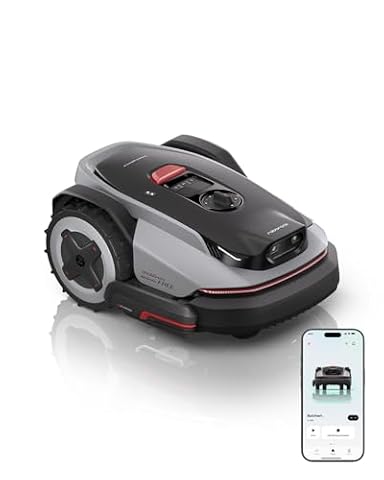
Segway Navimow i105N 1/8 Acre
Best for: Small, complex lawns without perimeter wires
- Lawn Size
- 1/8 acre
- Navigation Technology
- RTK + Vision
- Boundary Setup
- Wire-free
- Obstacle Avoidance
- AI vision (140° camera)
- Control Method
- App control
- Smart Features
- Multi-Zone Management
The NAVIMOW i105N is a wire-free robot mower designed for small lawns up to 1/8 acre. It uses RTK and Vision AI for centimeter-level positioning, allowing it to navigate complex layouts like narrow corridors or areas under trees. The 140-degree camera detects over 150 obstacle types for safe operation. You can manage up to 12 zones via the app. It weighs 24 pounds and includes a 3-year warranty.
- Wire-free setup using RTK and Vision AI
- 140-degree camera detects 150+ obstacle types
- Supports multi-zone management for up to 12 areas
- 3-year full warranty included
- 1/8 acre capacity is smaller than the 0.3 acre Sunseeker X3 Plus
- 24-pound weight is heavier than typical lightweight mowers
- 15-inch cutting width limits coverage speed on larger patches
- You have a small lawn under 1/8 acre
- You want to avoid installing perimeter wires
- You have complex garden layouts with trees or narrow spaces
- You need to mow more than 1/8 acre
- You prefer a lighter unit under 20 pounds
- You require a wider cutting deck for faster coverage
Verdict: NAVIMOW i105N 1/8 Acre Wire-Free Robot is ideal for homeowners with small, complex lawns who want precise navigation without wires. It fits users who value obstacle detection and multi-zone control over raw cutting width.

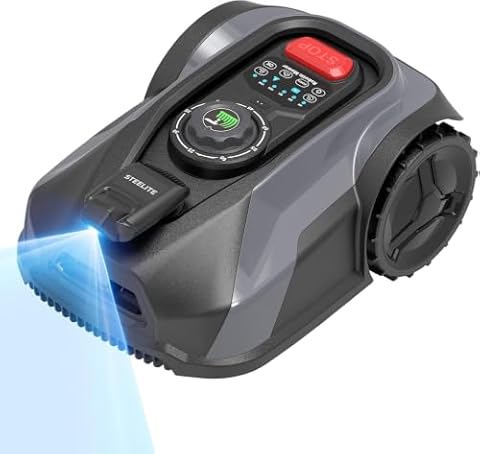
Sunseeker X3 Plus Vision AI Mower
Best for: small suburban yards under 0.3 acre
- Lawn Size
- Up to 0.3 acre / 13,000 sq. ft.
- Navigation Technology
- RTK + VSLAM
- Boundary Setup
- Wire-free
- Obstacle Avoidance
- Camera and ultrasonic sensing
- Control Method
- App control
- Smart Features
- Edge Mowing
The Sunseeker X3 Plus covers up to 0.3 acre using wire-free virtual boundaries. It combines RTK positioning with visual mapping for consistent navigation. The offset blade design cuts closer to fences and hardscapes. You control schedules and zones via the app. This model weighs 19.9 pounds and measures 15 inches wide. It suits suburban yards needing efficient edge trimming.
- Covers lawns up to 0.3 acre or 13,000 sq. ft.
- Wire-free setup with virtual boundaries via app
- RTK and VSLAM navigation for precise pathing
- Offset blade cuts closer to fences and borders
- Camera and ultrasonic sensing for obstacle avoidance
- Smaller 0.3 acre capacity compared to larger models
- 19.9 pound weight adds bulk for transport
- 15 inch cutting width limits speed on large areas
- You have a suburban yard under 0.3 acre
- You want to avoid burying perimeter wires
- You need closer edge cutting along hardscapes
- You have a yard larger than 0.3 acre
- You prefer manual control over app management
- You need a mower for commercial properties
Verdict: Sunseeker X3 Plus 0.3 Acre Robot Mower fits homeowners with small to medium yards who want wire-free convenience and precise edge cutting. It delivers reliable navigation for residential lawns without the hassle of buried wires.
Specifications side by side
| Spec | Segway Navimow i105N 1/8 Acre | Sunseeker X3 Plus Vision AI Mower |
|---|---|---|
| Lawn Size | 1/8 acre | Up to 0.3 acre / 13,000 sq. ft. |
| Navigation Technology | RTK + Vision | RTK + VSLAM |
| Boundary Setup | Wire-free | Wire-free |
| Obstacle Avoidance | AI vision (140° camera) | Camera and ultrasonic sensing |
| Control Method | App control | App control |
| Smart Features | Multi-Zone Management | Edge Mowing |
| Dimensions | 27.2 × 15 × 39.8 inches | 23.9 × 15 × 9.84 inches |
| Weight | 24 pounds | 19.9 pounds |
| Size | i105N-US-FBA | Sunseeker X3 Plus |
| Color | Grey, Black, Orange | silver gray |
| Model | i105N | SKRMX3PLUS |
Frequently asked questions
Which robot mower is lighter and easier to move?
The Sunseeker X3 Plus is the lighter option. It weighs 19.9 pounds, making it simpler to lift or transport. The NAVIMOW i105N is heavier at 24 pounds. You might notice the difference when moving the unit for maintenance or storage. The lower weight of the Sunseeker model can be a practical advantage for some users.
How tall is the Sunseeker X3 Plus compared to the Navimow?
The Sunseeker X3 Plus is significantly shorter. It stands 9.84 inches high, allowing it to fit under lower obstacles. The NAVIMOW i105N is much taller at 39.8 inches. This height difference affects clearance under decks or fences. You should check your yard’s low-clearance areas before deciding which height suits your layout better.
Do both mowers use the same navigation system?
Yes, both models use identical core navigation technology. They rely on RTK positioning combined with Vision AI. This setup allows for precise location tracking without perimeter wires. You get accurate mapping and reliable path planning on both units. The shared technology means you can expect similar precision in how they locate and cut your lawn.
Can I control both mowers through a smartphone app?
Yes, app control is standard on both devices. You can manage settings and schedules remotely via the application. The NAVIMOW i105N offers multi-zone management through the app. The Sunseeker X3 Plus supports edge mowing features via the same interface. You get full remote control regardless of which brand you choose.
Which mower is better for complex lawn shapes?
The NAVIMOW i105N is designed for complex layouts. It includes multi-zone management to handle irregular shapes efficiently. Its Vision AI detects over 150 obstacle types. This helps it navigate tight spaces and complex boundaries. The Sunseeker X3 Plus is also wire-free but focuses more on edge cutting for suburban yards.
What is the cutting width for these robot mowers?
Both mowers share the same cutting width. They both cut a 15-inch swath. This width is consistent across both the NAVIMOW i105N and the Sunseeker X3 Plus. You will get the same coverage per pass with either unit. The difference lies in their total acreage capacity and physical dimensions rather than the blade width.