As Amazon Associates, we earn from qualifying purchases. This means we may receive a small commission at no extra cost to you if you click through and make a purchase.
As an Amazon Associate we earn from qualifying purchases. Links on this page are affiliate links.
Understanding Robot Mower Navigation Tech
You need to know how your robot mower finds its way. This guide breaks down the main methods used today. We focus on navigation technology explained through three common specs: Vision AI, RTK, and LiDAR. Each method has different strengths for your lawn.
Vision AI uses cameras to see the environment. The mower takes pictures and processes them to identify boundaries and obstacles. It does not rely on wires or satellites. Instead, it maps the yard by recognizing visual features. You will see this labeled as "Vision AI" or "Camera-based" on listings. This method works well in open yards with clear edges. It struggles in dense shade or under heavy tree cover where cameras cannot see clearly.
RTK stands for Real-Time Kinematic. It uses satellite signals with high precision. Standard GPS is accurate to a few meters. RTK improves this to centimeter-level accuracy. The mower communicates with a base station or satellite network. Listings often label this as "RTK GPS" or "High-Precision GPS." This system allows the mower to return to the exact same spot after charging. It creates very straight, efficient paths. It requires an open sky view. Tall trees or large buildings can block the signal.
LiDAR uses laser pulses to map surroundings. It sends out light waves and measures the time it takes to bounce back. This creates a detailed 3D map of the yard. You might see "LiDAR" or "Laser Navigation" on product pages. This method is excellent for avoiding obstacles in low light. It works independently of GPS. However, it can be sensitive to heavy rain or fog.
Why does this matter to you? The navigation type affects how well the mower covers your lawn. It determines whether you need a boundary wire. It influences how the mower handles slopes and obstacles. Check the spec sheet for your specific needs. Choose the method that matches your yard conditions. This ensures you get a mower that works reliably every time.
Compare Navigation Tech Options
Vision AI
Vision AI uses cameras to map your yard and detect obstacles. It creates a digital layout without physical wires. You get auto mapping and obstacle avoidance. This tech works well in small, complex yards. The Roborock RockNeo Q110H combines Vision AI with RTK for precision. It handles steep slopes up to 45%. You benefit from clear edge detection. However, camera systems can struggle in low light. They also need clear lines of sight. If your yard has many trees or shadows, Vision AI might miss details. It suits users who want a wire-free setup with good obstacle detection. Check if your mower pairs it with other sensors for better reliability.
RTK
RTK stands for Real-Time Kinematic. It uses satellite signals for centimeter-level accuracy. You do not need boundary wires. The mower knows its exact location at all times. This method is ideal for precise mapping. The TerraMow V1000 relies on RTK for wire-free mowing. It is great for complex gardens with many obstacles. You get consistent coverage without missing spots. RTK works best in open areas with clear sky views. Dense tree cover can block signals. If you have a large, open lawn, RTK is highly effective. It ensures the mower returns to its dock accurately. Consider your yard’s exposure to the sky. Poor signal can reduce performance. Pairing RTK with other sensors often improves results in tricky terrain.
LiDAR
LiDAR uses laser pulses to create a detailed map of your yard. It detects objects with high precision. The ECOVACS Goat O1000 LiDAR PRO uses this for narrow passages. It is excellent for tight spaces and clean edges. You get accurate obstacle avoidance without wires. LiDAR works day and night. It is not affected by lighting changes. The HOOKII Neomow X SE adds 3D LiDAR for better depth perception. This helps in complex yards. However, LiDAR sensors can be bulky. They may protrude from the mower body. This can make turning in very tight spots harder. If you have a small yard with narrow gaps, LiDAR is a strong choice. It offers reliable mapping in varied conditions.
Who Needs Advanced Navigation Tech
Who needs it
You should prioritize models with LiDAR or RTK if your yard has significant slope changes or complex boundaries. These technologies provide precise mapping and reliable boundary detection without the need for physical perimeter wires. This setup saves you time on installation and reduces maintenance issues caused by wire corrosion or damage. If you have a large property with multiple zones, RTK offers centimeter-level accuracy that keeps the mower on track even in open areas where GPS signals might drift. Vision AI is better suited for yards with many dynamic obstacles like trees, garden furniture, or pets. It helps the mower identify and avoid these items in real-time. Choose these advanced specs if you want a set-and-forget experience with minimal manual intervention. Precision matters most when you have difficult terrain or want to avoid the hassle of digging trenches for wires.
Who can skip it
You can skip advanced navigation if you have a small, flat yard with simple geometry. Basic models with wire-guided systems are often sufficient for these spaces. They are easier to install and require less technical knowledge to set up. If you are on a tight budget or prefer a simpler setup, the extra cost for LiDAR or RTK may not be worth it. You can prioritize ease of use and lower upfront costs instead. Wire-guided mowers work well for rectangular lawns with few obstacles. You do not need complex sensors if your yard does not have significant elevation changes or numerous dynamic objects. Focus on cutting width and battery life rather than navigation complexity. These factors often matter more for efficiency in smaller spaces. Save the advanced tech for larger or more challenging properties where precision and automation truly add value.
Navigation Tech Glossary
Vision AI
Camera-based mapping that creates digital yard layouts. It detects obstacles and navigates without physical wires, ideal for small, complex spaces.
RTK
Real-Time Kinematic GPS for centimeter-level accuracy. It enables precise mapping and reliable boundary detection without perimeter wires or physical guides.
LiDAR
Light Detection and Ranging sensors that map surroundings. It provides precise navigation for yards with significant slope changes or complex boundaries.
Auto Mapping
The robot creates a digital layout of your yard. This feature allows for efficient path planning without manual setup of boundary wires.
Obstacle Avoidance
Technology that detects and navigates around objects. It prevents collisions with furniture, trees, or toys, ensuring safer operation in cluttered yards.
Perimeter Wire
Physical boundary wire installed around the yard edge. Traditional models use this wire to define the mowing area, unlike wire-free navigation systems.
Cutting Width
The width of the blade path in inches. Wider decks cover more ground per pass, reducing the total time needed to mow large areas.
| # | Product | Best for | Price |
|---|---|---|---|
| 1 | Roborock RockNeo Q110H 1/4 Acre | small yards with steep slopes | |
| 2 | ECOVACS Goat O1000 LiDAR PRO | small yards with narrow passages | |
| 3 | WORX WR320 Robot Mower for 1/2 Acre | Small wire-free lawns needing precise edge cutting | |
| 4 | HOOKII Neomow X SE 0.75 Acre 3D LiDAR | Small lawns needing wire-free precision | |
| 5 | Segway Navimow i105N 1/8 Acre | small, complex lawns under 1/8 acre | |
| 6 | TerraMow V1000 36-Blade Wire-Free Mower | Wire-free mowing in complex gardens with obstacles |
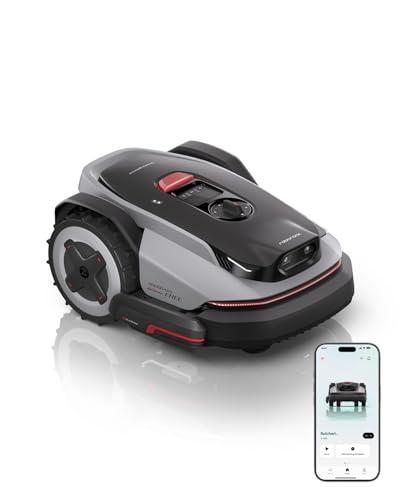
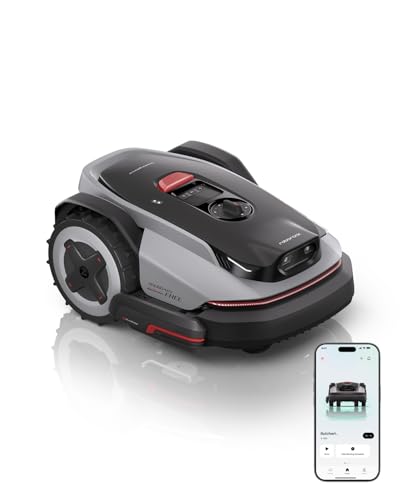
Roborock RockNeo Q110H 1/4 Acre
Best for: small yards with steep slopes
- Navigation Technology
- Vision AI, RTK
- Lawn Size
- Up to 1/4 acre
- Boundary Setup
- Wire-free
- Slope Capability
- 45%
- Obstacle Avoidance
- Dual-camera AI vision
- Control Method
- App control
The Roborock RockNeo Q110H uses Full-Band RTK and VSLAM navigation for wire-free setup. It handles slopes up to 45% and obstacles up to 1.57 inches. Dual-camera AI vision helps it avoid static objects and living beings. You get app control for multi-zone scheduling. This mower fits yards up to 1/4 acre. It suits complex layouts with dense shade or tight passages.
- Full-Band RTK and VSLAM dual-navigation system
- Handles 45% slopes and 1.57-inch obstacles
- Dual-camera AI vision for obstacle avoidance
- Wire-free boundary setup with dual mapping modes
- Slim 2.3 ft passage capability
- Limited to 1/4 acre lawn size
- Heavier at 27 pounds than some competitors
- Optional modules sold separately for edge precision and tracking
- You have a yard up to 1/4 acre
- You need wire-free setup for complex boundaries
- You have steep slopes up to 45%
- You have a lawn larger than 1/4 acre
- You prefer perimeter wire installation for stability
- You need included anti-theft tracking hardware
Verdict: The Roborock RockNeo Q110H Wire-Free RTK fits users with small, steep, or complex yards who want precise wire-free navigation. Its dual navigation system handles tight spaces and slopes well.
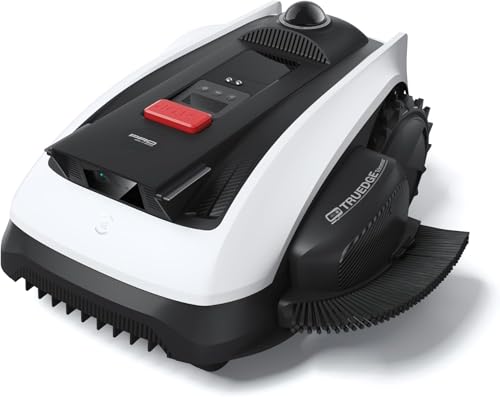
ECOVACS Goat O1000 LiDAR PRO
Best for: small yards with narrow passages
- Navigation Technology
- LiDAR
- Lawn Size
- Up to 1/4 Acre
- Boundary Setup
- Wire-Free
- Obstacle Avoidance
- AI Vision, 3D ToF LiDAR
- Control Method
- App control
- Smart Features
- Obstacle Avoidance, Edge Mowing
This wire-free robotic mower uses HoloScope 360° Dual-LiDAR for precise 2 cm positioning without perimeter wires. It features AI Vision and 3D ToF LiDAR to detect obstacles down to 5 cm. The integrated TruEdge trimmer cuts along borders, while its narrow 1.56-inch width fits tight spaces. It handles lawns up to 1/4 acre and allows custom zones via the app.
- HoloScope 360° Dual-LiDAR navigation with 2 cm positioning accuracy
- Integrated TruEdge trimmer for true edge-to-edge cutting
- AI Vision and 3D ToF LiDAR detect obstacles as small as 5 cm
- Narrow 1.56-inch width fits paths as slim as 0.8 m
- 1/4 acre lawn capacity is smaller than the 1/2 acre and 3/4 acre options on this list
- Maximum cutting height is limited to 1.89 inches compared to taller alternatives
- You have a compact yard up to 1/4 acre
- You need a mower that fits through narrow side paths
- You want precise edge trimming without manual string trimming
- You have a large lawn exceeding 1/4 acre
- You prefer a taller cutting height for thick grass
- You want a mower with a larger blade count
Verdict: ECOVACS Goat O1000 LiDAR PRO is a precise, narrow-body mower for small, complex yards. It suits you if you need tight-space navigation and clean edges.

WORX WR320 Robot Mower for 1/2 Acre
Best for: Small wire-free lawns needing precise edge cutting
- Navigation Technology
- Vision AI, RTK
- Lawn Size
- 1/2 Acre
- Boundary Setup
- No Perimeter Wire
- Slope Capability
- 30%
- Drive Type
- Two-Wheel Drive
- Obstacle Avoidance
- Vision AI
The WORX WR320 handles lawns up to 1/2 acre using RTK Cloud and Vision AI for navigation. It requires no perimeter wire and uses V-SLAM for shaded areas. You get precise edge cutting and multiple mowing patterns. The unit weighs 44.5 pounds and measures 22.7 inches long. It suits users wanting cloud-based accuracy without local antennas.
- RTK Cloud navigation for centimeter-level accuracy
- Vision AI for obstacle recognition and auto mapping
- Cut-to-edge border cutting capability
- Multiple mowing patterns including Checkerboard and Diamond
- Two-Wheel Drive limits traction on steep slopes
- 1/2 Acre capacity is smaller than 1 Acre options
- 44.5 pound weight adds bulk for storage
- You want precise navigation without installing perimeter wire
- You have a lawn under 1/2 acre with shade
- You prefer cloud-based RTK accuracy over local antennas
- You need to mow slopes steeper than 30%
- You require All-Wheel Drive for better traction
- You have a lawn larger than 1/2 acre
Verdict: WORX WR320 Vision Cloud 1/2 Acre fits small yards where you need precise edge cutting and wire-free setup. It works well if you accept Two-Wheel Drive for a lighter, more affordable unit.

HOOKII Neomow X SE 0.75 Acre 3D LiDAR
Best for: Small lawns needing wire-free precision
- Navigation Technology
- RTK, LiDAR
- Lawn Size
- Up to 0.75 acre (32,670 sq.ft)
- Boundary Setup
- No boundary wires
- Drive Type
- Front-wheel drive
- Obstacle Avoidance
- 360° 3D LiDAR and AI Vision fusion
- Control Method
- App control (WiFi, Bluetooth, 4G)
This robot mower uses 360° 3D LiDAR and AI vision for navigation without perimeter wires or RTK stations. It handles up to 0.75 acres with inch-level accuracy. The 11-inch cutting deck adjusts from 1.18 to 3.35 inches. It supports WiFi, Bluetooth, and 4G control. This model suits users who want precise mapping without satellite dependency or wire installation.
- 360° 3D LiDAR and AI vision fusion navigation
- No boundary wires or RTK antenna required
- 11-inch cutting width with adjustable height
- Supports WiFi, Bluetooth, and 4G app control
- 0.75-acre capacity is smaller than the 1-acre and 1.5-acre options available
- 16-inch width is narrower than the 11-inch deck width listed in variations
- 38-pound weight is heavier than the 35-pound ECOVACS Goat O1000
- You want precise navigation without installing boundary wires
- You have a lawn up to 0.75 acres
- You need reliable operation under trees or at night
- You have a lawn larger than 0.75 acres
- You prefer a lighter unit for easier transport
- You require a wider cutting deck for faster mowing
Verdict: HOOKII Neomow X SE 3D LiDAR fits users with small to medium lawns who need wire-free precision. It is ideal for those who prioritize accurate obstacle avoidance and flexible app control over maximum coverage area.

Segway Navimow i105N 1/8 Acre
Best for: small, complex lawns under 1/8 acre
- Navigation Technology
- Vision AI, RTK
- Lawn Size
- 1/8 acre
- Boundary Setup
- Wire-free
- Obstacle Avoidance
- AI vision (140° camera)
- Control Method
- App control
- Smart Features
- Multi-Zone Management
The Navimow i105N handles up to 1/8 acre using RTK and Vision AI navigation. It sets virtual boundaries without perimeter wires. The 140-degree camera detects over 150 obstacle types. You can manage up to 12 zones via the app. This model weighs 24 pounds and measures 15 inches wide. It suits small, complex lawns where precise mapping matters more than raw cutting width.
- RTK and Vision AI navigation for centimeter-level accuracy
- Wire-free setup with AI-assisted mapping
- 140-degree camera detects 150+ obstacle types
- Manage up to 12 zones via app
- 1/8 acre capacity is smaller than competitors covering up to 1 acre
- 15-inch cutting width is narrower than wider models
- 24-pound weight requires manual transport despite being lightweight
- You have a small garden under 1/8 acre
- You want to avoid installing perimeter wires
- You need precise navigation under trees or in narrow corridors
- You have a lawn larger than 1/8 acre
- You prefer a wider cutting deck for faster coverage
- You do not want to use a smartphone app for control
Verdict: Navimow i105N 1/8 Acre RTK+Vision Mower fits users with small, complex yards who value precise wire-free mapping over large-area coverage.

TerraMow V1000 36-Blade Wire-Free Mower
Best for: Wire-free mowing in complex gardens with obstacles
- Navigation Technology
- Vision AI, RTK
- Boundary Setup
- Wire-free
- Obstacle Avoidance
- Triple-Camera AI Vision
- Control Method
- App control
- Smart Features
- Obstacle Avoidance, Auto Mapping, Multi-Zone Management
- Dimensions
- 23.7 × 15.5 × 13 inches
The TerraMow V1000 uses TerraVision 2.0 Triple-Camera AI Vision for navigation, operating without boundary wires or RTK signals. It handles up to 20 mowing zones across three independent maps and cuts grass between 0.98 and 2.95 inches. The unit weighs 26 pounds and runs at under 54 dB. It suits users who want wire-free setup with real-time obstacle detection for complex garden layouts.
- TerraVision 2.0 Triple-Camera AI Vision navigation
- Wire-free boundary setup with auto mapping
- Manages up to 20 mowing zones
- Adjustable cutting height from 0.98 to 2.95 inches
- 26 pound weight is heavier than lighter competitors
- Under 54 dB operation is louder than some quiet models
- Single navigation system lacks multi-sensor redundancy
- You want a wire-free installation without RTK signals
- You have a complex garden with multiple zones
- You need real-time obstacle avoidance for pets or furniture
- You require RTK precision for large open fields
- You prefer a lighter unit for easy transport
- You need LiDAR-based mapping for dense tree cover
Verdict: TerraMow V1000 AI Vision Robot Mower fits users who prioritize wire-free convenience and AI obstacle detection over RTK precision or LiDAR mapping in complex yards.
Specifications side by side
| Spec | Roborock RockNeo Q110H 1/4 Acre | ECOVACS Goat O1000 LiDAR PRO | WORX WR320 Robot Mower for 1/2 Acre | HOOKII Neomow X SE 0.75 Acre 3D LiDAR | Segway Navimow i105N 1/8 Acre | TerraMow V1000 36-Blade Wire-Free Mower |
|---|---|---|---|---|---|---|
| Lawn Size | Up to 1/4 acre | Up to 1/4 Acre | 1/2 Acre | Up to 0.75 acre (32,670 sq.ft) | 1/8 acre | – |
| Navigation Technology | Full-Band RTK + VSLAM | HoloScope 360° Dual-LiDAR | RTK Cloud, V-SLAM, Vision AI | 360° 3D LiDAR, AI Vision | RTK + Vision | Triple-Camera AI Vision |
| Boundary Setup | Wire-free | Wire-Free | No Perimeter Wire | No boundary wires | Wire-free | Wire-free |
| Slope Capability | 45% | – | 30% | – | – | – |
| Drive Type | – | – | Two-Wheel Drive | Front-wheel drive | – | – |
| Obstacle Avoidance | Dual-camera AI vision | AI Vision, 3D ToF LiDAR | Vision AI | 360° 3D LiDAR and AI Vision fusion | AI vision (140° camera) | Triple-Camera AI Vision |
| Control Method | App control | App control | App Control | App control (WiFi, Bluetooth, 4G) | App control | App control |
| Application | – | – | 1/2 Acre | – | – | – |
| Smart Features | Obstacle Avoidance, Auto Mapping | Obstacle Avoidance, Edge Mowing | Obstacle Avoidance, Auto Mapping | Obstacle Avoidance | Multi-Zone Management | Obstacle Avoidance, Auto Mapping, Multi-Zone Management |
| Dimensions | 24.6 × 16.5 × 10.6 inches | 1.95 × 1.56 × 0.58 inches | 22.7 × 18.1 × 11.3 inches | 35 × 16 × 22 inches | 27.2 × 15 × 39.8 inches | 23.7 × 15.5 × 13 inches |
| Weight | 27 pounds | – | 44.5 pounds | 38 pounds | 24 pounds | 26 pounds |
| Color | Black | White | Two-Wheel Drive | Gray | Grey, Black, Orange | Gray |
| Model | RockNeo Q110H | GOAT O1000 LiDAR PRO | WR320 | Neomow X SE | i105N | V1000-36Blades |
| Size | – | O1000 LIDAR PRO | Up to 1/2 Acre | – | i105N-US-FBA | V1000-36Blades |
Frequently asked questions
Is RTK navigation better than standard GPS?
RTK offers centimeter-level accuracy, whereas standard GPS is less precise. This precision allows for reliable boundary detection without physical perimeter wires. Models like the Roborock RockNeo Q110H and Segway Navimow i105N use RTK to map yards accurately. You benefit from this technology if you want wire-free setup with high positional confidence.
What is the difference between LiDAR and Vision AI?
LiDAR uses laser pulses to create precise maps of your yard. Vision AI relies on cameras to detect obstacles and map spaces. The ECOVACS Goat O1000 LiDAR PRO uses LiDAR for narrow passages. The Roborock RockNeo Q110H combines Vision AI with RTK. You choose based on whether you prioritize laser precision or camera-based obstacle detection.
Do I need a wire-free mower for RTK?
Yes, RTK technology enables wire-free operation by using satellite signals for positioning. You do not need to install physical boundary wires. The ECOVACS Goat O1000 and Segway Navimow i105N both support wire-free boundary setups. This feature simplifies installation and allows for easier layout changes as your yard grows or changes.
Can RTK mowers handle steep slopes?
RTK provides precise positioning, which helps maintain control on difficult terrain. The Roborock RockNeo Q110H handles slopes up to 45%. Accurate navigation ensures the mower does not get stuck or miss sections on inclines. You should check the slope capability spec alongside navigation type to ensure the unit can grip and climb your yard's hills.
Is LiDAR necessary for small yards?
LiDAR is not strictly necessary but offers high precision for complex layouts. The ECOVACS Goat O1000 LiDAR PRO excels in narrow passages. It creates detailed maps for tight spaces. If your yard is small but complex, LiDAR provides clean edges. For simpler small yards, Vision AI may be sufficient and more affordable.
How does Vision AI improve obstacle avoidance?
Vision AI uses cameras to identify and navigate around objects in real time. It creates a digital layout to avoid collisions. The Roborock RockNeo Q110H and WORX WR320 use this tech for auto mapping and obstacle avoidance. You get better navigation in cluttered yards where physical sensors might struggle with low or transparent objects.
Which navigation tech is best for multi-zone lawns?
Vision AI and RTK combinations work well for multi-zone management. The Segway Navimow i105N supports multi-zone management via its app. RTK provides the accuracy needed to switch between zones without losing track. You benefit from this setup if you have separate yard areas that require distinct mowing patterns or schedules.
Does RTK require a base station?
Some RTK systems use a base station for maximum accuracy, while others rely on satellite corrections. The data shows wire-free RTK models like the TERRAMOW V1000 and Roborock RockNeo Q110H. These units offer precise mapping without visible hardware installations. You should check the specific boundary setup details to confirm if external hardware is required for your model.

