As Amazon Associates, we earn from qualifying purchases. This means we may receive a small commission at no extra cost to you if you click through and make a purchase.
MOZA has rapidly earned a reputation in sim racing for producing rigid hardware ecosystems centered around direct-drive realism, modular upgrades, and durable all-metal pedal designs. Unlike traditional potentiometers that measure how far a pedal travels, modern moza load cell pedals measure kinetic braking force directly through electronic strain gauges. This reliance on muscle memory rather than physical pedal displacement is critical for consistent threshold braking, but it places extreme mechanical stress across mounting baseplates, pivot arms, and elastomer bushings. For dedicated racers, evaluating these systems requires examining structural deflection, bushing wear under heavy foot pressure, and the longevity of high-resolution sensors.
Understanding which hardware configuration matches your cockpit depends entirely on how each unit handles mechanical strain: the lineup spans from basic mechanical resistance kits for bundled entry sets, through heavy-duty alloy steel dual-pedal assemblies, up to advanced hybrid load cell systems with multi-axis ergonomic adjustments. In this comprehensive moza pedals comparison, we break down chassis rigidity, electronic architecture, and long-term durability factors to help you determine which moza pedals to buy for your setup.
MOZA Load Cell Pedals Compared
| Model | Materials & Structure | Sensing Mechanism | Adjustability Features | Platform Support |
|---|---|---|---|---|
| MOZA CRP2 Load Cell Pedals | Not listed (2.99 lbs total weight) | Load cell sensor | Not listed | PC compatible |
| MOZA SR-P Pedals | All-metal heavy frame (7 lbs) | 100 kg load cell & 15-bit magnetic encoders | Adjustable positioning and resistance | PC |
| MOZA SRP2 Pedals Racing Simulator Load | High-strength steel & aerospace aluminum | 100 kg load cell + 15-bit angle sensor fusion | 25 brake feels, 10°/25° angle, ±15mm spacing | PC |
| MOZA SR-P Lite Brake Pedal Performance | Steel springs & rubber damping block | Pure mechanical resistance upgrade | Interchangeable springs and elastomer spacers | PC (R3, R5, Truck bundles) |
| MOZA SRP Dual Pedals | Alloy steel construction (3.78 kg) | Not listed | 9/16-inch threading, modular placement | PC |
| MOZA CRP2 Clutch Pedal for Sim | Ergonomic metal construction | Pedal angle sensor controller | Ergonomic pedal geometry | PC, Xbox One, Xbox Series X |
MOZA CRP2 Load Cell Pedals for Modular Rig Architecture

Best for: Sim racers building a modular flagship rig
Pros
- Lightweight single-pedal form factor
- CRP platform modularity
- Dedicated load cell engineering
Cons
- Sparse listing documentation
- Baseplate mounting sold separately
The MOZA CRP2 Load Cell Pedals represent an elite class of individual pedal components designed for sim racers who demand high-tier force registration and rigid build geometry. Shipped in a packaging profile of 16.5 by 16 by 5.6 inches and weighing approximately 2.99 pounds, this single-unit hardware listing highlights the modular approach of modern flagship sim gear. Rather than binding racers to a fixed, non-negotiable pedal plate width, modular pedal systems enable racers to mount the brake unit directly to custom aluminum profile extrusions, aligning pedal faces perfectly with driver hip and knee angles.
From an advocate’s reliability perspective, the minimalist nature of this specific product listing means buyers must look closely at how the single unit integrates with their wider cockpit hardware. Because load cell sensors register braking force by calculating micro-deflection in a metal strain gauge, mounting hardware must exhibit zero flex under continuous threshold braking. Pairing this unit with a rigid chassis alongside a matching moza wheel base ensures that kinetic braking force transfers entirely into the sensor rather than twisting the pedal tray, keeping sensor calibration reliable across long endurance sessions.
This pedal unit is intended for dedicated sim enthusiasts assembling or expanding an elite CRP2 setup one module at a time. The listing does not specify whether mounting baseplates, multi-pedal link cables, or elastomer packs are included in this individual package, making it essential to verify your cockpit mounting plates before installation. Drivers seeking an out-of-the-box, dual-pedal kit with integrated base plates will likely find pre-bundled packages simpler to deploy.
MOZA SR-P Pedals for Dual-Pedal Precision

Best for: PC racers wanting dual hybrid braking
Pros
- 100 kg load cell rating
- 15-bit magnetic throttle encoder
- Organ-style accelerator pedal
Cons
- Rigid cockpit required
- Dual pedal configuration only
The MOZA SR-P Pedals deliver a complete dual-pedal package featuring a dedicated 100 kg load cell brake paired with an organ-type accelerator pedal. Built with an overall shipping weight of 7 pounds and dimensions measuring 12 inches deep, 6 inches wide, and 8 inches high, this set uses a heavy-duty chassis to provide a grounded, flex-free racing platform. The accelerator employs a 15-bit magnetic angle encoder that operates without physical contact points, eliminating the typical sensor jitter and dust contamination that plagues legacy potentiometers over time.
The standout mechanical engineering feature on the moza sr-p pedals is its hybrid braking system. Instead of relying purely on elastomer compression or purely on angle displacement, the hybrid architecture utilizes both a load cell rated up to 100 kg and magnetic angle sensing. During the initial soft travel phase, the sensor reads the pedal angle to allow smooth, non-disruptive inputs; once the mechanical slack is taken up and the elastomer compresses, the 100 kg strain gauge measures driver foot pressure directly. This hybrid behavior provides excellent trail-braking control, allowing drivers to feather off the brake smoothly while rotating through corner apexes.
This unit is suited for competitive PC sim racers who run modern sports cars, prototypes, or GT3 classes where a dedicated clutch pedal is rarely utilized. The integrated adjustability enables users to tune pedal spacing and physical resistance to match their seating position. However, because a 100 kg load cell requires significant foot pressure to exploit fully, using these pedals on loose office flooring or with wheeled chairs will compromise braking stability without a solid floor mount.
MOZA SRP2 Pedals Racing Simulator Load for Granular Brake Customization

Best for: Competitive racers seeking granular brake adjustments
Pros
- 25 standard brake feel setups
- 15-bit sensor fusion telemetry
- Aerospace aluminum and steel build
Cons
- Elastomer maintenance required
- Complex multi-axis calibration
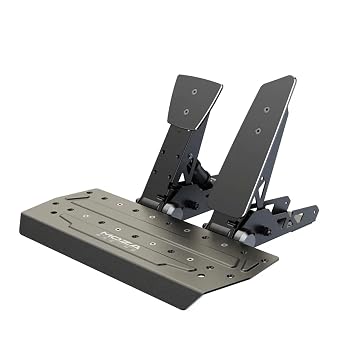
Engineered with aerospace-grade CNC-machined aluminum and high-strength structural steel, the MOZA SRP2 Pedals Racing Simulator Load stand out as one of the best moza pedals for sim racing due to their deep mechanical adjustability. This dual-pedal layout integrates a high-precision 100 kg load cell working in tandem with a 15-bit high-precision angle sensor capable of 32,768 pulses per revolution. This advanced sensor fusion captures both immediate pedal angle and overall structural force, delivering instantaneous electronic response into sim telemetry.
Mechanical reliability and wear resistance are prioritized throughout the chassis design of these moza srp2 pedals. The brake mechanism supports 25 distinct brake feel configurations out of the box using two included elastomer sets and multi-hardness compression springs. Racers can alter the pedal face angle between two stages (10 degrees and 25 degrees), shift pedal spacing laterally by 15 millimeters, and adjust vertical height across a 36-millimeter range. This extreme modularity prevents muscle fatigue and repetitive strain injuries during multi-hour endurance events by matching the pedal face flat against the driver’s soles.
For racers demanding total control over their pedal curve, the SRP2 supports real-time software output displays and two-step preload adjustments on throttle travel. The primary wear point over seasons of heavy use will be elastomer degradation; elastomers naturally soften and deform after millions of high-pressure compression cycles. Drivers who regularly push threshold braking forces near the 100 kg limit should inspect their elastomer stacks periodically for split edges or loss of rebound elasticity to preserve identical braking benchmarks.
MOZA SR-P Lite Brake Pedal Performance for Entry-Level Pedal Reinforcement

Best for: MOZA R3 and R5 bundle owners
Pros
- Progressive spring and elastomer resistance
- Simple screw-and-pivot installation
- Includes two tuning springs
Cons
- Incompatible with standard SR-P pedals
- Pure mechanical upgrade without sensors
Racers operating bundled MOZA starter setups often find the stock brake pedal too soft and light for realistic threshold control, which is where the MOZA SR-P Lite Brake Pedal Performance kit proves essential. Designed specifically as a mechanical reinforcement for the SR-P Lite pedal assemblies found on R3, R5, and specialized truck bundles, this kit installs directly onto the existing brake arm. The package measures 4.73 by 2.37 by 3.15 inches and provides a dedicated combination of steel coil springs and a high-density rubber damping block to increase overall pedal resistance.
From an engineering standpoint, this hardware modification is not an electronic sensor change; it functions as a mechanical spring upgrade rather than a true electronic moza load cell brake upgrade. Instead of converting the SR-P Lite pedals to read physical pressure via a strain gauge, it alters the mechanical resistance curve of the stock angle-sensing brake. The included high-strength springs absorb the initial pedal movement, while the thick damping block creates a firm, progressive stop at the end of the stroke, simulating the physical resistance of a hydraulic brake caliper.
The package includes two Allen keys, a fixed axis pin, two M3 retaining screws, two spacers, two different rate springs, and one damping block. Installation is straightforward: drivers secure the top screws and press the lower pivot pins directly into the pedal arm grooves. Shoppers must take careful note of hardware compatibility: the listing explicitly clarifies that this performance kit is not compatible with standard SR-P pedals, as those already feature a dedicated hybrid load cell and spring cage assembly.
MOZA SRP Dual Pedals for High-Strength Steel Durability
Best for: Racers prioritizing heavy alloy steel construction
Pros
- Solid 3.78 kg alloy steel frame
- High flex resistance under pressure
- Standard 9/16-inch hardware threads
Cons
- Minimal listing telemetry details
- Two-pedal baseline configuration
The MOZA SRP Dual Pedals showcase a heavy-gauge alloy steel architecture built to eliminate chassis flex entirely. Weighing in at 3.78 kilograms (approximately 8.33 pounds) and finished in modern industrial gray, these moza srp dual pedals rely on thick metal arms and a reinforced baseplate. When braking hard into heavy deceleration zones, pedal trays built from thin stamped metal or plastic flex downward, sapping brake pressure and compromising muscle memory; this alloy steel construction ensures every ounce of leg power transmits directly into the pedal travel.
Hardware specifications highlight standard 9/16-inch threading hardware across its structural mounts, allowing users to bolt the assembly securely onto standard racing cockpits and wheel stands. The physical mass of the dual assembly acts as an anchor on rigid simulator frames. The mechanical pivots operate smoothly on heavy-duty pins designed to resist lateral wobble and twisting under aggressive, off-center foot stabs, which is a common failure mode when drivers rush downshifts or panic brake during race starts.
This dual-pedal kit is best suited for PC sim drivers who want a rock-solid mechanical platform without excessive frills. Pairing this set with an external peripheral like a moza gear shifter creates a balanced, utilitarian cockpit layout. Because this specific listing details the alloy steel frame and dual-pedal count without elaborating on software telemetry curves, buyers should confirm whether their intended software environment requires external calibration profiles through the standard peripheral management suite.
MOZA CRP2 Clutch Pedal for Sim for Three-Pedal Manual Realism
Best for: Three-pedal manual and drift drivers
Pros
- Direct USB connectivity
- Xbox console and PC compatibility
- Ergonomic pedal arm geometry
Cons
- Requires CRP2 main pedal set
- Standalone clutch module only
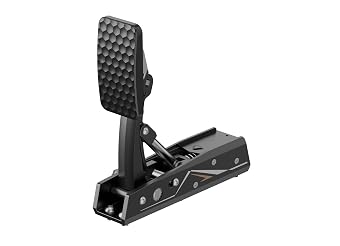
Drivers who transition from paddle-shifted GT cars to classic touring machinery, rally stages, or drift layouts will find a crucial mechanical piece in the MOZA CRP2 Clutch Pedal for Sim. Built as a standalone expansion module by Gudsen/MOZA, this dedicated pedal introduces true three-pedal flexibility to existing high-end setups. The unit features an ergonomic pedal face designed to facilitate rapid footwork and heel-and-toe downshifting alongside a matching moza steering wheel.
A key mechanical highlight of this peripheral is its dual platform versatility. While most load cell and high-end sim components remain strictly tied to Windows operating systems, this CRP2 clutch pedal listing specifies compatibility with PC alongside Microsoft Xbox One and Xbox Series X consoles via direct USB connectivity. This makes it an exceptionally versatile peripheral for multi-platform sim drivers who jump between PC simulation titles and console-based racing series.
From a hardware reliability perspective, the single-pedal package includes one MOZA CRP2 clutch pedal unit ready for direct hard-mounting. The primary mechanical stress on a clutch pedal is different from a load cell brake; rather than sustained high-tonnage pressure, clutches endure rapid, explosive depression and release cycles. Drivers must ensure the pivot pins are kept clean from floor grit and debris to maintain smooth throw actuation and preserve the internal angle sensors over hundreds of operating hours.
How to Choose the Right MOZA Load Cell Pedals
Selecting the correct pedal hardware requires balancing your sim rig’s structural mounting strength against your personal racing preferences and target vehicle classes. A high-pressure load cell is completely useless if installed on an unstable platform; before selecting a pedal set, consider these critical hardware factors:
- Chassis Flex and Cockpit Rigidity: Load cell units like the MOZA SRP2 and MOZA SR-P apply up to 100 kg of measured force against the pedal face. If you mount these units to a lightweight wheel stand or an unbraced desk setup, the pedal tray will flex or your office chair will roll backwards before you reach maximum threshold braking. True load cell hardware demands an aluminum profile rig, a reinforced steel chassis, or firmly anchored wheel stand floor brackets.
- Sensor Architecture (Hybrid vs. Pure Mechanical): Determine whether you require electronic strain gauge measurements or simple mechanical resistance. The MOZA SRP2 utilizes hybrid sensor fusion—combining a 100 kg load cell with a 15-bit magnetic angle sensor—to deliver progressive data throughout both the light initial travel and heavy threshold phases. In contrast, the SR-P Lite Performance Kit is a purely mechanical upgrade that adds physical stiffness to entry-level pedals without altering their underlying electronic sensor type.
- Ergonomics and Geometry Adjustability: Drivers with different physical heights or cockpit seating positions need adequate pedal face adjustments. The MOZA SRP2 offers exceptional ergonomic tailoring with two-stage angle adjustments (10 degrees or 25 degrees), lateral pedal face spacing adjustments of ±15 millimeters, and vertical height adjustments across 36 millimeters. Basic dual-pedal steel assemblies offer rigid structural longevity but fewer quick-change geometric adjustments.
- Modular Upgradability: If you currently race GT3, open-wheel, or prototype classes, a two-pedal throttle and brake setup like the MOZA SR-P or MOZA SRP Dual provides everything needed for left-foot braking. If you plan to expand into manual rallying, drifting, or historic racing, verify that your ecosystem supports add-on clutch hardware like the MOZA CRP2 Clutch Pedal.
- Bundle Modifications vs. Dedicated Platform Replacements: If you currently own an R3 or R5 bundle with stock SR-P Lite pedals, the SR-P Lite Performance Kit provides a cost-effective path to stiffen pedal feel without discarding your existing set. However, if you want true load cell telemetry and 15-bit magnetic precision, upgrading directly to the MOZA SRP2 or a dedicated CRP2 configuration is the necessary path.
FAQ
What is the benefit of a 100 kg load cell sensor in sim racing pedals?
A 100 kg load cell measures the physical pressure exerted by the driver’s leg rather than the distance the pedal swings forward. In real race cars, hydraulic braking pressure creates an extremely firm pedal face where deceleration is modulated by muscle memory rather than joint angle. A 100 kg sensor allows drivers to calibrate a stiff, realistic braking threshold, preventing accidental wheel lockups and dramatically improving lap-to-lap braking consistency.
Can the MOZA SR-P Lite Brake Pedal Performance kit be installed on standard SR-P pedals?
No. The MOZA SR-P Lite Brake Pedal Performance kit is engineered exclusively for the SR-P Lite pedals included with R3, R5, and truck bundles. Standard SR-P pedals already feature a built-in hybrid 100 kg load cell assembly, an integrated spring cage, and different mounting geometry that does not accept the SR-P Lite performance bracket.
What is the difference between sensor fusion and standard potentiometer pedals?
Standard potentiometer pedals use mechanical wiper contacts that measure physical rotational distance. Over time, dust and friction degrade these potentiometers, causing signal jumping, jitter, and calibration drift. Sensor fusion, as implemented on the MOZA SRP2 pedals, merges a 15-bit contactless magnetic angle encoder with a 100 kg strain-gauge load cell, allowing the system to track initial pedal stroke position and high-force pressure simultaneously without physical electronic contact wear.
Do MOZA load cell pedals require a dedicated sim racing cockpit?
Yes, dedicated mounting is strongly recommended. Because load cell units require substantial foot force to reach 100% brake engagement, mounting them on unbraced floor mats or using them with rolling desk chairs will cause the pedals to tip or push the chair backward. To achieve reliable, repeatable braking performance, load cell pedals should be bolted firmly to an aluminum extrusion sim rig or a rigid steel wheel stand.
How do you adjust the brake stiffness on the MOZA SRP2 pedals?
The MOZA SRP2 pedals allow users to customize pedal resistance by swapping the included compression springs and rubber damping blocks. By combining different elastomer hardness ratings with varied spring tensions, racers can configure up to 25 different physical brake feels out of the box, ranging from soft street-car travel to ultra-stiff, short-throw formula car feedback.