


As Amazon Associates, we earn from qualifying purchases. This means we may receive a small commission at no extra cost to you if you click through and make a purchase.
KRK Systems has spent decades outfitting project studios and professional broadcast suites with active nearfield monitors instantly recognized by their signature yellow driver cones. In professional audio production, the brand is known for offering powerful bass response, consistent transient impact, and accessible room-tuning options that help audio engineers identify frequency masking in dense arrangements. When evaluating modern krk studio speakers from a hardware reliability standpoint, the primary technical concerns shift away from mere aesthetics and focus squarely on amplifier thermal dissipation, cabinet acoustic isolation, and long-term component durability under sustained continuous output.
While the advanced Rokit lines prioritize cool-running Class D amplifiers and onboard digital signal processing to limit internal heat accumulation, the Classic series retains traditional Class A/B analog amplification with front-ported cabinet designs, and the compact Kreate series introduces lightweight woven glass fiber drivers with consumer-oriented connectivity for smaller desktop workspaces.
KRK Studio Monitors Compared
| Model | Driver Configuration | Amplifier Class and Output | Enclosure and Porting | Acoustic Tuning Controls |
|---|---|---|---|---|
| KRK Rokit 7 G4 Studio Monitor | 7-inch Kevlar woofer, 1-inch Kevlar tweeter | Bi-amp Class D (Wattage not listed) | Low-resonance Kevlar enclosure | Onboard visual LCD DSP-driven EQ |
| KRK Classic 7 Powered Two-Way Professional (Pair) | 7-inch woofer, tweeter size not listed | 73-watt bi-amped Class A/B | Heavy-duty enclosure, front-firing port | Analog low and high frequency adjustments, +2 dB Bass Boost |
| KRK Kreate 3 Powered Studio Monitors | 3.5-inch glass aramid woofer, 1-inch textile dome tweeter | Not listed | Tabletop compact housing | Not listed |
| KRK RP5G5 ROKIT 5 Generation Five | 5-inch woofer, 1-inch silk dome tweeter | Custom Class D (Wattage not listed) | Low-diffraction baffle with acoustic foam pads | DSP with 3 voicing modes, 25 EQ combinations |
| KRK K5L Kreate 5 Latte Studio | 5-inch woven glass fiber woofer, tweeter size not listed | 2 watts maximum output listed | Glass fiber composite with factory-installed foam pad | High and low frequency level adjust controls |
| KRK Classic 7 Powered Two-Way Professional (Single) | 7-inch woofer, tweeter size not listed | 73-watt bi-amped Class A/B | Heavy-duty enclosure, front-firing port | Analog low and high frequency adjustments, +2 dB Bass Boost |
KRK Rokit 7 G4 Studio Monitor for Digital Precision
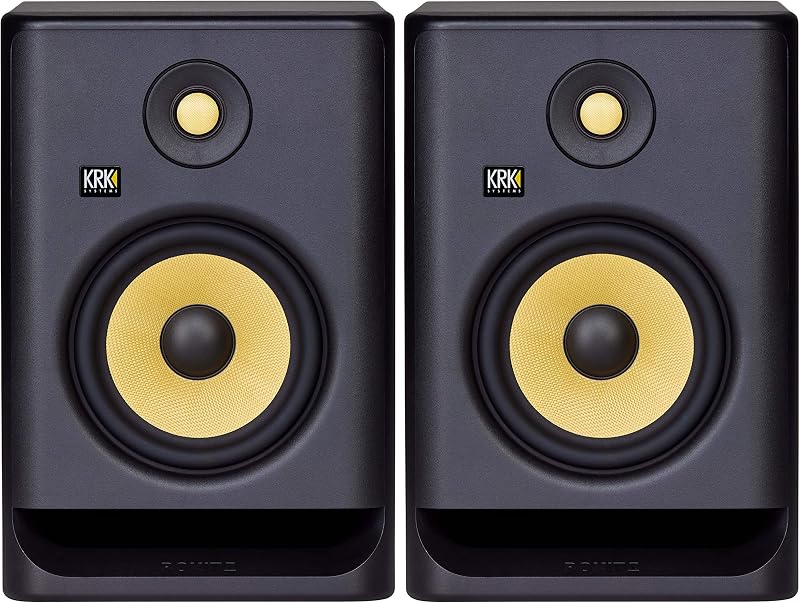
The KRK Rokit 7 G4 Studio Monitor is a bi-amplified active monitor engineered in the United States, built around matching 7-inch woofer and 1-inch tweeter assemblies crafted from Kevlar. Utilizing matching cone materials across both drivers ensures uniform sonic integrity and transient response across the crossover spectrum. Driving these proprietary transducers is an internal Class D power amplifier, which provides high operational efficiency. The rear panel houses a visual LCD screen driven by onboard digital signal processing, giving tracking engineers visual confirmation when selecting equalization curves to compensate for room boundaries and acoustic anomalies.
From a hardware reliability perspective, the krk rokit 7 g4 design mitigates common thermal failure modes found in older active speaker architectures. Operating Class D power stages generates substantially less waste heat than analog designs, preserving internal filter capacitors and sensitive digital processing chips from thermal stress during marathon mix sessions. The enclosure uses a scientifically designed low-resonance structure with Kevlar integration, which limits structural rattling at high volume levels. When executing a thorough krk studio monitor comparison against passive systems or analog competitors such as select jbl monitor speakers, the presence of digital processing provides measurable tuning flexibility without adding outboard hardware.
This monitor pair is best suited for electronic music producers, tracking engineers, and mid-sized commercial control rooms that require deep low-end reproduction down to near-subwoofer territories without mechanical port chuffing. It provides a distinct upgrade over smaller nearfield units that lack low-frequency headroom. However, users who prefer purely tactile rotary potentiometers or work in environments without direct line-of-sight to the rear-facing LCD screen may find navigating the single-encoder menu interface less convenient than standard analog switches.
KRK Classic 7 Powered Two-Way Professional for Analog Workflows

The KRK Classic 7 Powered Two-Way Professional bundle delivers a pair of self-powered 73-watt monitors incorporating custom bi-amped Class A/B amplification. Built on over 30 years of brand development, the Classic line defaults to a flat frequency response profile intended for critical listening and reliable mix translation. For bass-heavy playback and tracking sessions, the rear panel includes an optional switchable +2 dB KRK Bass Boost alongside dedicated low- and high-frequency level adjustment controls. The cabinet incorporates a front-firing acoustic port that vents bass energy forward rather than into rear wall boundaries.
Evaluating this model through an equipment longevity lens reveals a focus on proven analog circuitry. Class A/B amplifiers provide continuous analog headroom and low harmonic distortion, but they produce higher internal heat levels than modern Class D topologies. Maintaining open airflow behind the metal amplifier plate is critical to prevent thermal throttling or adhesive degradation inside the heavy-duty enclosure over years of heavy operation. The inclusion of front-firing ports substantially reduces placement sensitivity, ensuring users with cramped desks do not suffer bass buildup when positioning the cabinets near drywall.
This system suits tracking musicians and post-production editors who prioritize immediate physical controls over digital menus and want a predictable flat monitoring baseline. It excels in untreated rooms where rear boundary proximity makes rear-ported speakers unusable. When conducting a krk rokit vs classic evaluation, the Classic 7 gives way to the Rokit series if your workflow demands surgical multi-band digital filtering or maximum power efficiency inside unventilated studio furniture.
KRK Kreate 3 Powered Studio Monitors for Compact Desktops
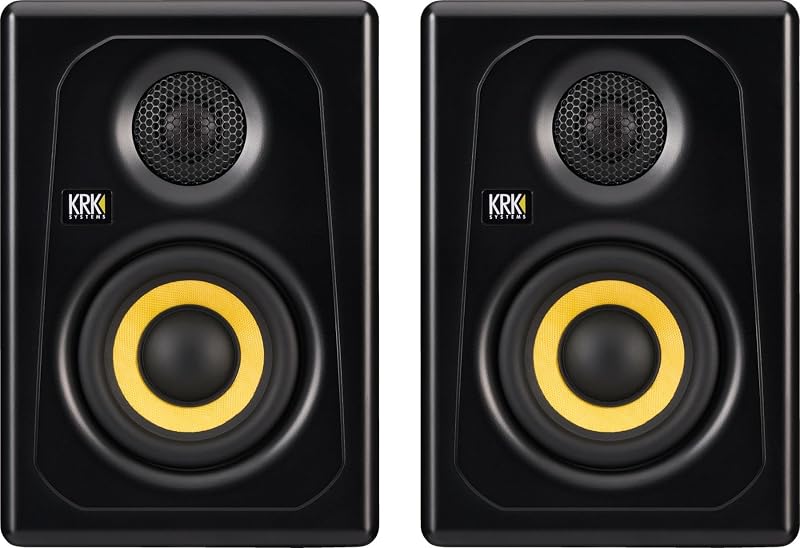
The KRK Kreate 3 Powered Studio Monitors pair pairs a 3.5-inch glass aramid, lightweight woven glass fiber composite woofer with a 1-inch textile dome tweeter. Designed specifically for space-restricted work surfaces, the Kreate 3 incorporates wireless Bluetooth streaming alongside multiple analog input jacks for universal studio connectivity. The textile dome tweeter provides smooth high-frequency dispersion, while the specialized woven cone maintains structural rigidity to output articulate midrange clarity and controlled bass response from a minimal desktop footprint.
Because smaller monitor enclosures concentrate mechanical stress and voice coil heat within tight boundaries, the material selection here plays a protective role. The lightweight woven glass fiber woofer is less prone to cone deformation and environmental humidity changes than conventional paper diaphragms. While the inclusion of Bluetooth circuitry provides convenient consumer-grade reference checks, professional monitoring should rely on the wired analog inputs to prevent the latency and dynamic compression inherent to wireless transmission. The listing does not specify internal amplifier wattage or onboard equalization features, indicating a simplified internal circuit topology.
The krk kreate 3 is tailored for video editors, podcasters, and bedroom beatmakers seeking legendary yellow-cone aesthetics in compact editing bays where standard 7-inch cabinets would overwhelm the desk. It also serves well as a secondary reference monitor for comparing mixes against commercial multimedia setups, contrasting with general entertainment options like a harman kardon bluetooth speaker by maintaining discrete left-right nearfield separation. It naturally yields to larger models like the Rokit 5 or Classic 7 when producing bass-heavy music genres that require monitoring below 60 Hz.
KRK RP5G5 ROKIT 5 Generation Five for Advanced Voicing

The KRK RP5G5 ROKIT 5 Generation Five represents the fifth iteration of the brand’s primary nearfield line, featuring a 5-inch woofer matched to a newly designed 1-inch silk dome tweeter. Amplification is handled by custom-designed Class D power units specifically built to reduce operating temperatures and preserve audio integrity under prolonged duty cycles. The cabinet features a low-diffraction baffle to reduce edge reflections and sharpen stereo imaging, supported by included acoustic foam wedge isolation pads that prevent physical cabinet vibrations from transferring into monitor stands or desk surfaces.
Thermal stability and structural engineering are focal points of the Generation Five design. By integrating low-temperature Class D stages, KRK directly targets the historical failure points of studio monitors—prolonged heat buildup that bakes internal solder joints and dries electrolytic capacitors over time. The integrated DSP system provides three distinct voicing profiles: Mix Mode for flat critical mixing, Create Mode for inspiring writing sessions, and Focus Mode, alongside 25 selectable equalization combinations accessible via app control. The inputs are handled via a locking XLR and 1/4-inch TRS combo jack, providing secure physical connections that resist mechanical cable pull.
This monitor is an optimal selection for project studio owners, audio engineers, and content creators working in small-to-medium treated rooms who want comprehensive acoustic adaptation tools. It ranks among the best krk studio monitors for modern hybrid production environments where flexible sound profiles streamline tracking and mastering stages. However, because this listing represents a single unit rather than a stereo pair, buyers must budget for two units to assemble a functioning production setup.
KRK K5L Kreate 5 Latte Studio for Modern Aesthetics
The KRK K5L Kreate 5 Latte Studio provides a stylized departure from traditional dark studio gear, featuring a distinctive white and latte cabinet finish. Built with a 5-inch (12.7-centimeter) lightweight woven glass fiber composite woofer, this two-way studio monitor focuses on clear midrange reproduction and tight low-end dynamics. The hardware includes dedicated high- and low-frequency level adjustment controls, multiple audio inputs including auxiliary connectivity, and precision limiters engineered directly into the amplifier stage to safeguard drivers against voice coil burnout during sudden signal spikes.
A primary durability advantage of the krk kreate 5 latte lies in its integrated protective features. The precision limiters actively prevent amplifier clipping from reaching the voice coils, protecting against square-wave driver damage when non-mastered project audio spikes unexpectedly. Additionally, the unit comes equipped with a factory-installed foam isolation pad at its base, which provides acoustic decoupling right out of the box to prevent desk resonance without requiring aftermarket riser platforms. While the listing notes a maximum output power of 2 watts and push-button controls, its multi-input panel provides dependable routing flexibility for diverse creative setups.
This monitor fits modern streaming setups, home recording booths, and creative production spaces where equipment styling matters as much as acoustic output. It caters directly to multimedia creators who need quick boundary tuning controls without digging through deep digital menus. For high-SPL tracking rooms or heavy-duty commercial monitoring arrays that demand high continuous acoustic output, heavier Class A/B units or higher-wattage Class D configurations like the Rokit 7 G4 remain the appropriate path.
KRK Classic 7 Powered Two-Way Professional for Modular Arrays
The single-unit listing of the KRK Classic 7 Powered Two-Way Professional is identical in core hardware to its bundled counterpart, offering a 73-watt active bi-amplified platform driven by Class A/B amplification. It houses a 7-inch woofer set inside a durable, heavy-duty plastic and composite enclosure with a front-firing acoustic port. High- and low-frequency rotary adjustment switches allow sound engineers to compensate for wall proximity, while the manual +2 dB Bass Boost setting provides instant access to the punchy, low-end emphasized profile that characterized earlier monitor generations.
Purchasing the krk classic 7 as an individual monitor offers specific practical advantages for long-term studio management and system maintenance. It enables facility operators to replace a damaged channel without purchasing an entirely new stereo pair, or to expand an existing two-channel setup into an uneven surround sound configuration, such as a 5.1 or 7.1 monitoring environment. Unlike live reinforcement gear like mackie powered speakers designed for wide projection, the Classic 7 focuses its bi-amplified analog power on directional nearfield clarity, maintaining consistent phase behavior across its sweet spot.
This individual monitor serves studio operators building custom surround arrays, engineers sourcing a dedicated center channel, or producers seeking a reliable mono reference speaker. It eliminates digital menus in favor of rugged mechanical switchgear that retains its physical settings even after complete power cycles. It steps aside in favor of the RP5G5 or Rokit 7 G4 when studios require app connectivity, digital room correction presets, or reduced thermal generation in tightly enclosed desk setups.
How to Choose the Right KRK Studio Monitors
Selecting the correct model from the KRK monitor catalog requires balancing physical room acoustics, thermal ventilation limitations, and monitoring distance. Deciding which krk studio speakers to buy depends primarily on matching the physical properties of your workspace with the corresponding hardware architecture:
- Amplifier Topology and Thermal Management: Monitors equipped with Class D amplification, such as the Rokit 7 G4 and RP5G5 Rokit 5, run significantly cooler than Class A/B designs like the Classic 7. If your monitors are recessed into workstation bridge shelving or placed in rooms with restricted airflow, Class D reduces thermal stress on internal components, extending overall operating life. Conversely, Class A/B platforms offer reliable analog headroom and simple analog repairs should an electrical surge occur.
- Port Placement and Acoustic Boundary Loading: The Classic 7 features a front-firing bass port, making it vastly superior for placement close to back walls where rear ports would produce uncontrolled low-end resonance and muddy bass response. In contrast, smaller desk-focused units like the Kreate 3 require adequate breathing room to prevent localized boundary loading from artificially skewing low-end mix balance.
- Acoustic Tuning Interface: The Rokit Generation 4 and Generation 5 lines feature advanced DSP with digital displays or app-driven controls, offering up to 25 EQ combinations to flatten room peaks. The Classic 7 and Kreate 5 Latte rely on physical stepped rotary switches or push buttons. Physical switches eliminate software failure modes and retain settings permanently, whereas DSP menus allow surgical corrections for untreated room modes.
- Driver Scale and Listening Distance: A 7-inch woofer, found on the Rokit 7 G4 and Classic 7, requires a listening distance of approximately four to six feet to allow the acoustic waves from the separate woofer and tweeter to integrate smoothly. For compact desks or distances under three feet, 3.5-inch and 5-inch drivers like those on the Kreate 3, RP5G5 Rokit 5, and Kreate 5 Latte prevent phase cancellation at the listening position while avoiding excess room excitation.
FAQ
What is the functional difference between KRK Rokit and Classic monitors?
The primary difference lies in their internal amplifier design, acoustic porting, and room correction technology. Rokit models utilize efficient Class D power amplifiers paired with onboard digital signal processing (DSP) for precision acoustic tuning through an LCD screen or app. Classic models rely on traditional Class A/B analog amplifiers, physical rotary switches for high and low frequency adjustments, and front-firing acoustic ports that simplify placement near studio walls.
Do Class A/B amplifiers make the KRK Classic 7 run hot?
Yes, Class A/B amplifiers naturally generate more waste heat than Class D designs because their output transistors operate continuously across a wider conduction angle. The rear metal plate of the Classic 7 acts as a passive heatsink to dissipate this energy. While this elevated temperature is normal during sustained operation, users must maintain at least a few inches of open clearance behind the speaker to ensure passive convection airflow and prevent heat-related component aging.
Why do the Rokit 5 Gen 5 and Kreate 5 include foam isolation pads?
Both models include acoustic foam padding—either as modular wedge inserts or factory-installed base layers—to decouple the speaker cabinet mechanically from the supporting surface. When an active monitor rests directly on a wooden desk, cabinet vibrations transfer into the furniture, causing resonance that falsely exaggerates low-mid frequencies. Decoupling ensures that what you hear comes strictly from the driver cones rather than vibrating desk surfaces.
Can Bluetooth on the KRK Kreate 3 be used for critical audio mixing?
Bluetooth is intended for consumer reference checks, media consumption, and casual playback rather than critical mixing or mastering. Wireless audio transmission introduces data compression and latency that can obscure fine equalization details and misalign vocal synchronization during tracking. For professional recording and mix evaluation, always connect the Kreate 3 using balanced or unbalanced physical audio cables.
Are Kevlar drivers more durable than glass fiber composite cones?
Kevlar and woven glass fiber composites both offer superior structural rigidity and tear resistance compared to traditional treated paper cones. Kevlar exhibits higher tensile strength and resistance to thermal expansion under continuous high-excursion demands, which helps maintain consistent driver geometry over years of intense use. Woven glass fiber composites provide a lightweight alternative that delivers excellent transient snap and reliable durability in nearfield studio applications.


