


As Amazon Associates, we earn from qualifying purchases. This means we may receive a small commission at no extra cost to you if you click through and make a purchase.
Kodak remains an iconic touchstone in consumer imaging, maintaining a historical reputation for democratizing photography through accessible emulsions and straightforward hardware. In the modern analog revival, the brand occupies a critical niche by offering point-and-shoot 35mm film equipment that bridges the gap between intimidating, vintage mechanical hardware and the ephemeral convenience of digital smartphones. These compact cameras provide accessible entry points for amateur film enthusiasts, party documentarians, and travel hobbyists who prioritize the nostalgic tactile feedback of silver halide photography over manual shutter-and-aperture calculations.
While sharing the recognizable brand styling, these four models diverge sharply in optical configuration, mechanical frame advancement, film yield, and long-term reusability. Understanding how motorized full-frame chassis, manual half-frame advance mechanisms, and pre-wound single-use assemblies differ is essential for selecting the right hardware and avoiding the frustration of damaged negatives or compromised exposures.
Kodak 35mm Film Cameras Compared
| Model | Optical Design | Frame Format | Flash System | Winding Mechanism |
|---|---|---|---|---|
| KODAK Snapic A1 35mm Film Camera (Rhino Grey) | 3-Element Glass Lens | Full Frame (35mm) | Built-in Auto Flash with Red-Eye Reduction | Automatic Motor Wind and Rewind |
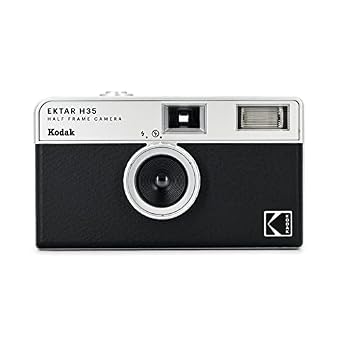
| Kodak EKTAR H35 Half Frame Film | Focus-Free (Not listed) | Half Frame (35mm) | Built-in Flash (Lens Ring Activation) | Manual Thumbwheel Advance |
| KODAK Snapic A1 35mm Film Camera (Ivory White Bundle) | 3-Element Glass Lens | Full Frame (35mm) | Built-in Auto Flash with Red-Eye Reduction | Automatic Motor Wind and Rewind |
| Kodak Funsaver One Time Use Film | Not listed | Full Frame (35mm) | Manual Flash (4 to 11.5 ft Range) | Pre-wound Reverse Thumbwheel |
KODAK Snapic A1 35mm Film Camera for Creative Double Exposures

Best for: Beginners wanting an immediate ready-to-shoot bundle
Pros
- Includes Ultramax 400 film roll
- Sharp 3-element glass lens
- Automated film handling
Cons
- AAA battery not included
- Fixed shutter speed limit

Best for: Creative shooters wanting full-frame glass optics
Pros
- 3-element glass lens
- Motorized auto advance and rewind
- Multiple exposure shooting mode
Cons
- Requires fresh AAA batteries
- Film not included in box
The KODAK Snapic A1 35mm Film Camera in Rhino Grey represents a significant departure from rudimentary toy cameras by incorporating a refined 3-element glass lens rather than a basic single-element plastic optic. Designed around standard 35mm film cassettes, this full-frame model incorporates a dedicated two-zone focus toggle, enabling photographers to switch optical distance quickly to ensure crisper subjects across differing scenes. The camera integrates an optical viewfinder, a fixed maximum shutter speed of 1/100 second, and an automatic exposure control system paired with a built-in auto flash featuring red-eye reduction. For experimental analog artists, it features a specialized multiple exposure switch, allowing intentional layering of two separate scenes directly onto one frame. Evaluating this camera alongside classic compact snapshot tools, as seen in our kodak small camera guide, highlights how physical lens design and physical transport systems dictate analog usability.
From an engineering and reliability perspective, the motor-driven transport system of this kodak snapic a1 35mm film camera resolves one of the most common failure points found in consumer analog photography: uneven frame spacing and torn sprocket holes caused by jerky manual thumb advances. The internal motor precisely meters the film pitch across the gate and automates the rewind sequence, protecting the latent images inside the cassette once the roll concludes. However, mechanical automation introduces dependency on battery power. The camera requires a fresh AAA battery, which is not included in the retail packaging, to drive both the motorized winding mechanism and the built-in flash capacitor. If the battery lacks sufficient voltage, the motorized cycle may stall mid-roll, creating a mechanical interruption that necessitates careful handling in a darkroom or changing bag to avoid exposing sensitive emulsion.
This model is best suited for casual photographers and creative hobbyists who prioritize cleaner glass optics and the artistic potential of double exposures over ultra-lightweight minimalism. It serves as a dependable tool for everyday personal documentation and environmental portraits where 1/100 second shutter speeds suffice. Photographers who prefer purely mechanical manual operation or those seeking to cut film costs in half by doubling their shot counts per roll will find a more suitable match in the brand’s half-frame offerings.
Kodak EKTAR H35 Half Frame Film for Economical Roll Splitting

Best for: Budget-minded photographers maximizing frame count
Pros
- Doubles exposures per roll
- Lightweight pocket-friendly chassis
- Tactile manual flash ring
Cons
- Plastic focus-free optic
- Manual winding requires gentle handling
The Kodak EKTAR H35 Half Frame Film camera approaches everyday photography through an economic and compositional lens by splitting standard 35mm negative frames in half. Through this half-frame layout, a standard 36-exposure film canister produces approximately 72 vertical-format photographs, effectively doubling the frame capacity of every loaded roll. The chassis is exceptionally lightweight and pocket-sized, finished in black with a clean retro appearance, and is engineered for beginner-friendly operation with a focus-free optical setup. The camera incorporates an optical viewfinder with 1.0x magnification, an automatic exposure system, and a maximum shutter speed rated in listing specifications between 1/250 and 1/500 second, paired with an ISO light sensitivity range spanning 100 to 400. Lighting assistance comes via an integrated flash unit activated mechanically by rotating the silver ring positioned around the perimeter of the lens barrel.
Regarding mechanical build durability and long-term film transport reliability, this model relies entirely on a tactile manual thumbwheel and a physical release button on the baseplate for rewinding. Without an internal motor, the tactile feedback of the advance wheel directly signals the tension of the film inside the light-tight gate. The primary mechanical risk with this manual setup involves user over-rotation: when the roll reaches its end, forcing the plastic thumbwheel past normal resistance can snap fragile film sprocket perforations or dislodge internal plastic gearing. Operating this camera requires a disciplined, gentle touch when advancing the frame to the next locked position. Furthermore, the silver flash control ring is fully manual; leaving it engaged will continuously drain the single AAA battery needed to charge the flash capacitor, even when shooting in broad daylight.
This half-frame unit is ideal for students, visual diarists, and budget-conscious street shooters who want to stretch their photographic yield amid rising film production and lab development costs. Its native vertical composition encourages diptych storytelling and creative sequential imagery. However, those who require full-frame negative resolution for large fine-art enlargements, or who prefer glass optical assemblies over focus-free plastic lenses, should bypass this model in favor of the Snapic A1.
KODAK Snapic A1 35mm Film Camera for Out-of-the-Box Shooting
Offering a complete starting package, this Ivory White version of the KODAK Snapic A1 35mm Film Camera pairs the full-frame reusable body directly with a 24-exposure roll of Kodak Ultramax 400 color negative film. The hardware shares the robust technical foundation of the standalone Snapic line, showcasing a 3-element glass lens configured to capture enhanced sharpness, edge definition, and optical detail compared to single-element acrylic designs. The camera features two-zone manual focus switching, built-in automatic flash with red-eye reduction, automatic exposure control, an optical viewfinder, and a maximum shutter speed of 1/100 second. The chassis also retains the specialized multiple exposure switch, allowing users to layer two scenes onto a single frame without manually manipulating the winding spool. Tracing the trajectory of accessible Kodak snapshot hardware back to compact point-and-shoots, such as the digital sensor technology analyzed in the Kodak EasyShare 14 megapixels review, underscores how consumer cameras balance automated convenience against physical simplicity.
The operational core of this bundled model centers on automated film handling, incorporating motorized auto-wind and auto-rewind mechanics that eliminate the anxiety of manual leader loading. When a new roll is inserted, the internal drive tensions the leader and indexes the first frame accurately, reducing the likelihood of loose spool winding that can cause frame overlap or internal light leaks. The bundled Ultramax 400 film provides a forgiving latitude that pairs well with the fixed 1/100 shutter speed and automatic flash metering. Potential operational bottlenecks remain tied to electrical power: the bundle does not supply the required AAA battery. Utilizing low-drain or exhausted batteries can lead to sluggish winding, extended flash recharge cycles, or an uncompleted rewind cycle that traps the exposed film against the pressure plate until fresh power is introduced.
This bundled configuration is tailored specifically for beginners, gift recipients, and travel snapshot shooters who want a verified, compatible film stock included from day one. It eliminates the guesswork of matching film sensitivities to the camera’s shutter characteristics right out of the box. Conversely, experienced film hobbyists who maintain dedicated inventories of specific emulsion types or who require full control over shutter duration will find the fixed automation restrictive.
Kodak Funsaver One Time Use Film for Carefree Event Documentation

Best for: Casual events and low-maintenance party snapshots
Pros
- Fast ISO 800 film included
- Light-safe reverse winding design
- Convenient two-pack bundle
Cons
- Single-use plastic disposal
- Manual flash charging required
The Kodak Funsaver One Time Use Film camera comes as a practical two-pack bundle, offering an accessible, throw-in-the-bag option for environments where expensive equipment faces risk of damage or loss. Each single-use unit arrives pre-loaded from the factory with a 27-exposure cassette of Kodak 800 speed color film, providing high light sensitivity capable of rendering vivid colors across mixed indoor and outdoor settings. Optical framing is handled through a clear optical viewing window, while exposures are regulated by an automatic exposure control mechanism and a focal plane shutter. An integrated manual flash system offers an effective working range of 4 to 11.5 feet, which listing specifications highlight must be charged manually via a spring-loaded push button prior to releasing every shutter frame.
In terms of internal mechanical design, the Funsaver utilizes an inverted pre-wound film transport architecture that offers unexpected reliability advantages. Inside the sealed plastic chassis, the unexposed film roll is entirely wound out of its metal cassette onto an auxiliary internal spool during manufacturing. As the user advances the plastic thumbwheel after each shot, the exposed film is drawn backward into the light-tight metal cassette. Consequently, if the outer housing cracks, drops on pavement, or splits open accidentally, the previously captured frames remain safely shielded inside the metal cartridge. The primary user limitation lies in the manual flash system: the internal capacitor must be intentionally pressed and held until the ready indicator illuminates. Failing to charge the flash in dim ambient conditions results in severely underexposed frames due to the fixed, narrow aperture. Readers exploring the distinctions between disposable and reusable chassis can find broader context in our kodak disposable camera comparison.
The Funsaver is built for beach outings, music festivals, weddings, and rugged outdoor adventures where dust, moisture, sand, or rough physical handling would ruin a precision reusable camera. It provides reliable snapshot utility with zero maintenance or initial battery loading. Nevertheless, it gives way to reusable hardware like the Snapic A1 or Ektar H35 for long-term analog projects, where repetitive disposable purchases generate excessive plastic waste and high recurring costs.
How to Choose the Right Kodak 35mm Film Cameras
Selecting between the diverse options in the modern Kodak analog catalog requires matching your shooting habits, tolerance for plastic mechanical wear, and overall film expenditure against specific mechanical designs. Determining which kodak 35mm camera to buy comes down to evaluating frame format, optical quality, transport mechanisms, and long-term reusability.
- Frame Format and Film Economy: Deciding between full-frame and half-frame architecture represents a primary operational crossroad. Full-frame cameras like the KODAK Snapic A1 expose standard 24x36mm negative areas, preserving the complete resolution and classic aspect ratio expected from 35mm film. In contrast, the Kodak EKTAR H35 utilizes a half-frame mechanism that splits the negative gate to yield double the frames per roll. For photographers facing high film acquisition and processing costs, half-frame operation slashes per-frame expenses in half, though at the trade-off of smaller negative size and vertical orientation.
- Optical Quality and Lens Elements: Lens construction directly influences contrast, edge sharpness, and optical distortion. The KODAK Snapic A1 models stand out by utilizing a 3-element glass lens assembly paired with a 2-zone focusing switch, offering noticeably cleaner subject separation than typical acrylic snapshot lenses. The EKTAR H35 and Funsaver models utilize fixed, focus-free single-element configurations, designed to keep everything reasonably sharp from several feet to infinity through deep depth of field, though with softer perimeter rendition.
- Film Winding and Transport Reliability: Mechanical film winding represents the most common failure point across consumer analog cameras. Motorized mechanisms, such as the automatic advance and rewind integrated into the Snapic A1, eliminate operator error, prevent jerky transport, and protect film sprockets from tearing. However, motors require steady voltage from AAA batteries. Manual thumbwheel models, including the EKTAR H35 and Funsaver, operate independently of motor failures, but require a gentle user touch to avoid snapping film perforations when reaching the physical end of a roll.
- Flash Integration and Power Management: Flash architecture dictates low-light usability. The Snapic A1 provides an automated flash circuit with red-eye reduction that triggers when ambient light drops. The EKTAR H35 requires manual engagement via a rotating silver ring around the lens barrel, demanding user diligence to deactivate the circuit to prevent battery drain. The Funsaver uses a manual charging button that must be held down before every shot, which provides dependable illumination within its 4 to 11.5-foot range but risks underexposed frames if the user fires prematurely.
- Reusability Versus Disposable Durability: Reusable chassis represent a sustainable, long-term investment for ongoing personal photography, enabling users to experiment with diverse film stocks, speeds, and processing methods. Single-use cameras like the Kodak Funsaver, while environmentally inefficient for routine shooting, provide exceptional durability in harsh, sandy, or wet conditions where risking a reusable camera body is impractical.
FAQ
Can the Kodak Funsaver be reloaded with fresh 35mm film?
The Kodak Funsaver is engineered strictly as a single-use camera and is not designed for consumer reloading. When the roll concludes, the entire camera unit must be submitted to a photo lab, where technicians break open the sealed plastic outer casing to retrieve the internal film canister. While some hobbyists attempt to disassemble disposable housings in darkrooms, the internal clips, plastic winding teeth, and exposed electrical flash components are not built for repeated cycling and present an electrical shock hazard from the capacitor.
How does Kodak half frame differ from full frame 35mm photography?
A full-frame 35mm camera exposes a standard negative area measuring approximately 24x36mm in a horizontal landscape orientation. A half-frame camera, such as the Kodak EKTAR H35, exposes an image area measuring approximately 17x24mm in a vertical portrait orientation. Because each shot consumes half the standard negative width, a regular 36-exposure film canister produces approximately 72 distinct half-frame images, dramatically lowering the cost per photograph while naturally producing vertical compositions.
What should I do if the manual thumbwheel on a Kodak 35mm camera resists turning?
When the manual thumbwheel on a reusable camera resists turning, you have reached the physical end of the film roll. Forcing the wheel past this mechanical stop risks tearing the film sprocket holes or stripping the camera’s internal plastic gears. Instead of pushing past the resistance, press the small film release button located on the bottom plate of the camera chassis, then fold out the rewind crank and turn it clockwise until tension releases and the film is safely pulled back into the metal canister.
Does the Kodak Snapic A1 require batteries to operate the shutter?
The KODAK Snapic A1 relies on AAA battery power to operate its internal electronic subsystems, including the motorized film advance, auto-rewind mechanism, and built-in auto flash unit. Because exposure control and film transport are automated rather than purely mechanical, maintaining fresh AAA batteries is essential to ensure the camera cycles reliably and does not stall mid-roll.
Which film speed works best with the Kodak Ektar H35 and Snapic A1?
The Kodak EKTAR H35 operates within an ISO range of 100 to 400, making ISO 400 film the most versatile choice for general outdoor daylight and indoor flash photography. The KODAK Snapic A1 is optimized for ISO 400+ sensitivity, as demonstrated by the manufacturer bundling it with Kodak Ultramax 400. Using 400-speed film provides sufficient exposure latitude to accommodate the fixed 1/100 second shutter speed across varied daylight conditions.


