


As Amazon Associates, we earn from qualifying purchases. This means we may receive a small commission at no extra cost to you if you click through and make a purchase.
Olympus has built an enduring reputation in the Micro Four Thirds system by engineering compact optics that do not compromise on glass quality or barrel integrity. For photographers navigating landscape, architecture, astrophotography, and street scenes, choosing an olympus wide angle lens micro four thirds setup requires balancing physical durability against optical flexibility. Micro Four Thirds sensors impose unique optical demands on wide-angle designs, making barrel construction, coating effectiveness, and focus mechanisms critical factors for long-term ownership.
The three lenses in this comparison diverge significantly in mechanical operation, optical purpose, and environmental resilience, spanning a specialized f/2.0 prime with a mechanical snap-focus ring, a rugged f/2.8 ultra-wide zoom with extensive weather sealing, and an ultra-compact pancake prime designed for unobtrusive everyday shooting.
Olympus Wide-Angle Lenses Compared
| Model | Optical Design | Focal Length (35mm Eq.) | Angle of View | Durability & Sealing |
|---|---|---|---|---|
| OM SYSTEM Olympus M.Zuiko Digital ED 12mm F2.0 | Prime | 12mm (24mm) | 84 degrees | Full metal body; weather sealing not listed |
| Om SYSTEM Olympus M.Zuiko Digital ED 7-14mm F2.8 Pro | Zoom | 7-14mm (14-28mm) | 114 to 75 degrees | Splash and dustproof construction |
| Olympus M.Zuiko 17mm f 2.8 Lens | Pancake Prime | 17mm (34mm) | 64.9 degrees | Compact pancake; weather sealing not listed |
OM SYSTEM Olympus M.Zuiko Digital ED for Low-Light Landscapes

Best for: Harsh weather landscapes and architectural fieldwork
Pros
- Splash and dustproof construction
- 114-degree ultra-wide view
- Manual focus clutch mechanism
- Advanced ED optical elements
Cons
- Heavier zoom barrel
- More complex optical design

Best for: Low-light astrophotography and street shooting
Pros
- Fast f/2.0 aperture
- Full metal body
- Snap ring distance indicator
Cons
- No weather sealing listed
- Single fixed focal length
The OM SYSTEM Olympus M.Zuiko Digital ED 12mm f/2.0 is a dedicated wide-angle prime built specifically for scenarios demanding high light gathering and precise manual control. Featuring an 84-degree real angle of view and a 35mm-equivalent focal length of 24mm, this lens caters directly to astrophotographers, night-sky shooters, and landscape artists. The optical formula utilizes Olympus ZERO Coating to reduce internal surface reflections, flare, and ghosting when pointing directly toward bright illumination. Digital image stabilization compatibility ensures clean handheld captures when paired with stabilized camera bodies, while the bright f/2.0 aperture allows photographers to keep sensor sensitivity low in dim environments.
From an advocate’s perspective on hardware longevity, the physical build of the olympus m.zuiko digital ed 12mm f2.0 stands out through its full metal body. Unlike composite plastics that can crack or warp under temperature swings, the machined metal chassis provides structural rigidity. The critical mechanical component on this lens is the snap-focus ring, which slides backward toward the camera body to reveal a physical distance indicator and enable pan focusing. This mechanical engagement gives photographers repeatable manual focus stops, which is invaluable for nighttime infinity focusing. However, mechanical clutch collars require sensible handling: without listed environmental gaskets, abrasive dust or moisture accumulating around the sliding collar can affect the smooth travel of the focus ring over years of heavy use. Much like inspecting mobile rigging such as a freewell iphone lens adapter for thread wear, monitoring mechanical focus rings prevents unexpected field friction.
This optic is best suited for night-sky shooters, architectural documentarians, and street photographers who demand a fast maximum aperture in a compact metal shell. It provides superior low-light gathering compared to slower zoom options. However, where it gives way to other models in the lineup is environmental protection: because the listing does not specify splashproof or dustproof sealing, outdoor photographers working in continuous rain or blowing sand will find safer operational security with the fully sealed Pro zoom series.
Om SYSTEM Olympus M.Zuiko Digital ED for Weather-Sealed Fieldwork
Engineered as an ultra-wide professional workhorse, the Om SYSTEM Olympus M.Zuiko Digital ED 7-14mm F2.8 Pro covers an expansive focal range equivalent to 14-28mm in full-frame terminology. The lens commands an extreme angle of view ranging from 114 degrees at the wide end to 75 degrees at 14mm, allowing dramatic perspectives in tight interiors or sweeping landscapes. The optical array is notably complex, incorporating 3 Super ED lens elements, 1 ED lens element, and 2 additional elements dedicated to diminishing chromatic and spherical aberrations. Olympus applies its proprietary ZERO Coating across optical surfaces to preserve contrast under extreme backlight, and the constant f/2.8 maximum aperture remains uniform across the entire 2.0x zoom range.
For cautious buyers focused on m.zuiko wide angle durability, this optic offers the highest level of environmental defense in the wide lineup. The listing confirms a dedicated splash and dustproof construction, safeguarding sensitive internal glass groups and electronics against foul weather. It features a manual focus Clutch Mechanism for rapid transitions between autofocus and tactile manual control, alongside an assignable L-Fn function button on the barrel for customizable camera operations. The lens also achieves an impressively close focusing distance of just under 7.5 centimeters with a 0.12x maximum magnification, allowing dramatic near-macro wide perspectives. Even with this optical density, the lens maintains a form factor that is approximately 60 percent of the weight of a 35mm full-frame lens providing identical coverage and speed. Evaluating wide perspectives across such a broad frame provides visual expansiveness reminiscent of working across a samsung ultra wide display.
The om system olympus m.zuiko digital ed 7-14mm f2.8 pro is the definitive choice for rugged outdoor landscape photographers, commercial interior shooters, and expedition workers operating in wet or dusty climates. Its heavy-duty sealing and optical correction justify its place in demanding professional bags. It gives way, however, to the primes when minimal weight, pocketability, or maximum wide aperture are the governing priorities, as both the 12mm and 17mm primes occupy significantly less physical space.
Olympus M.Zuiko 17mm f 2.8 Lens for Compact Everyday Shooting
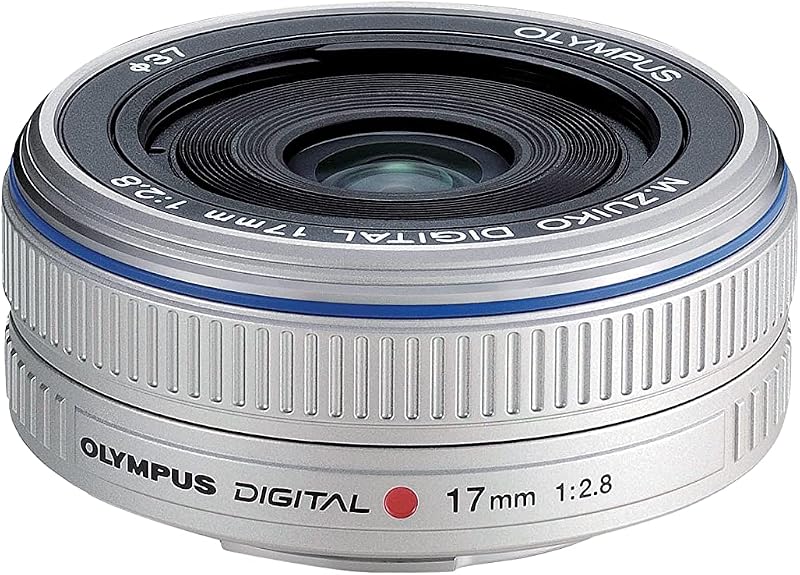
Best for: Discreet everyday carry and lightweight travel
Pros
- Slim 22.5mm pancake profile
- ZERO coating anti-reflection
- Natural 34mm equivalent view
Cons
- Micromotor autofocus drive
- No environmental weather sealing
The Olympus M.Zuiko 17mm f 2.8 Lens is built entirely around portability, minimalism, and discreet operation. Designed as a pancake-type prime, the lens measures an exceptionally slim 22.5mm in overall length, allowing a Micro Four Thirds body to slip easily into a jacket pocket or small daypack. With a focal length equivalent to 34mm on a 35mm camera, it provides a natural 64.9-degree angle of view that closely approximates classical documentary perspectives. The f/2.8 maximum aperture affords solid low-light capability while maintaining the tiny dimensions of the barrel, and ZERO Coating is utilized to suppress flare across digital sensor surfaces.
When assessing long-term mechanical reliability, the trade-offs of the pancake form factor must be understood. To maintain its 22.5mm profile, this 17mm lens relies on a micromotor focus drive rather than the complex sliding focus clutches found on larger Olympus glass. Micromotor systems are lightweight and practical for general autofocus, but they lack physical manual focus distance scales and depend entirely on focus-by-wire electronic operation. While heavy cinema designs like a sirui anamorphic lens employ heavy brass helicoids for manual control, this pancake optic minimizes moving mass to protect internal micromotor gears from strain during everyday use. Because environmental sealing is not listed for this model, owners should protect the extending inner barrel from moisture and fine grit.
This pancake prime suits street photographers, casual travelers, and daily documentarians who require an unobtrusive, lightweight setup for street shooting, landscapes, portraits, and close-ups. It excels when discretion and pocket carry are essential. However, it concedes ground to the 12mm f/2.0 in light gathering and edge-to-edge optical complexity, and yields completely to the 7-14mm Pro when extreme wide-angle framing or heavy weather resistance is required.
How to Choose the Right Olympus Wide-Angle Lenses
Selecting the best olympus mft wide angle lens requires an objective evaluation of your shooting environments, optical framing requirements, and mechanical expectations. A thorough olympus wide angle lens comparison reveals that these three models do not merely differ in focal length; they represent three distinct mechanical design philosophies ranging from ultra-compact everyday glass to sealed professional field instruments.
Focal length and field of view represent the primary operational divide. Shooters deciding which olympus wide angle lens to buy must assess whether their compositions demand the radical 114-degree perspective of the 7-14mm zoom, the expansive 84-degree sweep of the 12mm prime, or the moderate 64.9-degree documentary perspective of the 17mm pancake. The 7-14mm allows dramatic perspective distortion, making foreground subjects loom large against sweeping backgrounds. The 12mm captures broad vistas and starry skies without excessive edge stretching, while the 17mm produces a natural field of view ideal for environmental portraits, street scenes, and everyday travel documentation.
Environmental sealing and barrel durability represent critical reliability considerations. If your assignments involve coastal salt spray, mountain rainstorms, or dusty desert environments, the weather sealed olympus wide angle 7-14mm Pro lens is the only model among these three with listed splashproof and dustproof construction. Its sealed barrel prevents moisture ingress that can lead to internal fungus or ruined electronic aperture motors. By contrast, the 12mm offers exceptional physical rigidity via its full metal body and snap ring, but lacks certified weather gaskets, requiring protective rain covers in foul weather. The 17mm pancake is unsealed and features an extending inner barrel, making it strictly a dry-weather or protected-carry lens.
Mechanical focus drives and maximum apertures define low-light and astrophotography performance. The 12mm f/2.0 prime is the speed leader here, gathering a full stop more light than the f/2.8 alternatives. This makes it the superior choice for handheld night shooting and clean astrophotography without trailing stars. Additionally, its physical snap ring provides a true mechanical focus feel with a visible distance scale, allowing quick zone focusing on the street. The 7-14mm zoom features a manual focus clutch and an assignable L-Fn button for rapid tactical control in the field, while the 17mm pancake uses a simpler micromotor drive that prioritizes featherweight carry over tactile manual feedback.
FAQ
Which Olympus wide-angle lens offers certified weather sealing?
Among the three models discussed, only the Om SYSTEM Olympus M.Zuiko Digital ED 7-14mm F2.8 Pro features listed splash and dustproof construction. The 12mm f/2.0 and 17mm f/2.8 listings do not specify environmental weather seals, so they require external rain protection when used in damp or dusty conditions.
What is the benefit of the manual focus clutch mechanism?
The manual focus clutch mechanism found on the 7-14mm Pro and the snap ring on the 12mm f/2.0 allow photographers to switch instantly between autofocus and tactile manual focus by sliding the focus ring backward. This engages a mechanical feel and, on the 12mm, reveals a distance indicator scale that simplifies pan focusing and hyperfocal distance setting.
How does the 17mm f/2.8 compare in physical size to the other lenses?
The Olympus M.Zuiko 17mm f/2.8 is an ultra-compact pancake lens with an overall length of just 22.5 millimeters. It is substantially smaller and lighter than both the full-metal 12mm f/2.0 prime and the complex 7-14mm f/2.8 Pro zoom, making it the most discreet choice for pocket travel.
What role does ZERO Coating play on these wide-angle optics?
All three lenses feature Olympus ZERO Coating, an optical surface treatment designed to minimize reflections, ghosting, and flare. Wide-angle lenses frequently include the sun, streetlamps, or bright sky within their broad angles of view, and ZERO Coating helps preserve contrast and color saturation under challenging backlighting.
Can these lenses be mounted on any Micro Four Thirds camera body?
Yes. All three lenses utilize the standard Micro Four Thirds mount and are fully compatible with any camera body adhering to the Micro Four Thirds standard, supporting digital communication for autofocus, aperture control, and digital image stabilization.


