




As Amazon Associates, we earn from qualifying purchases. This means we may receive a small commission at no extra cost to you if you click through and make a purchase.
Modern unmanned aerial vehicles rely heavily on automated collision avoidance to protect both hardware investments and bystanders on the ground. DJI has earned a dominant industry reputation by engineering multi-sensor safety arrays that combine stereoscopic optical cameras, time-of-flight rangefinders, and laser-guided radar modules. However, real-world crash statistics demonstrate that sensor coverage is rarely foolproof. Factors such as direct sunlight glare, optical blind spots during lateral maneuvers, and low-contrast obstacles like power lines or bare tree branches continue to challenge flight controllers. Evaluating dji drones with obstacle avoidance requires looking past basic marketing claims to understand sensor refresh rates, low-light thresholds, and how automated failsafes behave when GPS links deteriorate.
While premium commercial airframes like the Mavic and Air series incorporate forward-facing LiDAR modules and omnidirectional vision systems capable of navigating dense environments after dusk, the ultra-light Mini lineup balances optical coverage against strict regulatory weight thresholds, and budget-oriented models forgo directional anti-collision sensors entirely in favor of basic altitude holding and satellite return-to-home protocols.
DJI Drones Compared
| Model | Obstacle Sensing System | Camera & Video Specs | Flight Time & Range | Remote Controller |
|---|---|---|---|---|
| DJI Mini 5 Pro Fly More | Nightscape Omnidirectional (Forward LiDAR + Vision) | 1-Inch CMOS, 50MP, 4K/60fps HDR | Up to 52 minutes, Range not listed | DJI RC 2 (Screen Integrated) |
| DJI Mavic 4 Pro Triple Camera | 0.1-Lux Nightscape Omnidirectional | 100MP 4/3 CMOS Hasselblad + Dual Tele, 6K/60fps HDR | 51 minutes, 30 km (41 km listed) | DJI RC 2 (Screen Integrated) |
| DJI Mini 4 Pro Fly More | Omnidirectional Vision Sensing | 48MP, 4K/60fps HDR | Up to 102 minutes (3 batteries), 20 km | DJI RC 2 (Screen Integrated) |
| DJI Mini 4K Camera Drone Combo | Not listed (Downwards/GPS hover only) | 12MP CMOS, 4K UHD | 31 minutes (62 mins combo), 10 km | Standard Remote Control |
| DJI Air 3S Fly More Combo | Nightscape Omnidirectional (Forward LiDAR + Vision) | 1-Inch CMOS Primary, 50MP, 4K/60fps HDR | 45 minutes, 20 km | DJI RC 2 (Screen Integrated) |
| DJI Neo 2 Fly More Combo | Omnidirectional Obstacle Sensing | 12MP CMOS, 4K Video | Not listed, 10 km | DJI RC-N3 (Requires Smartphone) |
DJI Mini 5 Pro Fly More for Low-Light Exploration

Best for: Low-light creators needing compact safety
Pros
- Nightscape LiDAR sensing
- 1-inch CMOS sensor
- 52-minute flight time
Cons
- App requires manual Android sideloading
The DJI Mini 5 Pro Fly More integrates high-end collision safeguards into an ultra-portable airframe. The craft features a 1-inch CMOS image sensor capable of recording 4K/60fps HDR video alongside 50MP still captures. For autonomous navigation, this model introduces Nightscape omnidirectional obstacle sensing, combining wide-angle vision cameras with a dedicated forward-facing LiDAR sensor. This hybrid configuration addresses a classic vulnerability of optical-only systems, which typically fail once ambient illumination drops below the working threshold of camera-based detection arrays.
Safety during complex tracking maneuvers is governed by an upgraded ActiveTrack 360 system designed to maintain subject lock during dynamic outdoor activities like cycling. The hardware package includes the DJI RC 2 controller with a built-in screen, three Intelligent Flight Battery Plus units offering up to 52 minutes of flight each, and 42GB of internal high-speed storage. The listing specifies a 225-degree flexible gimbal rotation with true vertical shooting capabilities, eliminating software-cropped framing for portrait deliverables. A multi-battery charging hub powers three packs sequentially in approximately 193 minutes.
From an operational reliability perspective, prospective buyers should recognize platform constraints noted directly on the retail listing. The companion DJI Fly application is not hosted on Google Play due to platform compatibility limitations, requiring Android users to download installation packages directly from the official manufacturer portal. While the forward LiDAR bolsters obstacle detection during evening flights and automated return-to-home routines, lateral and rear detection pathways still rely predominantly on visual sensors, meaning pilots must maintain manual vigilance when drifting sideways through wooded corridors.
DJI Mavic 4 Pro Triple Camera for Flagship Commercial Operations

Best for: Professional filmmakers demanding triple lenses
Pros
- 100MP triple camera system
- 1-Lux night obstacle sensing
- 360-degree infinity gimbal
Cons
- Heavier commercial airframe
The DJI Mavic 4 Pro Triple Camera represents an uncompromising aerial imaging platform engineered for professional content creators, surveying tasks, and high-altitude inspections. The central imaging module consists of a 100MP 4/3 CMOS Hasselblad camera capturing up to 6K/60fps HDR footage, supplemented by two secondary telephoto lenses for progressive optical compression. This package includes an authorized full USA warranty paired with a 2-year CPS extended warranty bundle, mitigating catastrophic financial risks associated with field equipment failures.
Flight protection relies on a 0.1-Lux Nightscape obstacle sensing array calibrated to map solid terrain and structures under minimal ambient lighting. When compared across an enterprise-grade dji drone mavic lineup, the platform stands out for spatial tracking resilience. Its O4+ video transmission protocol delivers a stable 10-bit HDR video feed over ranges specified up to 30 km (with an extended theoretical range of 41 km under clean interference profiles). Gimbal movement is managed through a specialized Infinity Gimbal design that allows full 360-degree rotation, enabling dynamic Dutch angles and continuous tracking through an upgraded ActiveTrack 360 engine.
With an operational ceiling backed by a 51-minute maximum flight time, the craft incorporates 64GB of onboard memory to prevent data stalls during high-bitrate RAW capture workflows. The Fly More combo bundle equips operators with the DJI RC 2 remote, three flight batteries, four pairs of low-noise propellers, a 100W USB-C power adapter, and a parallel charging hub. Despite the high-precision 0.1-lux rating, users must note that water bodies, reflective architectural glass, and slender cables fall outside the predictable return signatures of visual sensing matrices, necessitating physical visual line-of-sight compliance.
DJI Mini 4 Pro Fly More for Sub-249g Autonomous Tracking

Best for: Travelers seeking sub-249g autonomous tracking
Pros
- Omnidirectional vision sensors
- Sub-249g registration exemption
- ActiveTrack 360-degree tracking
Cons
- Lacks low-light LiDAR
Weighing under 249 grams in its standard configuration, the DJI Mini 4 Pro Fly More occupies a unique regulatory niche by bypassing mandatory FAA recreational registration requirements while retaining enterprise-level avionics. Its imaging unit captures 4K/60fps HDR video and 48MP RAW photography, supporting true vertical shooting modes for streamlined mobile media deployment. For creators seeking a reliable dji mini camera platform, this model was the first lightweight aircraft to feature full omnidirectional vision sensing, employing binocular fish-eye cameras on the crown and underbelly to monitor environmental threats across 360 degrees.
The aircraft supports DJI ActiveTrack 360, allowing operators to trace customized orbit pathways around moving subjects while the flight controller dynamically calculates avoidance paths around trees and terrain. Video transmission reaches up to 20 km through an FHD live link, while the bundled Fly More package delivers three flight batteries rated for up to 102 minutes of cumulative airtime. The system also supports cross-compatibility with select FPV hardware, such as the RC Motion series and Goggles units, expanding control modalities for operators who prefer immersive piloting perspectives.
A vital regulatory detail emphasized in the listing concerns battery selection: equipping the aircraft with the higher-capacity Intelligent Flight Battery Plus alters the craft weight past the 249-gram threshold, which automatically activates Remote ID broadcasting and requires formal civil aviation registration. Furthermore, the omnidirectional visual sensors do not possess active illumination or laser measurement capabilities, meaning collision avoidance degrades rapidly in dim environments, triggering automated hovering or sensor deactivation warnings inside the DJI Fly application.
DJI Mini 4K Camera Drone Combo for Budget Aerial Filming
Best for: Budget pilots practicing manual flight
Pros
- 3-axis 4K gimbal
- Level 5 wind resistance
- GPS return to home
Cons
- No obstacle avoidance sensors
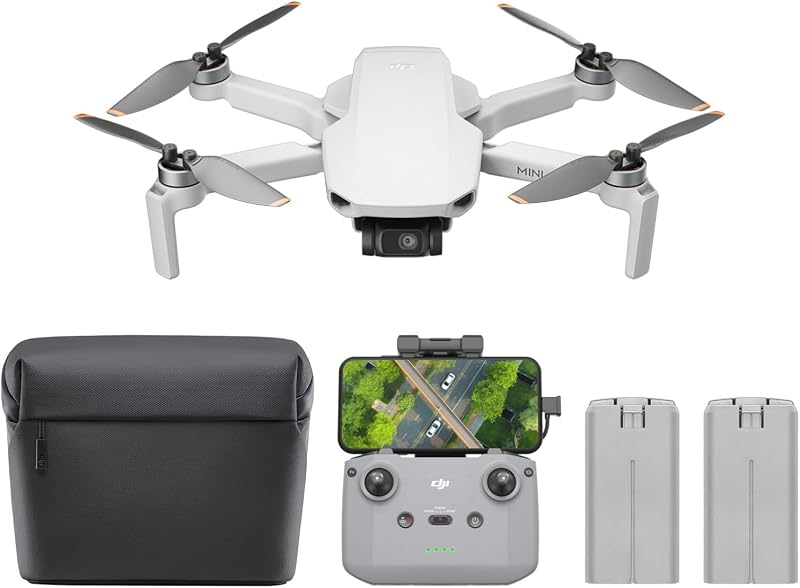
The DJI Mini 4K Camera Drone Combo serves as an entry-level aerial photography solution optimized for fundamental piloting mastery without excess software complexity. The drone weighs under 249 grams, freeing recreational pilots from standard registry mandates. Stabilization is achieved through a true 3-axis mechanical gimbal stabilizing a 12MP sensor capable of recording 4K Ultra HD video, while automated flight modes include QuickShots trajectories like Helix, Dronie, Rocket, Circle, and Boomerang.
Where this airframe diverges completely from more advanced models is in crash-prevention architecture. Unlike multi-directional vision platforms or premium alternatives in our broader holy stone drones evaluations, the Mini 4K lacks omnidirectional, forward, or backward obstacle sensing modules. Its flight stabilization depends exclusively on downward-facing visual positioning sensors to maintain steady hover over textured ground, assisted by satellite positioning for GPS Return to Home (RTH). It provides Level 5 wind resistance against breezes up to 38 kph and includes two flight batteries yielding up to 62 minutes of combined operational flight time alongside a 10 km video transmission range.
Because there are no autonomous braking sensors facing the flight path, the aircraft will not halt if flown into buildings, branches, or cliffs. Return-to-home procedures rely strictly on a pre-programmed cruising altitude: if the drone triggers failsafe RTH at an altitude lower than surrounding trees or structures, it will fly directly into those obstacles. Novice operators must manually configure a safe RTH clearance altitude before takeoff and rely entirely on manual stick inputs to avoid collisions.
DJI Air 3S Fly More Combo for Travel Landscape Production
Best for: Landscape travel creators flying at dusk
Pros
- Forward-facing LiDAR sensor
- Next-gen smart RTH
- Dual 4K HDR cameras
Cons
- Wall charger sold separately
The DJI Air 3S Fly More Combo strikes a strategic middle ground between compact travel drones and heavier commercial platforms. Engineered around dual imaging modules, the primary camera utilizes a 1-inch CMOS sensor capturing 50MP stills and 4K/60fps HDR video with up to 14 stops of dynamic range. The aircraft also introduces a Free Panorama mode that stitches expansive high-resolution landscapes from multiple frames across both wide and medium telephoto angles, minimizing barrel distortion.
Flight safety is significantly enhanced by Nightscape omnidirectional obstacle sensing, driven by a forward-facing LiDAR module paired with surrounding stereoscopic optical cameras. This sensor suite permits autonomous navigation and building avoidance during evening operations that would otherwise blind traditional optical drone sensors. The platform also debuts Next-Gen Smart Return-To-Home, which calculates real-time obstacle avoidance trajectories back to the takeoff point even when satellite GPS signals are severely degraded or obstructed by surrounding urban architecture.
The Air 3S Fly More bundle includes the screen-equipped DJI RC 2 controller, three flight batteries rated for 45 minutes of individual endurance, an ND filter kit, and a multi-battery charging hub. Notably, the product specification sheet warns that a dedicated AC wall plug is omitted from the package, requiring users to supply a separate high-wattage power source, such as the recommended DJI 65W portable charger, to utilize rapid charging hub functions.
DJI Neo 2 Fly More Combo for Handheld Social Vlogging
Best for: Casual vloggers wanting palm takeoff
Pros
- Full propeller guard protection
- Omnidirectional obstacle sensing
- Palm launch and gesture control
Cons
- Smaller 12MP sensor
The DJI Neo 2 Fly More Combo is designed for vloggers, action sports enthusiasts, and short-form video creators prioritizing immediate deployment over traditional manual flight prep. Weighing just 151 grams and carrying an official C0 certification, the unit incorporates integrated, full-coverage propeller guards that physically enclose the spinning blades. The craft features 4K high-quality video capture, 12MP stills, and software-assisted SelfieShot routines that capture automated portraits with a single command.
Navigation and interaction differ sharply from conventional controller setups. The Neo 2 supports palm takeoff and landing, alongside gesture controls that allow users to dispatch, position, and recall the aircraft without handling a remote. For tracking moving individuals, an onboard ActiveTrack engine maintains framing, supplemented by integration with Apple Watch devices for live telemetry previews and direct voice commands. Uniquely for an ultra-compact airframe, the technical specifications list omnidirectional obstacle sensing, providing active electronic buffering alongside its physical cage guards.
The Fly More combo comes equipped with the DJI RC-N3 controller, three flight batteries, an external charging hub, and the DJI Neo 2 Digital Transceiver, extending transmission range up to 10 km when paired with standard flight sticks. However, because the system relies on compact, low-profile sensors mounted inside a tight structural envelope, high-speed tracking through complex foliage can overwhelm detection refresh rates. The physical propeller guards provide critical mechanical protection when electronic avoidance margins diminish.
How to Choose the Right DJI Drone
Navigating the modern DJI ecosystem requires aligning individual flight conditions with specific sensor capabilities, weight categories, and operational environments. When evaluating dji drones obstacle sensing, buyers must recognize that collision safety systems fall into three distinct tiers: no obstacle sensing (Mini 4K), vision-only omnidirectional sensing (Mini 4 Pro, Neo 2), and hybrid LiDAR-assisted vision sensing (Mini 5 Pro, Air 3S, Mavic 4 Pro).
- Low-Light and Nighttime Operation: Standard binocular vision sensors require substantial ambient lux to calculate depth maps. If your workflow requires flying during blue hour, dusk, or nightscapes, models equipped with forward-facing LiDAR—such as the DJI Air 3S or DJI Mini 5 Pro—or the 0.1-lux rated DJI Mavic 4 Pro represent the only reliable options for preventing low-light collisions during automatic return-to-home maneuvers.
- Regulatory Weight Restrictions: Pilots seeking to avoid mandatory civil aviation registration, licensing hurdles, or Remote ID compliance for recreational flights should look directly at the sub-249g segment. The DJI Mini 4 Pro and DJI Mini 5 Pro provide full-coverage active tracking while staying within the weight cap under standard battery configurations, whereas the Mavic 4 Pro and Air 3S require full regulatory adherence.
- Physical vs. Electronic Crash Protection: Close-quarters indoor flight or crowded event coverage demands mechanical tolerance over software avoidance. While high-end drones halt abruptly when sensing nearby walls, the DJI Neo 2 combines omnidirectional electronic sensing with full-coverage physical propeller guards, preventing catastrophic blade strikes if the airframe drifts near soft obstacles or indoor surfaces.
- Controller Ecosystem: Bundles utilizing the DJI RC 2 provide built-in ultra-bright displays that eliminate phone mounting, overheating issues, and battery drainage on the pilot’s personal mobile device. Conversely, the DJI RC-N3 remote requires clamping a smartphone and managing external cable linkages, which introduces potential app crashes mid-flight.
Conducting a comprehensive dji drone comparison demonstrates that safety is fundamentally about redundancy. Novices frequently assume obstacle sensors create a crash-proof perimeter, but high flight speeds in Sport mode automatically disable all sensing suites across every single model. Choosing the right aircraft means matching pilot skill with appropriate fail-safe envelopes.
FAQ
How does DJI drone obstacle avoidance work in low-light conditions?
Traditional vision-based obstacle avoidance systems rely on ambient light to identify environmental features and calculate distances using stereoscopic image sensors. In dim lighting, shadows, or nighttime conditions, vision sensors lose tracking accuracy and will automatically shut off, displaying an ambient light warning on the remote screen. However, newer models like the DJI Air 3S, DJI Mini 5 Pro, and DJI Mavic 4 Pro integrate active forward-facing LiDAR or ultra-low-light 0.1-Lux sensors. These active systems emit their own light pulses to map terrain, providing reliable obstacle detection and safe return-to-home functionality even in complete darkness.
Can DJI obstacle avoidance sensors detect thin branches and wires?
No obstacle sensing system on consumer drones can reliably detect thin telephone wires, chain-link fences, or bare winter tree branches. Stereoscopic cameras and small LiDAR modules require a minimum surface area and structural contrast to register an object as an impassable obstacle. Slender objects often slip between the pixel grids of vision sensors or fail to bounce back a sufficient laser signature, causing the aircraft to maintain forward propulsion directly into the hazard. Pilots must always maintain visual line of sight and avoid flying through dense tree canopies using automated tracking.
What happens if obstacle sensing fails during Return to Home?
When an aircraft initiates Return to Home (RTH) due to low battery or signal loss, its collision avoidance behavior depends on the hardware generation. Standard GPS models like the Mini 4K fly in a straight path at the predetermined RTH height and will crash into anything taller than that setting. Airframes equipped with advanced APAS and smart RTH algorithms attempt to dynamically steer around obstacles in their path. However, if sensors become blinded by pointing directly into the rising sun, or if low light disables optical cameras, the drone will revert to basic straight-line cruising. Setting a proper RTH altitude that clears the tallest obstacles in the local area is the pilot’s primary defense against loss.
Why is the DJI Fly application missing from the Google Play Store?
Due to ongoing platform compatibility and security framework updates, DJI does not distribute the DJI Fly application through Google Play. Android users must navigate directly to the official DJI download page to obtain the official APK installation file, which must be manually sideloaded onto their mobile device. To avoid malicious third-party copies, operators should only download installation files directly from the manufacturer domain. Users flying with dedicated screen remotes, such as the DJI RC 2, bypass this issue entirely because the operating system and flight software come pre-installed on the controller hardware.
Does the DJI Mini 4K feature collision avoidance sensors?
The DJI Mini 4K does not have any forward, backward, upward, or lateral obstacle avoidance sensors. Its sensor array is limited to downward-facing visual and infrared positioning units used solely for altitude stability and precision hovering over textured surfaces. If the aircraft is flown forward, backward, or sideways into an obstacle, it will not brake or steer away. Pilots operating the Mini 4K must rely entirely on manual flight maneuvers, spatial awareness, and correct Return to Home altitude configuration to prevent collisions.


