

As Amazon Associates, we earn from qualifying purchases. This means we may receive a small commission at no extra cost to you if you click through and make a purchase.
AMD established an enduring standard for desktop computing by engineering processors that combine capable central processing cores with competent graphics hardware on a single piece of silicon. Within the long-lived AM4 desktop platform, these hybrid designs—historically referred to as Accelerated Processing Units or APUs—allow system builders, office managers, and budget-conscious gamers to construct fully functional personal computers without purchasing an expensive standalone graphics card. Relying on integrated graphics reduces overall power draw, simplifies thermal management inside compact desktop enclosures, and removes a major hardware failure point. However, navigating the AM4 catalog requires vigilance because silicon architecture, graphical compute power, and motherboard firmware requirements vary substantially across hardware generations.
While this selection spans entry-level quad-core chips up to powerful eight-core computing powerhouses, the models diverge sharply across architectural generations, graphical compute unit counts, and critical display support, culminating in confusing catalog traps like the standard Ryzen 5 5500 that omits display hardware entirely.
AMD Processors Compared
| Model | Cores and Threads | Graphics Model | Base and Boost Clock | Cache Configuration | Bundled Cooler |
|---|---|---|---|---|---|
| AMD Ryzen 5 3400G Computer CPU | 4 Cores, 8 Threads | Radeon RX Vega 11 | 3.7 GHz / 4.2 GHz | 6 MB L2+L3 | AMD Wraith Stealth |
| AMD Ryzen 7 5700G 8-Core | 8 Cores, 16 Threads | Radeon Graphics | Not listed / 4.6 GHz Boost | 20 MB Total | AMD Wraith Stealth |
| AMD Ryzen 3 3200G 4-core unlocked | 4 Cores, 4 Threads | Radeon Vega 8 | 3.6 GHz / 4.0 GHz | 6 MB Cache (4 MB Installed, 2 MB Secondary) | AMD Wraith Stealth |
| AMD Ryzen 5 5600G 6-Core 12-Thread | 6 Cores, 12 Threads | Radeon Graphics | 4.4 GHz / 4.6 GHz Boost | 19 MB Total | AMD Wraith Stealth |
| AMD Ryzen 5 2400G Processor | 4 Cores, 8 Threads | Radeon RX Vega 11 | 3.6 GHz / 3.9 GHz | 6 MB (4 MB L3, 2 MB L2) | AMD Wraith Stealth |
| AMD Ryzen 5 5500 6-Core | 6 Cores, 12 Threads | None (Discrete GPU Required) | Not listed / 4.2 GHz Boost | 19 MB Total (16 MB Secondary) | AMD Wraith Stealth |
AMD Ryzen 5 3400G Computer CPU for Balanced Legacy Builds
Best for: Builders planning to install dedicated GPUs
Pros
- 6 responsive processing cores
- 12 processing threads
- Bundled AMD Wraith Stealth cooler
Cons
- No integrated graphics hardware
- Requires separate graphics card
Best for: Legacy AM4 motherboard repairs and retrofits
Pros
- 11 graphics core Vega engine
- Unlocked 4 cores and 8 threads
- Native compatibility with early motherboards
Cons
- Lower 3.9 GHz max turbo speed
- Older first-generation APU design

Best for: Mainstream users wanting modern 6-core capability
Pros
- 6 cores and 12 processing threads
- Modern Zen 3 architecture
- Supports fast DDR4-3200 memory
Cons
- Requires updated motherboard BIOS
- Listing notes unknown software updates

Best for: Balanced desktop builds wanting Vega 11 graphics
Pros
- Radeon RX Vega 11 graphics
- 4 cores with 8 threads
- Wraith Stealth cooler bundled
Cons
- Older quad-core architecture
- Modest 6MB combined cache
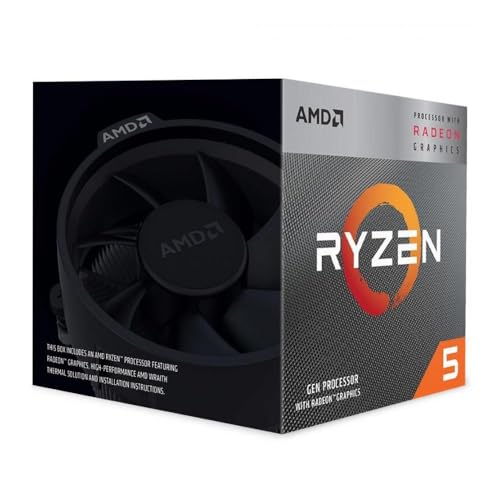
The AMD Ryzen 5 3400G Computer CPU remains one of the most recognizable workhorses of the AM4 ecosystem. Built on a four-core, eight-thread architecture running at a base clock of 3.7 GHz with boost potential up to 4.2 GHz, this processor features 6 MB of combined L2 and L3 cache alongside an unlocked multiplier for clock adjustments. Its thermal envelope sits at a standard 65 watts, packaged neatly with AMD’s Wraith Stealth air cooler to provide out-of-the-box system assembly without requiring secondary thermal purchases.
What sets this unit apart from budget counterparts is its integrated Radeon RX Vega 11 graphics engine. Unlike lesser graphical implementations, the Vega 11 configuration delivers balanced Full HD 1080p performance across light esports titles and standard office multimedia software. This processor is engineered for system builders who prioritize broad hardware compatibility, as its older architecture works harmoniously across legacy 300-series and 400-series AM4 motherboards without demanding cutting-edge BIOS updates that complicate initial system configuration.
This chip suits practical desktop owners who want snappy general desktop performance and modest graphical capabilities without investing heavily in auxiliary components. However, where heavy multi-threaded productivity, modern code compilation, or high-tier creative rendering are concerned, the amd ryzen 5 3400g naturally yields ground to the newer six-core and eight-core 5000-series G-variants that pack significantly faster central processing cores.
AMD Ryzen 7 5700G 8-Core for Heavy Multitasking and Productivity

Best for: Content creators wanting maximum multi-threaded performance
Pros
- 8 cores and 16 processing threads
- Fast 4.6 GHz boost speed
- Generous 20MB cache capacity
Cons
- May require motherboard BIOS flashing
- High 95C max operating temperature
Sitting at the pinnacle of AMD’s integrated desktop lineup, the AMD Ryzen 7 5700G 8-Core brings enthusiast-grade compute density to the standard 65-watt AM4 socket. Armed with 8 physical cores and 16 concurrent processing threads, this processor reaches a maximum boost frequency of 4.6 GHz and incorporates 20 MB of installed cache. The chip natively supports dual-channel DDR4-3200 system memory and carries a maximum operating temperature threshold of 95 degrees Celsius, kept in check by the bundled Wraith Stealth thermal solution.
This processor incorporates modern AMD Radeon Graphics, providing fluid 1080p display output and video acceleration directly through compatible motherboard I/O ports. For buyers reviewing a comprehensive ryzen integrated graphics comparison, this unit stands out as the best amd processor with integrated graphics for workstation duty, running virtual machines, encoding local video streams, and manipulating massive spreadsheets without experiencing CPU bottlenecks. Builders weighing this against prebuilt mobile configurations like those explored in our ryzen 7 am4 analysis will appreciate the flexibility of full desktop expansion.
The amd ryzen 7 5700g represents the ideal selection for content creators, software engineers, and prosumers who refuse to install a noisy, power-hungry discrete graphics card in their primary workspace. It gives way only when a user’s workflow is strictly limited to entry-level budget tasks, where its extensive thread count and higher initial component investment offer surplus power that simple daily web tasks will never fully exploit.
AMD Ryzen 3 3200G 4-core unlocked for Basic Office Workstations
Best for: Basic office workstations and secondary PCs
Pros
- Integrated Radeon Vega 8 graphics
- Efficient 65W thermal envelope
- Wraith Stealth cooler included
Cons
- Lacks multithreading with only 4 threads
- Capped at DDR 2933 memory support
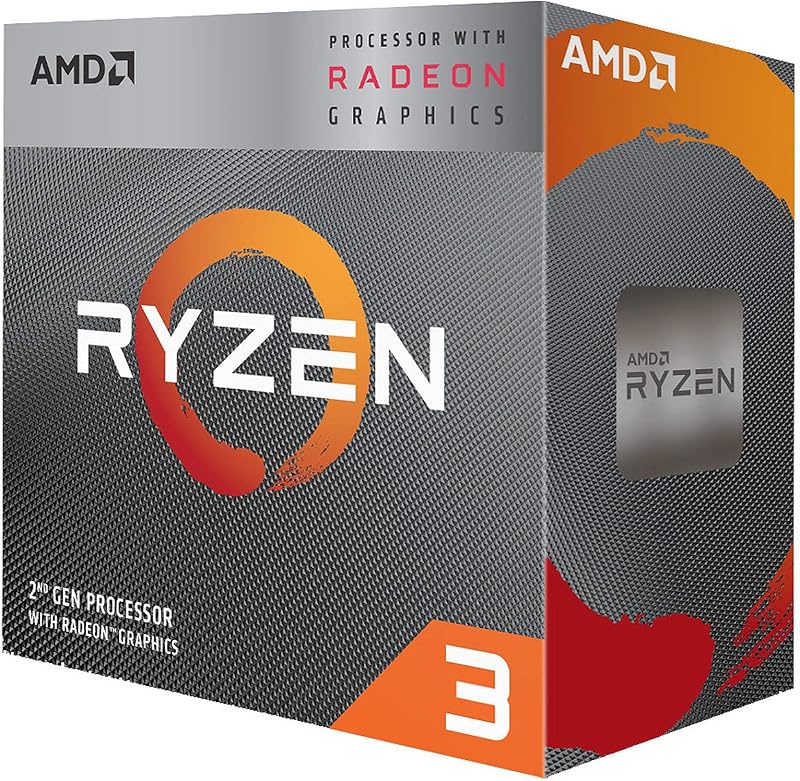
The AMD Ryzen 3 3200G 4-core unlocked desktop processor represents an entry point into functional AM4 computing. Operating with 4 physical processing cores and 4 threads, this chip foregoes simultaneous multithreading in favor of efficient, dedicated physical core execution. It features a base operating clock of 3.6 GHz with a 4.0 GHz boost capability, supported by 6 MB of overall cache (with 4 MB installed cache noted on the listing) and native DDR4-2933 system memory support, all within a restrained 65-watt TDP envelope cooled by a bundled air heatsink.
Integrated directly onto the silicon is the Radeon Vega 8 graphics engine. This graphical subsystem easily manages high-definition video playback, dual-monitor desktop setups, and undemanding web applications without stutter. The amd ryzen 3 3200g provides reliable visual outputs for institutional computing labs, point-of-sale terminals, and light living-room home theater PCs that demand zero maintenance and minimal thermal output.
This model is best suited for cost-sensitive shoppers who require guaranteed display output for straightforward, single-threaded office applications and video conferencing. However, because it lacks multi-threading support, it gives way to the Ryzen 5 3400G and 5600G as soon as modern multitasking, continuous background browser tabs, or modern multi-threaded operating system workloads enter the equation.
AMD Ryzen 5 5600G 6-Core 12-Thread for Mainstream Balance
Striking an optimal balance between everyday system agility and integrated graphics reliability, the AMD Ryzen 5 5600G 6-Core 12-Thread desktop processor delivers modern Zen 3 architecture to mainstream desktops. It packs 6 cores and 12 processing threads capable of reaching a 4.6 GHz max boost clock (with a listed 4.4 GHz operating frequency), accompanied by 19 MB of cache and support for high-speed DDR4-3200 memory modules within a standard 65-watt thermal profile.
The built-in AMD Radeon Graphics engine leverages the improved memory controller and elevated core performance of modern 5000-series silicon. This synergy allows the processor to push higher sustained frame rates in competitive 1080p games and accelerate photo editing suites without requiring an external graphics add-in card. Shoppers researching portable hardware benchmarks, such as those evaluated in a kaiger light gaming laptop overview, will recognize similar graphical versatility here in a durable desktop footprint.
When buyers debate which ryzen apu to buy for general-purpose computing, family desktop assemblies, or entry-level esports play, the amd ryzen 5 5600g is generally the smartest recommendation. It yields only to the 5700G when sustained production renders or workstation multithreading justify the extra hardware spend, easily outpacing older quad-core legacy APUs in daily responsiveness.
AMD Ryzen 5 2400G Processor for Legacy AM4 Restorations
The AMD Ryzen 5 2400G Processor represents the first generation of Raven Ridge silicon that validated the AM4 APU concept. Featuring 4 cores and 8 threads with an unlocked multiplier, the chip achieves a base clock of 3.6 GHz and a maximum turbo frequency of 3.9 GHz. It integrates 2 MB of L2 cache and 4 MB of L3 cache, backed by proprietary AMD technologies including SenseMI, Ryzen Master utility support, and Radeon FreeSync display capability, packaged with the standard Wraith Stealth cooler at a 65W rating.
Graphical tasks are managed by an onboard Radeon RX Vega 11 engine housing 11 graphics cores operating at 1250 MHz. This hardware allocation gave early AM4 adopters authentic light gaming capability straight from the motherboard I/O panel. Furthermore, because this chip stems from the initial APU generation, it possesses near-universal baseline compatibility with original B350, X370, and A320 motherboards, functioning on early BIOS versions where newer Zen 3 processors fail to initialize entirely.
This legacy processor is well-suited for buyers repairing, maintaining, or repurposing older AM4 motherboards without wanting to navigate complex BIOS update procedures or hardware flashing tools. Nevertheless, for any modern ground-up PC build, the amd ryzen 5 2400g yields directly to the refined Ryzen 5 3400G and modern 5600G, both of which offer higher clock frequencies, upgraded memory controller efficiency, and superior long-term software driver support.
AMD Ryzen 5 5500 6-Core as a Common Buyer Trap
The AMD Ryzen 5 5500 6-Core processor is a capable processing unit that presents a major purchasing pitfall for unwary shoppers. On paper, it presents compelling specifications: 6 processing cores, 12 concurrent threads, a 4.2 GHz max boost speed, 19 MB of total cache (with 16 MB secondary cache noted on the listing), DDR4-3200 support, a bundled Wraith Stealth cooler, and an efficient 65-watt power target. However, as explicitly noted in its product listing, this chip requires a discrete graphics card to produce an image.
Shoppers frequently search for ryzen 5 5500 integrated graphics under the mistaken assumption that all Ryzen 5000 desktop chips sharing similar model numbers feature display engines. Unlike the 5600G, the standard Ryzen 5 5500 has no active Radeon compute units on its die. If you mount this processor onto an AM4 motherboard and connect an HDMI or DisplayPort cable to the rear motherboard shield, the system will power on, but the monitor will remain entirely blank, triggering display failure error codes on the motherboard.
This chip is engineered strictly for gamers and desktop builders who already own or intend to purchase a dedicated standalone PCI Express graphics card. For any user who needs native video output straight from the motherboard without spending extra budget on a dedicated GPU, this model must be avoided in favor of true am4 processors with radeon graphics such as the 5600G or 3400G.
How to Choose the Right AMD Processors
Selecting an integrated graphics processor requires careful technical alignment between the processor die, system memory, and the host motherboard. Unlike dedicated graphics setups where the video card carries its own video RAM, cooling hardware, and display outputs, an APU depends entirely on host system components to operate reliably.
- Motherboard Video Outputs and Form Factor: Because an APU generates graphical data that routes through the motherboard, your motherboard must physically feature the display ports you intend to use. Verify whether your prospective board includes HDMI, DisplayPort, or legacy DVI connections, and confirm that the board’s display outputs support your monitor’s native resolution and refresh rate.
- System Memory Speed and Dual-Channel Operation: Integrated Radeon Vega graphics engines do not have dedicated high-speed GDDR memory. Instead, they reserve a portion of standard desktop system RAM to act as frame buffer memory. Running a single stick of RAM severely chokes graphical throughput. Installing a dual-channel memory kit running at DDR4-3200 (or DDR4-2933 for older quad-core chips) ensures the graphics cores receive the memory bandwidth required to prevent frame stuttering.
- Motherboard BIOS Compatibility: AM4 motherboards built across different generational releases (such as B450, B550, or A520) frequently require a firmware update to recognize newer processors like the 5600G or 5700G. If you pair a Zen 3 APU with an older board, verify that the board features a “BIOS Flashback” button or has been updated by the vendor to avoid black-screen POST failures. Buyers evaluating pre-integrated systems can review workstation alternatives in our lenovo ryzen 7 overview to bypass firmware installation challenges altogether.
- Core Count Versus Visual Workload Demands: For simple administrative work, media streaming, and point-of-sale machines, four cores (found on the 3200G and 3400G) remain sufficient. For contemporary office productivity with heavy multitasking, media editing, or casual gaming, stepping up to the 6-core 5600G or 8-core 5700G provides essential longevity and operating headroom.
- The “G” Suffix Rule: Always double-check model designations. In the AM4 desktop ecosystem, only AMD processors bearing the “G” suffix (such as 3200G, 3400G, 5600G, and 5700G) contain integrated display capability. Processors like the standard Ryzen 5 5500 do not output video signal under any circumstances without an add-in discrete card.
FAQ
Does the AMD Ryzen 5 5500 have integrated graphics?
No, the AMD Ryzen 5 5500 does not have integrated graphics. The listing explicitly states that a discrete graphics card is required. If connected to a motherboard display port without an add-in GPU installed, the system will fail to display any video output.
What is the difference between Vega 8 and Vega 11 graphics on AM4?
Vega 8 and Vega 11 refer to the number of graphical compute units integrated on the processor die. Vega 8 (featured on the Ryzen 3 3200G) contains 8 compute units, whereas Vega 11 (featured on the Ryzen 5 2400G and 3400G) contains 11 compute units running at elevated clock frequencies. The Vega 11 engine delivers faster graphics rendering and smoother frame rates in 3D applications.
Can AMD Ryzen integrated graphics support multiple display monitors?
Yes, AMD APUs can support dual or triple monitor configurations, provided your specific AM4 motherboard includes multiple physical video outputs such as HDMI, DisplayPort, or DVI ports. The integrated GPU processes display streams for whatever compatible ports the motherboard manufacturer has physically wired to the socket.
Do AM4 processors with Radeon graphics require dedicated video memory?
Integrated Radeon processors do not contain dedicated onboard video memory (VRAM). Instead, the system BIOS dynamically reserves a slice of standard system DDR4 RAM to serve as shared video memory. Configuring your PC with fast dual-channel RAM modules is essential for maximizing integrated visual performance.
Why does a newly assembled PC with a Ryzen 5000 G-series processor fail to boot?
The most common cause of boot failure with newer APUs like the Ryzen 5 5600G or 5700G on older motherboards (such as B450 or X470 chipsets) is an outdated motherboard BIOS. Older motherboards manufactured prior to the release of these processors require a BIOS firmware update before they can recognize and initialize the newer Zen 3 APU silicon.