As Amazon Associates, we earn from qualifying purchases. This means we may receive a small commission at no extra cost to you if you click through and make a purchase.
Sony earned its reputation in the compact imaging market by packing precision optics, advanced sensor manufacturing, and miniaturized internal stabilization into pocketable frames. The brand established early dominance with its Cyber-shot family, pioneering slim metal chassis construction and integrating high-grade Carl Zeiss lenses into consumer hardware. For decades, these compact models defined portable photography for vacationers, family archivists, and street photographers who required dedicated optical zoom assemblies without the cumbersome weight of interchangeable lens systems.
Evaluating this particular selection reveals a distinct hardware transition, dividing early legacy models utilizing classic CCD sensors and proprietary media formats from modern ultracompacts equipped with Exmor R CMOS sensors, high-ratio G series zoom lenses, and integrated wireless transfer. Understanding these mechanical and hardware design differences is essential to determining which model provides the practical longevity and day-to-day usability required for your specific imaging projects.
Sony Point and Shoot Cameras Compared
| Model | Sensor Resolution and Type | Optical Zoom | Storage Media Format | Video Capability |
|---|---|---|---|---|
| Sony Cybershot DSCW55 | 7.2 MP CCD | 3x Optical | Memory Stick DUO / MS Pro DUO | MPEG VX with Audio |
| Sony Cybershot DSCW70 | 7.2 MP CCD | 3x Optical | Memory Stick DUO / Pro | MPEG VX Video |
| Sony Cyber-Shot DSC-W570 | 16.1 MP CCD | 5x Optical | Not listed | 720p HD MP4 |
| Sony Cyber-shot DSC-W290 | 12.1 MP CCD | 5x Optical | Memory Stick Duo / PRO Duo | 720p HD Video |
| Sony DSCWX350 | 18.2 MP BSI CMOS | 20x Optical | Not listed | Full HD / Motion Shot |
| Sony DSCWX220 N | 18.2 MP BSI CMOS | 10x Optical | Not listed | 1080/60p Full HD |
Sony Cybershot DSCW55 for Classic CCD Snapshots

Best for: Vintage CCD photo collectors seeking manual controls
Pros
- Stamina battery rated for 380 shots
- Carl Zeiss 3x optical zoom lens
- CCD sensor delivers distinct color rendering
Cons
- Relies on discontinued Memory Stick media
The Sony Cybershot DSCW55 7.2MP Digital Camera represents an era of robust metal-bodied snapshot tools engineered for direct, tactile point-and-shoot operation. Built around a 1/2.5-inch Super HAD CCD sensor, this unit produces 7.2-megapixel files that deliver the distinct visual characteristics, tonal gradients, and highlight roll-off prized in vintage digital photography. The front of the chassis houses a Carl Zeiss 3x optical zoom lens paired with combined digital and optical stabilization, working across a maximum aperture of f/2.8 at wide angles. It also features a bright 2.5-inch rear LCD and an expanded ISO range scaling to 1000 for managing dim interior settings without flash blow-out.
From an ownership and operational durability perspective, the Sony Cybershot DSCW55 requires understanding legacy hardware constraints. The camera uses Sony Stamina battery engineering, offering up to 380 shots per charge cycle, though buyers must verify whether replacement cells remain readily available on the secondary market. Storage relies on Memory Stick DUO or MS Pro DUO media cards alongside 56 MB of internal fallback storage, necessitating dedicated card readers rather than modern SD slots. For shoppers seeking aesthetic styling like a vibrant pink sony camera, this series remains historically popular, but users wanting effortless USB-C syncing or high-definition output should recognize its functional boundaries.
This camera suits retro photography enthusiasts and digital archivists looking to replicate mid-2000s image rendering using authentic CCD hardware. However, those who require fast continuous autofocus, automated cloud file backups, or standard micro-USB charging will be better served looking toward the brand’s contemporary CMOS alternatives detailed later in this guide.
Sony Cybershot DSCW70 for Guided Manual Operation
Best for: Simplicity seekers wanting straightforward menu navigation
Pros
- Simple on-screen Function Guide text
- Includes dedicated external battery charger
- Optical viewfinder aesthetic and compact metal body
Cons
- Limited video resolution via MPEG format
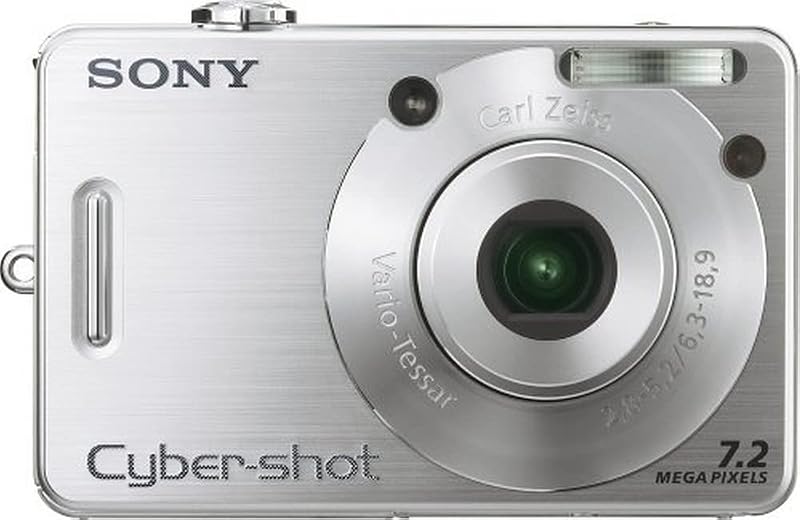
The Sony Cybershot DSCW70 7.2MP Digital Camera shares much of the durable physical architecture found in its line while refining the user navigation experience for developing photographers. Featuring an identical 7.2-megapixel 1/2.5-inch CCD sensor, the camera is tuned to capture sufficient detail for 15 x 20-inch prints under proper lighting. It carries a 3x optical zoom lens with an f/3.5 maximum aperture, dual optical and digital image stabilization, and an automatic exposure control system supported by shutter speeds reaching 1/2000 second. Framing is handled through a clear 2.5-inch LCD display, supported by an optical framing window reminiscent of traditional rangefinder styling.
Hardware longevity on the Sony Cybershot DSCW70 is enhanced by user-focused firmware, notably the integrated on-screen Function Guide text that explains menu configurations without requiring a paper manual. Sony shipped this model with an external lithium-ion battery and wall charger, reducing reliance on worn-out in-camera charging ports. Image saving utilizes Memory Stick DUO or Pro media alongside 58 MB of internal flash memory. While the mechanical telescoping lens barrel is durable, the moving gear teeth demand protection from sand and pocket lint to prevent lens drive jams over extended ownership.
This unit serves collectors and film-look hobbyists who want vintage CCD color reproduction with simpler menu navigation than the W55 provides. Conversely, anyone seeking high-definition video recording or wide dynamic range in back-lit environments will find its MPEG VX movie format and fixed automatic exposure baseline too limiting for modern production demands.
Sony Cyber-Shot DSC-W570 for Wide-Angle Panoramic Coverage

Best for: Casual shooters needing 720p HD movie recording
Pros
- Carl Zeiss Vario-Tessar 5x wide lens
- Sweep Panorama mode included
- Optical SteadyShot blur reduction
Cons
- Narrow maximum aperture at telephoto reach
Stepping forward into the transition period of compact camera design, the Sony Cyber-Shot DSC-W570 16.1 MP Digital elevates resolution significantly with a 16.1-megapixel 1/2.3-inch CCD image sensor. Optics receive a substantial upgrade via a Carl Zeiss Vario-Tessar 5x wide-angle optical zoom lens, granting broader framing options for landscape vistas and tight indoor spaces. Framing and image review take place on an enlarged 2.7-inch LCD display. For motion capture, the camera records 720p HD movies encoded in the flexible MP4 file format, while Optical SteadyShot helps eliminate camera movement during handheld shooting.
In terms of practical reliability, the Sony Cyber-Shot DSC-W570 incorporates Sony intelligent Auto (iAuto) mode, which dynamically calculates scene parameters to mitigate user exposure error. It also introduces Sweep Panorama Mode, allowing continuous panoramic image generation without stitching software on a PC. With an expanded ISO floor starting at 80 and shutter durations up to 2 seconds, low-light nightscapes gain better noise reduction. However, its f/6.3 maximum aperture at full telephoto requires stable handling or daylight conditions to prevent shutter speeds from dipping into blur territory.
Shoppers wanting an affordable step up in resolution from early CCD cameras will appreciate the fine detail capture and wide lens coverage on this model. When contrasted with standard canon point and shoot digital cameras from the same era, the W570 offers competitive wide-angle utility, though heavy video creators may still yearn for full 1080p recording and modern wireless export functions.
Sony Cyber-shot DSC-W290 for High-Resolution Display Composition

Best for: Everyday family snapshots needing a larger preview display
Pros
- Clear Photo 3.0-inch LCD screen
- Fast BIONZ image processing engine
- 28mm equivalent wide-angle optical framing
Cons
- Proprietary media required with small internal memory
The Sony Cyber-shot DSC-W290 12.1 MP Digital delivers a balanced middle ground between sensor density and optical prowess, driven by a 12.1-megapixel Super HAD CCD sensor. Its standout mechanical feature is the Carl Zeiss Vario-Tessar 5x optical zoom assembly, which starts at an expansive 28mm equivalent wide-angle focal length and extends to 14 centimeters of optical reach. Imaging tasks are orchestrated by the BIONZ image processor, enabling high-precision metering options spanning multi-pattern, center-weighted, and spot configurations. Optical SteadyShot stabilization works behind the scenes to control vibration across the entire focal corridor.
From an interface standpoint, the Sony Cyber-shot DSC-W290 replaces cramped view screens with an expansive 3.0-inch Clear Photo LCD pushing 230,000 dots of resolution. This display makes focus validation, framing accuracy, and menu navigation significantly easier for aging eyes. Integrated firmware tools like Face Detection and Smile Shutter automate family portraiture. Like its siblings, physical media handling relies on Memory Stick Duo and PRO Duo cards, with an internal memory buffer of only 11MB that serves solely for testing operations when no card is present.
This camera fits casual documentary photographers and parents who want sharp 720p video clips and reliable wide-angle lens capability paired with a large rear screen. It naturally yields ground to newer WX series cameras when low-light high-ISO performance or universal micro-USB charging cables become absolute necessities for daily travel.
Sony DSCWX350 for Extended Optical Reach and Wireless Sharing
Modern engineering priorities take center stage with the Sony DSCWX350 18 MP Digital Camera, shifting the core platform from traditional CCD hardware to an 18.2-megapixel Exmor R BSI CMOS sensor. Back-illuminated sensor architecture captures significantly more light, dramatically reducing digital noise in high-contrast or dimly lit venues. The front features an expansive 20x optical zoom Sony G Lens, extendable to 40x via Clear Image Zoom processing, packing immense telephoto range into a casing that comfortably slips into a jeans pocket. Optical image stabilization counteracts extreme telephoto vibrations, while Lock-On AF maintains tracking focus on energetic subjects.
Long-term operational support on the Sony DSCWX350 is superior to vintage predecessors due to modern component standardization. Power is supplied via the universal NP-BX1 rechargeable battery pack, a cell that Sony continues to manufacture and distribute widely. In-camera charging is conducted through a standard Multi/Micro USB terminal, eliminating the need for bulky external cradles while traveling. Modern connectivity includes Wi-Fi with NFC pairing for instant phone transfers. Additionally, photographers can plug directly into a modern display or sony tv 65 inch through the Micro HDMI port to showcase full 4K still image output.
Travelers, nature enthusiasts, and concertgoers needing extreme optical magnification without carrying a heavy camera bag will find this model ideal. Its advanced BSI CMOS performance and standard battery platform provide modern reliability that legacy W-series cameras simply cannot match, though users must manage a more complex array of sub-menus and electronic shooting modes.
Sony DSCWX220 N for High-Speed Ultracompact Street Shooting
Best for: Pocket travel with high-speed burst shooting
Pros
- Ultracompact body with 10x optical zoom
- 10 frames per second burst capture
- Full HD 1080/60p video recording
Cons
- Fixed 2.7-inch display lacks articulation
The Sony DSCWX220 N 18.2 MP Digital strips away all remaining bulk to present an ultracompact form factor finished in an elegant gold chassis. Internally, it mirrors the imaging excellence of the WX350, utilizing an 18.2-megapixel 1/2.3-inch Exmor R CMOS sensor paired with the fast BIONZ X processing engine. Optics consist of a 10x optical zoom G Lens that doubles to 20x via Clear Image Zoom. This processing pipeline supports continuous burst shooting at an impressive 10 frames per second, making it remarkably effective for fast-moving street scenes, pets, or athletic events.
Video capture on the Sony DSCWX220 N outperforms earlier compacts by offering broadcast-grade Full HD 1080/60p recording, complete with Motion Shot Video tracking to trace dynamic subject movement across the frame. Framing is handled by a sharp 2.7-inch rear screen, supplemented by creative Picture Effect modes and a 360-degree Sweep Panorama function. Physical connectivity incorporates Hi-Speed USB 2.0, a Micro HDMI port supporting 4K still playback, and a Multi/Micro USB terminal. Wireless image transfer and remote camera management are streamlined using on-board Wi-Fi and NFC connectivity.
This camera is the definitive choice for daily carry enthusiasts, street photographers, and urban commuters who want genuine 10x optical reach and high-definition video capabilities in an ultra-slim chassis. While it provides half the optical telephoto reach of the WX350, its smaller footprint and rapid burst capabilities make it a formidable daily imaging companion that fits into any shirt pocket.
How to Choose the Right Sony Point and Shoot Cameras
Deciding which Sony Cyber-shot model to invest in requires assessing how historical hardware specifications intersect with your practical daily workflow. The most crucial consideration is sensor architecture. Early models such as the DSC-W55, DSC-W70, and DSC-W290 utilize CCD image sensors. These sensors are celebrated for their organic color rendition, saturated primary tones, and distinctive retro look, but they struggle in low light and top out at lower ISO thresholds. Newer variants like the WX350 and WX220 feature Exmor R BSI CMOS sensors, which excel in low-light indoor shooting, offer wide dynamic range, and permit high-speed continuous shooting up to 10 frames per second.
Physical media and peripheral support represent another vital operational divide. Vintage Cyber-shot cameras rely on Sony’s discontinued Memory Stick DUO and PRO Duo formats, which require specialized memory cards and external USB card readers to import files onto modern computers. In contrast, the modern WX series benefits from universal connectivity protocols, utilizing standard Micro USB cables for data transfer and charging, as well as integrated Wi-Fi and NFC for transferring pictures directly to your smartphone. If seamless cloud sharing and hassle-free cabling matter to your routine, the modern WX line avoids obsolete hardware headaches.
Optical reach and lens durability should dictate your choice based on shooting environment. If your photography centers on indoor parties, social gatherings, or everyday desktop documentation, a compact 3x or 5x optical zoom lens like those on the W55, W70, or W570 keeps the mechanical barrel small, simple, and less prone to internal dust contamination. If your focus shifts to wildlife, stadium concerts, or expansive vacation scenery, the 20x optical zoom lens on the WX350 or the 10x reach of the WX220 provides optical versatility that no smartphone digital zoom can simulate.
Battery longevity and cell replacement must not be overlooked when buying pre-owned or classic electronics. While early Stamina batteries offered impressive shot counts, finding fresh, high-capacity replacement packs for fifteen-year-old designs can prove difficult. The WX350, utilizing the ubiquitous NP-BX1 battery pack, enjoys ongoing production and third-party support, guaranteeing that you can source reliable backup batteries for travel without relying on degraded vintage lithium cells.
FAQ
What is the main difference between Sony CCD and CMOS Cyber-shot cameras?
Sony CCD cameras, such as the DSC-W55, DSC-W70, and DSC-W290, process whole-frame image data to yield film-like color rendition, rich skin tones, and distinct highlight falloff, making them popular among vintage photography enthusiasts. Modern Exmor R CMOS models, like the WX350 and WX220, use back-illuminated pixel architecture to capture significantly more light, enabling high-ISO low-light photography, Full HD video recording, and rapid continuous burst shooting.
Can I still use Memory Stick cards on modern computers?
Yes, but you will need an external multi-card USB adapter that explicitly lists support for Memory Stick DUO or PRO Duo formats. Modern laptops and desktop computers do not feature native slots for Sony proprietary media, so transferring photos from models like the DSC-W55, DSC-W70, or DSC-W290 requires dedicated legacy accessory adapters.
Which Sony Cyber-shot camera is best for travel and pocket carry?
The Sony DSCWX350 is widely regarded as the ultimate travel choice within this lineup due to its 20x optical zoom lens housed inside an ultracompact body. It pairs extensive focal versatility with modern Wi-Fi and NFC connectivity, micro-USB charging, and a standard NP-BX1 battery pack that is easy to replenish on long journeys.
Do older Sony Cyber-shot cameras support video recording?
Older models do record video, but their capabilities reflect the standards of their release era. The DSC-W55 and DSC-W70 record standard-definition MPEG VX clips with audio. Mid-generation units like the DSC-W570 and DSC-W290 record 720p HD footage, while modern CMOS options like the DSCWX220 support Full HD 1080/60p video.
How do I maintain the mechanical zoom lens on a compact camera?
Point and shoot zoom mechanisms utilize telescoping lens barrels that extend via microscopic gear tracks. To ensure mechanical longevity, always store the camera in a dedicated padded pouch to prevent sand, dust, and pocket lint from entering the barrel seams, and never force the lens barrel inward when powering the unit down.
Preserving vintage camera assemblies requires keeping storage cabinets and studio shelves free from abrasive dust and lint. Pair your camera kit maintenance with a clean workspace by consulting our Cordless Vac Verdict to find reliable, lightweight suction tools built for quick cleanup sessions. Keeping grit out of delicate lens barrels will significantly extend the operational lifespan of your gear.
Proper maintenance and safe storage remain critical factors for keeping these vintage compact sensors and mechanical zoom assemblies operational for years to come. Pairing your camera with protective storage options detailed in our Tool Chest Guide ensures delicate internal electronics stay safe from dust, humidity, and accidental impacts during travel. Taking these small precautions allows you to maximize hardware longevity while capturing distinctive imagery across any project.