

As Amazon Associates, we earn from qualifying purchases. This means we may receive a small commission at no extra cost to you if you click through and make a purchase.
Minolta is historically recognized for traditional photographic glass and camera assemblies, but its modern outdoor digital catalog focuses heavily on solid-state CMOS imaging sensors paired with consumer-grade observation hardware. In the digital night optics space, Minolta combines digital sensors, infrared light-emitting diodes, and internal IPS display screens into handheld form factors designed for wildlife tracking, scouting, and casual nighttime property surveillance. However, evaluating these optics requires a rigorous look at real-world durability, sensor clarity, and hardware limitations, as digital night vision devices operate fundamentally differently from military-grade analog intensifier tubes.
When comparing these options against broader market alternatives like wosports night vision binoculars, shoppers will find that Minolta digital night vision binoculars and monoculars differ substantially in optical reach, battery architecture ranging from 800mAh cells to 2600mAh power packs, and chassis weatherproofing, spanning unsealed pocket monoculars to water-resistant roof prism dual-ocular binoculars.
Minolta Night Vision Optics Compared
| Model | Magnification Specs | Sensor & Display | Power & Battery Architecture | Weather Resistance & Durability |
|---|---|---|---|---|
| Minolta MNDM10B (Black) | 10x Optical, 4x Digital | 48MP Photos, 4K Video, IPS Display | Built-in 800mAh Rechargeable, USB-C | Not Water Resistant, Plastic (2.7 oz) |
| Minolta MNDM10B (Green) | 10x Optical, Digital Zoom Not Listed | 4K Video, Cross Reticle | Not listed | Not listed, Plastic Chassis |
| Minolta MNDM10B (Gunmetal) | 10x Optical, 8x Digital | 4K Video, 3.0-inch IPS, Cross Reticle | Not listed, USB-C File Transfer | Not listed, Tactical Housing (16 oz) |
| Minolta MNDM10B Bundle | 10 Optical Ratio, Digital Zoom | 48MP Photos, 4K Video, 3.0-inch IPS | USB-C Rechargeable, Wall Charger Included | Not listed, Handheld Housing |
| Minolta MN1232A | 12x Optical, 12x to 8x Ratio | 48MP Photos, 4K Video, Fixed Focus | Not listed | Water Resistant, Fog-Resistant Roof Prism |
| Minolta MNDM625 | 6x Optical, 8x Digital | 8.0MP CMOS, 4K Video, Cross Reticle | 3.7V 2600mAh Lithium-Ion Rechargeable | Not listed, Sturdy Plastic (1.9 lbs) |
Minolta MNDM10B 10×25 Digital Night Vision for Ultra-Lightweight Packability

Best for: First-time buyers wanting complete accessory kits
Pros
- Includes cleaning kit and card reader
- Wall charger and card wallet bundled
- Built-in microphone and audio speaker
- High-resolution 48MP photo capture
Cons
- Substantial 2.5-pound total package weight
- Water resistance rating is not listed

Best for: Crossbow hunters needing integrated reticle aiming points
Pros
- Built-in cross reticle display overlay
- Standard quarter-twenty mounting thread
- Compatible with bows crossbows and firearms
Cons
- Listing leaves battery capacity unspecified
- Plastic chassis lacks rubber armoring
Best for: Ultralight hikers wanting basic pocket night scouting
Pros
- 7-ounce featherweight chassis
- Includes 32GB microSD memory card
- Rechargeable USB-C 800mAh battery
- Integrated color IPS display screen
Cons
- Chassis is explicitly not water resistant
- Non-removable battery limits field replacement
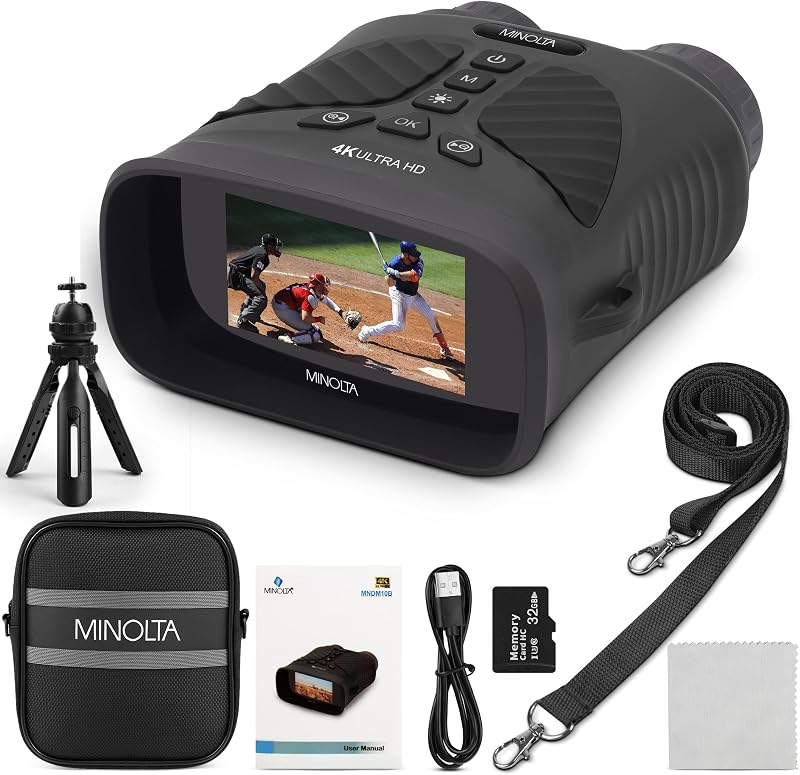
The Minolta MNDM10B 10×25 Digital Night Vision monocular is designed for users who prioritize featherweight portability above all other field attributes. Weighing a mere 2.7 ounces, this compact black monocular combines a 25mm objective lens with a fixed 10x optical magnification and a 4x digital zoom to magnify distant subjects in low-light environments. Instead of analog green-phosphor tubes, the unit uses low-light digital sensor technology to capture 48-megapixel still photographs and 4K Ultra HD video clips directly to an included 32GB microSD memory card, which can be upgraded up to 128GB. Users monitor their field of view and review footage on an integrated IPS display screen rather than looking through an optical eyepiece.
From an equipment reliability standpoint, buyers must weigh its convenient carry profile against noticeable physical vulnerabilities. The official product specifications explicitly classify this device as Not Water Resistant, which means any exposure to steady rain, river spray, or wet snow risks permanent damage to the electronic boards and display. The optical system features anti-reflective lens coatings and automatic focusing, simplifying operation for beginners but removing manual focus control when tracking targets through dense undergrowth. Power is delivered by an internal, non-removable 800mAh rechargeable battery charged over a modern USB-C connection, trading off field-swappable battery redundancy in favor of lightweight simplicity.
This version of the minolta mndm10b 10×25 digital night vision optic is best suited for day hikers, casual stargazers, and lightweight packers who stick to dry weather conditions. Its 2.7-ounce construction makes it virtually unnoticeable in a cargo pocket or trail pack. However, demanding field operators and hunters who require rubberized armor, swappable batteries, or rainproof gaskets will find this delicate plastic unit ill-suited for rugged outdoor expeditions.
Minolta MNDM10B 10×25 Digital Night Vision for Tactical and Crossbow Mounting
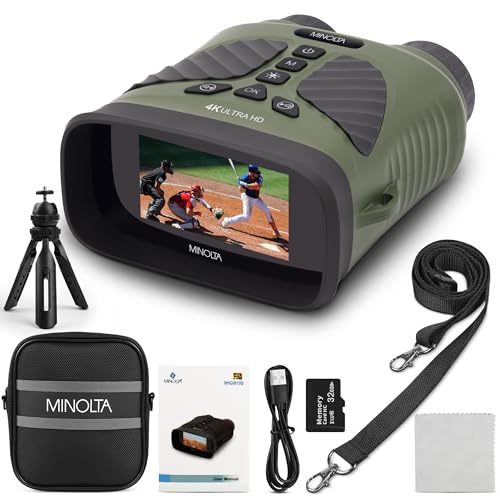
Finished in an outdoor green shell, this tactical configuration of the Minolta MNDM10B 10×25 Digital Night Vision is adapted specifically for stationary observation and hunting disciplines. The device retains a 25mm objective lens assembly and 10x magnification system paired with a 4K HD video recording sensor. To support sporting and target observation, Minolta integrates an electronic cross reticle directly onto the digital display screen, providing an aiming reference during stationary glassing sessions.
Hardware durability and mounting capability are central to this model’s design. The chassis includes a standardized 1/4″-20 threaded socket and is rated by the manufacturer for compatibility with firearms, bows, and crossbows. While this allows hunters to secure the optic to rail adapters, tree-stand brackets, or steady tripods, the construction remains standard plastic. Unlike dedicated weapon optics such as pard night vision equipment that undergo heavy recoil testing, the listing for this plastic monocular leaves recoil limits, shock resistance, and water ingress protection entirely unspecified. Furthermore, the listing does not specify the battery capacity, chemistry, or operating runtime for this specific green variant.
This tactical green MNDM10B serves archery scouts, crossbow hunters, and blind-based observers who require an integrated reticle and standard mounting threads for steady tripod observation in fair weather. The built-in 4K capture allows users to review their shots on demand. However, anyone requiring certified shockproof internals for heavy-recoil firearm platforms or guaranteed waterproofing should look past this unrated plastic housing.
Minolta MNDM10B 4K Video 10×25 Digital for Wide Field-of-View Scouting

Best for: Property scouts needing wide fields of view
Pros
- Broad 14-degree viewing angle
- Three-level 3W 850nm infrared illuminator
- Spacious 3.0-inch IPS viewing panel
- Extended 8x digital zoom ratio
Cons
- Heavier one-pound carry weight
- Listing omits water resistance rating
Presented in a sleek gunmetal gray housing, the Minolta MNDM10B 4K Video 10×25 Digital monocular expands tactical versatility with a wide optical angle and active illumination hardware. Built with a 25mm objective lens, this model features a generous 14-degree field of view, helping observers scan broad clearings, property boundaries, and game trails without inducing tunnel vision. For zero-light performance, it houses an integrated 3-watt 850nm infrared LED illuminator with three adjustable intensity settings, allowing users to balance illumination reach against battery consumption. Observation is handled through a built-in 3.0-inch IPS digital screen supported by an 8x digital zoom range for inspecting targets at distance.
A closer look at this gunmetal gray kit reveals a noticeably heavier, more robust structure than its 2.7-ounce sibling. The unit measures 3 inches long by 7.64 inches wide by 3 inches high and weighs a full 16 ounces (1 pound), providing substantial mass that helps steady handheld observation. Like the tactical variant, it incorporates a cross reticle, ambidextrous handling ergonomics, and a 1/4″-20 thread compatible with firearms, bows, and crossbows. However, the listing does not specify water resistance ratings, drop certification, or exact milliamp-hour battery specs. The 850nm infrared wavelength produces a faint, direct red glow at the LED emitter, which is standard for 850nm diodes but can alert nearby game animals in absolute darkness.
This gray 10×25 monocular is an effective match for property owners, nocturnal scouts, and night-shift perimeter monitors who need wide-angle surveillance from a fixed position. The larger 3.0-inch IPS display screen substantially reduces eye fatigue compared to tiny viewing ports. Even so, the lack of certified water sealing demands caution during wet nights, and users should operate from covered hunting blinds or sheltered outposts.
Minolta MNDM10B 10×25 Night Vision 4K for Field Kit Completeness
The Minolta MNDM10B 10×25 Night Vision 4K bundle packages the core black night vision monocular with an array of essential field maintenance accessories. Included alongside the optic are an optical cleaning kit, a USB wall charger, a 32GB microSD memory card, an SD/microSD USB card reader, and a protective memory card wallet. The core device pairs 10x optical magnification with a 25mm objective lens and an onboard 3W 850nm infrared LED with adjustable brightness tiers, capable of illuminating subjects across varying night conditions while capturing 4K UHD video and 48MP photographs.
Hardware functionality revolves around an integrated 3.0-inch IPS viewing screen that supports real-time framing, digital zoom adjustments, and in-device media playback. Unlike stripped-down alternatives, this model features an integrated microphone and speaker system, allowing users to record ambient outdoor audio and review footage with full sound directly in the field. Charging is managed through a USB-C input, which pairs conveniently with the bundled wall charger or portable power banks. However, prospective buyers should recognize that the listing does not specify water resistance or ingress protection standards. The entire retail bundle lists an item weight of 2.5 pounds, reflecting the combined bulk of the cleaning gear, charging blocks, and storage accessories.
This complete bundle is best for novice outdoor enthusiasts and travelers who want a ready-to-use digital night vision monocular setup straight out of the box without sourcing external memory cards or wall adapters. The cleaning kit is particularly useful for maintaining optical clarity on the front 25mm glass element. Conversely, weight-conscious backpackers who already own fast memory cards and charging hubs may find the bundled accessories redundant.
Minolta MN1232A 12×32 Roof Prism Digital for Long-Distance Daytime Observation
Best for: Daytime birdwatchers demanding two-barrel roof prism optics
Pros
- True roof prism binocular glass assembly
- Certified water-resistant and fog-resistant housing
- Larger 32mm light-gathering objective lenses
- Powerful 12x optical magnification
Cons
- Listing does not specify night vision illumination
- Narrow 5-degree field of view
Departing sharply from single-tube monoculars, the Minolta MN1232A 12×32 Roof Prism Digital brings true dual-barrel binocular optics to the Minolta line. Featuring a powerful 12x optical magnification and dual 32mm objective lenses, the MN1232A gathers considerably more natural ambient light than compact 25mm apertures. It integrates a digital imaging engine capable of recording 4K Ultra HD video at 30 frames per second and capturing 48-megapixel still photographs. Users observe through traditional glass roof prisms with a +/-4 diopter adjustment ring, while the integrated camera records what the binoculars see onto internal storage.
In terms of physical reliability, the MN1232A is the most environmentally resilient optic in this lineup. Unlike the unsealed plastic monoculars, this model carries explicit water-resistant and fog-resistant ratings, making it a rugged alternative comparable to traditional glass like binoculars hunting leupold series. It also includes an integrated tripod mount socket to stabilize its heavy 12x magnification. However, shoppers conducting a minolta night vision binoculars comparison must take careful note: the listing does not specify an infrared LED illuminator, night sensor modes, or low-light visibility ratings. With a fixed focus design, an exit pupil of 2.67mm, and a narrow 5.0-degree field of view (241 feet at 1,000 yards), this unit relies entirely on available daytime or ambient twilight illumination.
The MN1232A is built specifically for daytime birdwatchers, safari travelers, and sports spectators who require two-eyed binocular glass comfort combined with integrated 4K digital recording. The fog-resistant and water-resistant seals provide peace of mind in damp coastal or mountain environments. Nonetheless, for pitch-black nocturnal tracking or night hunting, this model cannot substitute for a dedicated infrared night vision device.
Minolta MNDM625 6×25 Digital Night Vision for Extended Field Surveillance
Best for: Overnight surveillance and extended nocturnal tracking
Pros
- High-capacity 2600mAh lithium-ion battery
- Native 8.0MP CMOS imaging sensor
- High-output 3W 850nm infrared LED
- Cross reticle with mounting support
Cons
- Heavier 1.9-pound plastic construction
- Modest 6x base optical magnification
The Minolta MNDM625 6×25 Digital Night Vision monocular is engineered to solve the primary weakness of compact digital optics: limited operating runtime. The MNDM625 is powered by a high-capacity 3.7V, 2600mAh lithium-ion rechargeable battery, providing substantial power to sustain long observation sessions without tethering to a wall plug. Optical capture is driven by a native 8.0MP CMOS image sensor paired with a 25mm objective lens, producing 4K UHD video at 30 frames per second. By adopting a moderate 6x base optical magnification alongside an 8x digital zoom, the MNDM625 delivers a much steadier handheld image than higher-power 10x units.
From an operational standpoint, the MNDM625 incorporates a high-output 3W 850nm infrared LED illuminator to penetrate total darkness. The chassis is built in a tactical black plastic style, scaling the scales at 1.9 pounds. It includes an integrated cross reticle overlay on the electronic display and a 1/4″-20 threaded mounting interface compatible with firearms, bows, and crossbows. However, despite its heavy-duty appearance and robust battery pack, the product listing does not specify water resistance ratings or ingress protection levels, requiring users to shield the housing from driving rain or splashing water.
This optic is the premier choice among Minolta digital night vision monoculars for nocturnal wildlife researchers, farm security managers, and hunters who conduct extended nighttime stakeouts. The 2600mAh battery eliminates anxiety over rapid power loss in cold weather. On the other hand, users seeking maximum optical reach without relying on digital zoom interpolation, or hikers desiring a featherweight pocket tool, may find its 1.9-pound heft and 6x optical baseline restrictive.
How to Choose the Right Minolta Night Vision Optics
Navigating the Minolta digital lineup requires matching your optical requirements, runtime demands, and environmental exposure to the specific hardware profile of each device. When deciding which minolta night vision binoculars to buy, the first critical step is distinguishing between active infrared night optics and daytime digital binoculars. Models such as the MNDM10B and MNDM625 feature 850nm infrared illuminators engineered specifically for zero-light observation. In contrast, the MN1232A is an optical roof prism binocular built for daytime observation and high-resolution recording, featuring no specified night vision infrared hardware.
Magnification and display field of view represent the next essential trade-off. The MNDM10B series delivers a 10x optical baseline, which is ideal for identifying stationary subjects at medium-to-long distances. For scanning wide pastures or open woodlands, the gunmetal MNDM10B provides an exceptional 14-degree field of view, minimizing disorienting movement. If handheld image stability is your primary concern, the MNDM625 features a lower 6x base optical magnification that is far easier to keep steady without a tripod, using its 8x digital zoom only when fine detail inspection is required.
Evaluating minolta night vision battery life is crucial for outdoor planning. Active infrared LEDs and bright IPS display screens consume significant power. The ultralight MNDM10B carries a modest 800mAh internal battery, prioritizing low weight (2.7 ounces) over operating endurance. For extended, multi-hour night vigils, the MNDM625 is the superior technical platform due to its 2600mAh lithium-ion power cell. If you select an 800mAh model for long trips, plan on packing an external USB-C power bank or selecting the MNDM10B bundle to secure charging adapters.
Finally, environmental durability and chassis design must guide your deployment strategy. The MN1232A binocular is the sole unit offering certified water-resistant and fog-resistant seals, making it the only model suitable for wet, humid field conditions. The monocular options feature plastic housings, with the base MNDM10B explicitly listed as not water resistant. If your application involves stationary hunting or stand mounting, prioritize models with 1/4″-20 threaded sockets, cross reticles, and weapon compatibility, such as the green MNDM10B, gunmetal MNDM10B, or MNDM625.
FAQ
Are Minolta digital night vision devices waterproof for rainy outdoor expeditions?
No, the digital night vision monoculars in the Minolta lineup are not waterproof. In fact, the entry-level Minolta MNDM10B explicitly carries a Not Water Resistant specification, while other monocular listings leave water ingress protection unspecified. Only the Minolta MN1232A roof prism binocular features documented water-resistant and fog-resistant protection, but that model lacks infrared night vision capabilities. Users deploying Minolta night vision monoculars outdoors must use protective rain covers or operate from covered blinds to avoid moisture damage.
How does Minolta night vision battery life compare between models?
Battery performance varies substantially across the lineup based on battery capacity and infrared usage. The ultralight MNDM10B utilizes a small 800mAh internal rechargeable battery designed to minimize carry weight down to 2.7 ounces, making it suited for short, intermittent viewing sessions. By comparison, the Minolta MNDM625 is equipped with a 2600mAh lithium-ion battery that delivers significantly greater power reserves for sustained nocturnal observation. Activating the 3W 850nm infrared LED at high brightness will deplete battery reserves much faster on all models.
Can Minolta digital night vision monoculars be safely used during the day?
Yes, Minolta digital night vision monoculars are fully compatible with daylight operation. Unlike traditional analog night vision scopes that rely on delicate photocathode intensifier tubes that can be permanently ruined by bright light, digital night vision utilizes electronic CMOS sensors. Models like the MNDM10B transition between full-color capture in daylight and black-and-white infrared viewing at night without risking sensor burn or optical degradation.
What is the difference between optical magnification and digital zoom on these optics?
Optical magnification refers to the physical magnification produced by the glass lens elements, such as 10x on the MNDM10B, 6x on the MNDM625, and 12x on the MN1232A, preserving the sensor’s full optical resolution. Digital zoom (which ranges from 4x to 8x across these models) electronically enlarges and crops the center of the captured image on the display screen. While digital zoom brings faraway subjects closer, excessive digital enlargement can introduce visual pixelation and reduce overall clarity.
Do Minolta night vision optics require specialized memory cards for 4K video recording?
Minolta digital optics capture 4K video and 48MP photographs directly to microSD cards, supporting capacities up to 128GB on models like the MNDM10B. Several options, including the base MNDM10B and bundle packages, include a 32GB microSD card in the box. Because recording 4K Ultra HD video requires sustained high data write speeds, users adding or upgrading storage should select high-speed microSD cards rated at Class 10, U3, or V30 to avoid dropped frames or write errors during recording.