

As Amazon Associates, we earn from qualifying purchases. This means we may receive a small commission at no extra cost to you if you click through and make a purchase.
Gskyer has built a prominent reputation among stargazing newcomers by offering all-in-one optical packages designed to remove the guesswork from buying an astronomical instrument. The brand focuses almost exclusively on complete starter bundles that combine an optical tube, an adjustable tripod, multiple eyepieces, magnifying Barlow lenses, and smartphone photography accessories in a single package. Rather than requiring beginners to source optical accessories and mounting hardware independently, each setup provides an out-of-the-box system intended for quick backyard viewing. However, because entry-level astronomy gear requires engineering compromises between light collection, tripod steadiness, and mechanical complexity, choosing a suitable model requires understanding what each kit can reliably achieve under real night skies.
Across the current catalog, these four models progress from ultra-portable 70mm and 80mm altazimuth travel refractors to a longer 90mm planetary refractor and ultimately a wide-aperture 130mm Newtonian reflector on an equatorial tracking mount.
Gskyer Telescopes Compared
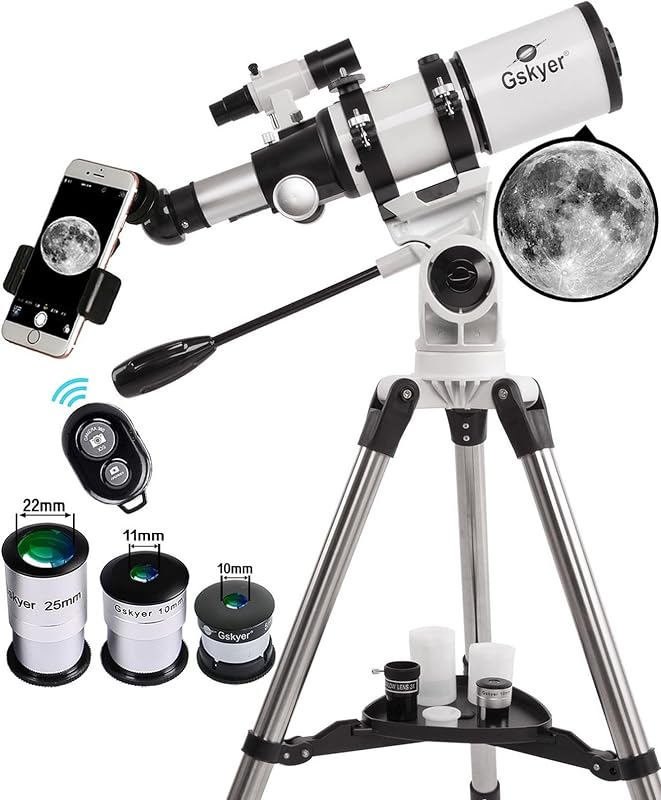
Best for: Backyard stargazers wanting a sturdier tripod
Pros
- Rigid stainless steel adjustable tripod
- 80mm aperture gathers good light
- Supplied with three distinct eyepieces
Cons
- Narrow 0.87-degree field of view
- High-power 5mm eyepiece has tight eye relief

Best for: Beginners needing lightweight portable travel viewing
Pros
- Lightweight 40cm optical tube
- Includes carry bag and accessories
- Wide 5.8-degree field of view
Cons
- Lightweight aluminum tripod flexes easily
- Modest 70mm light-gathering capacity
| Model | Optical Design & Aperture | Focal Length & Ratio | Mount Type | Included Eyepieces & Accessories |
|---|---|---|---|---|
| Gskyer 70mm Refractor | Refractor, 70mm | 400mm (f/5.7) | Altazimuth Mount | 2 eyepieces, 3x Barlow lens, phone adapter, wireless remote, carry bag |
| Gskyer 80mm Refractor | Refractor, 80mm | 400mm (f/5.0) | Altazimuth Mount | 3 eyepieces (25mm, 10mm, 5mm), 3x Barlow lens, BAK4 prism, phone adapter, remote |
| Gskyer 600x90mm AZ Refractor | Refractor, 90mm | 600mm (f/6.7) | Altazimuth Mount | 3 eyepieces (24x, 60x, 120x), 3x Barlow lens, BAK7 prism, astronomy software |
| Gskyer 130EQ Professional Reflector | Reflector, 130mm | 650mm (f/5.0) | German Equatorial Mount | 3 eyepieces, 3x Barlow lens, Bluetooth remote, toothless focusing base |
Gskyer Telescope for Portable Travel Stargazing
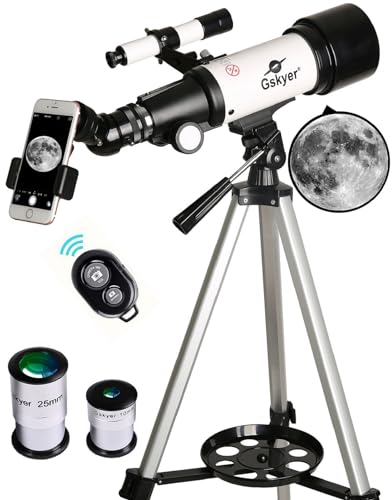
Serving as the quintessential grab-and-go option in the lineup, the 70mm Gskyer Telescope is engineered specifically for mobility, casual lunar observation, and daytime nature watching. Built around a 70mm aperture with a 400mm focal length at an f/5.7 focal ratio, this refractor utilizes fully coated optical glass with high-transmission coatings to maximize image brightness and protect eye safety. The optical tube assembly measures a compact 40 centimeters in length and is paired with an adjustable aluminum alloy tripod and a dedicated travel carry bag that stores the entire system for transport.
In terms of optical hardware, the package includes two replaceable eyepieces, a 3x Barlow lens that trebles magnification power, and a 5×24 reflex finderscope fitted with crosshair reticles to help locate bright celestial targets. Gskyer also bundles a smartphone adapter and a wireless camera remote, enabling users to capture images through the eyepiece without touching the optical assembly. The system delivers a wide 5.8-degree field of view, making it easy to sweep across constellations. However, the lightweight aluminum tripod is inherently sensitive to breezes and manual focusing touch, meaning users must wait a couple of seconds for vibrations to settle after adjusting the focuser.
This model is best suited for families, younger students, and outdoor campers seeking an uncomplicated gskyer telescope for beginners that packs down effortlessly into a single backpack. While its 70mm objective lens delivers satisfying views of lunar craters, Jupiter’s Galilean moons, and bright star fields, observers wanting sharper planetary contrast or a sturdier observing foundation will find greater stability by stepping up to the 80mm refractor.
Gskyer Telescope for Backyard Observation
Stepping up in light-gathering ability, the 80mm Gskyer Telescope retains a fast 400mm focal length while expanding the objective lens diameter to 8 centimeters. This increased aperture collects noticeably more light than the 70mm variant, enhancing image brightness when inspecting lunar rilles, star clusters, and the brighter cloud features of the solar system. The optical tube retains a manageable 40-centimeter profile, but the entire platform benefits from an upgraded, adjustable stainless steel tripod that provides a noticeably firmer footing than standard lightweight aluminum legs.
The optical kit for this gskyer 80mm refractor includes three replaceable eyepieces (a 25mm yielding 16x, a 10mm yielding 40x, and a 5mm yielding 80x magnification) paired with a 3x Barlow lens. Additional components include a larger 6×30 finderscope, an accessory tray, a phone attachment with a Bluetooth remote, and a 48-degree erecting BAK4 zenith prism that preserves natural, correct-image viewing for terrestrial and celestial targets alike. The listing highlights a 0.87-degree field of view and emphasizes reliable customer service with a 24-hour response time alongside a 1-year free replacement care policy. Buyers should recognize that the high-power 5mm eyepiece has tight eye relief and produces a noticeably dimmer image, particularly when combined with the Barlow lens.
This telescope suits amateur astronomers and science-minded learners who prioritize a more rigid observing platform without sacrificing the intuitive up-down, left-right panning of an altazimuth mount. It serves as a dependable backyard instrument for viewing the moon and brighter planets, though stargazers aiming for higher planetary magnification with less color fringing will be better served by the longer focal length of the 90mm model.
Gskyer Telescope 600x90mm AZ Astronomical Refractor for Planetary Viewing

Best for: Novices focusing on lunar and planetary detail
Pros
- Generous 90mm objective lens diameter
- Longer 600mm focal length enhances contrast
- Tool-free setup with astronomy software
Cons
- Heavy 17.5-pound total system weight
- Long tube increases tripod dampening time
The Gskyer Telescope 600x90mm AZ Astronomical Refractor represents a substantial jump in optical reach and physical presence, moving from compact travel tubes to a full-sized observing refractor. Equipped with a 90mm (3.54-inch) objective lens and a longer 600mm focal length (f/6.7), this refractor produces larger native image scales for planetary and lunar exploration. Its multi-coated glass optical components and German technology design help deliver clean, crisp views of planetary disks, Saturn’s rings, and lunar mountain ranges while reducing chromatic optical aberration compared to shorter focal length refractors.
The package contains three eyepieces delivering native magnifications of 24x, 60x, and 120x, alongside a 3x Barlow lens, a 6×30 reflex finderscope, a 48-degree erecting BAK7 prism, an accessory tray, and astronomy software to assist with night sky navigation. Assembly requires no tools, and the optical tube rests on an adjustable aluminum tripod with a working height range from 31.5 inches to 49 inches. With a total system weight of 17.5 pounds and an optical tube length of 60 centimeters, this is a substantial instrument. When the tripod legs are fully extended to 49 inches, the long tube creates significant leverage on the mount head, necessitating gentle handling when focusing at 120x magnification.
This gskyer 600x90mm astronomical refractor is tailored for adult beginners and serious novice observers who want dedicated planetary and lunar performance without having to collimate mirrors. It delivers noticeably better detail on planetary targets than smaller refractors, though observers who want to look past the solar system into faint nebulae and galaxies will need the larger light aperture of the 130EQ reflector.
Gskyer 130EQ Professional Astronomical Reflector Telescope for Deep-Sky Stargazing

Best for: Patient hobbyists tracking deep-sky objects
Pros
- Large 130mm parabolic reflector aperture
- German equatorial mount enables smooth tracking
- Smooth toothless focusing base mechanism
Cons
- Equatorial mount requires polar alignment
- Newtonian mirrors require periodic collimation
Departing from refractive lenses, the Gskyer 130EQ Professional Astronomical Reflector Telescope employs a large 130mm (5.1-inch) Newtonian mirror system to collect significantly more light than any refractor in the lineup. Featuring a 650mm focal length and a fast f/5 focal ratio inside a 24-inch optical tube, this instrument gathers sufficient photons to reveal deep-sky targets including star clusters, bright nebulae, and nearby galaxies. Because it uses all-glass mirrored optics with high-transmission coatings, the optical assembly is entirely free of chromatic aberration, presenting pinpoint star colors across the field of view.
Rather than using an intuitive altazimuth pan head, the 130EQ utilizes an advanced German equatorial mount (EQ-130) complete with counterweights and slow-motion manual tracking cables. The accessory kit supplies three eyepieces, a 3x Barlow lens, a reflex finderscope, an adjustable tripod, a toothless focusing base for smooth adjustments, and a Bluetooth camera remote compatible with iOS and Android devices. Gskyer backs this telescope with a 1-year warranty, lifetime maintenance support, and dedicated customer assistance. The primary trade-off is operational complexity: equatorial mounts require polar alignment with the celestial pole before observing, and the open Newtonian tube requires occasional mirror collimation to maintain peak sharpness.
The gskyer 130eq professional reflector is suited for patient, inquisitive beginners willing to master manual celestial tracking to observe faint deep-sky structures. While it represents the most optically capable platform for serious night sky exploration, casual users seeking a fast, zero-maintenance setup for quick backyard viewing will find the altazimuth refractors far simpler to operate.
How to Choose the Right Gskyer Telescope
Executing a careful gskyer telescope comparison comes down to balancing optical aperture against mechanical complexity, portability, and mount stability. The first consideration is optical design: refractors like the 70mm, 80mm, and 90mm models feature sealed tubes that never require optical alignment, resist internal dust, and include erecting prisms for correct-image viewing. In contrast, the 130mm reflector maximizes light gathering for deep-sky observation but features an open tube that requires periodic mirror collimation and displays an inverted image orientation unsuited for daytime terrestrial viewing.
The second critical factor is understanding gskyer altazimuth vs equatorial mount mechanics. Altazimuth mounts, found on the 70mm travel scope, the 80mm refractor, and the 90mm model, operate on intuitive up-and-down, left-to-right axes similar to a camera tripod. They allow immediate, point-and-view operation that makes them ideal for children and impatient beginners. Conversely, the German equatorial mount on the 130EQ requires balancing counterweights and aligning the polar axis with Polaris. Once aligned, it allows the observer to track drifting celestial bodies by turning a single slow-motion cable, making high-magnification viewing far more comfortable once the setup process is mastered.
Tripod steadiness is another vital benchmark when deciding which gskyer telescope to buy. Lightweight aluminum legs, such as those supplied with the 70mm travel unit and 90mm refractor, offer easy transport but flex under heavy loads or moderate wind. The stainless steel tripod paired with the 80mm model provides superior vibration dampening, ensuring that the image settles quickly after an observer touches the manual focuser. When using any of these starter mounts at maximum magnification, gentle hand pressure is essential to avoid blurring the target.
Finally, beginners should maintain realistic expectations regarding magnification and accessory claims. While marketing specifications reference zoom ratios reaching 120x or 307x, practical astronomy limits magnification to approximately 50 times per inch of aperture under typical atmospheric conditions. Pushing a 70mm or 80mm telescope past 150x using the included 3x Barlow lens and short focal length eyepieces invariably causes image dimming and narrow eye relief. Many hobbyists eventually improve visual comfort by pairing their telescope with a dedicated accessory like a celestron zoom eyepiece to reduce eyepiece swapping. Similarly, while the bundled smartphone adapters and Bluetooth remotes work well for lunar snapshots, serious long-exposure astrophotography requires motorized tracking mounts and standalone canon beginner cameras rather than mobile phone sensors.
FAQ
What is the difference between an altazimuth and an equatorial mount on a Gskyer telescope?
An altazimuth mount moves along horizontal (azimuth) and vertical (altitude) axes, functioning like a photography tripod. It is intuitive for beginners and requires no special setup. An equatorial mount has an axis tilted to match Earth’s rotational axis, requiring polar alignment toward the celestial pole. Once aligned, an equatorial mount allows observers to track drifting celestial objects smoothly using a single slow-motion control knob.
Can Gskyer telescopes be used for terrestrial viewing during the day?
The Gskyer 70mm, 80mm, and 90mm refractors include 48-degree erecting prisms that produce upright, correctly oriented images, making them suitable for viewing wildlife, landscapes, and boats during daylight hours. The Gskyer 130EQ reflector uses mirrors that naturally invert or rotate the image, making it unsuitable and awkward for daytime terrestrial observation.
Why does the image look blurry or dark when using the 3x Barlow lens?
A 3x Barlow lens triples the magnification of whichever eyepiece is inserted into it. However, pushing magnification beyond the optical limit of the objective lens spreads the incoming light over a larger area, causing severe image dimming and softening focus. Atmospheric turbulence also becomes magnified. For the sharpest views, beginners should use lower-power eyepieces without the Barlow lens before attempting higher magnification.
What does the Gskyer telescope warranty and customer support cover?
Warranty terms vary slightly across models. The 80mm refractor listing specifies reliable 24-hour customer service and a 1-year care policy for free replacement. The 130EQ reflector includes a 1-year warranty alongside lifetime maintenance support from the manufacturer. When purchasing, buyers should inspect all thumbscrews, tripod leg clamps, and optical surfaces immediately upon arrival to ensure customer support can address any shipping defects promptly.
How do you align the finderscope on a Gskyer beginner telescope?
Finderscope alignment must be done during daylight hours before taking the telescope outside at night. Point the main telescope at a distant, stationary object, such as a utility pole or tree branch, using the lowest-power eyepiece (such as the 25mm). Once the target is centered in the main view, look through the finderscope and adjust its bracket thumbscrews until the crosshairs rest exactly on the identical target.


