As Amazon Associates, we earn from qualifying purchases. This means we may receive a small commission at no extra cost to you if you click through and make a purchase.
DJI has spent years dominating the consumer motorized stabilizer market, engineering products defined by compact folding joints, quick-release magnetic clamps, and companion software built to smooth out mobile video. For Apple users looking for a reliable dji gimbal for iphone workflows, mechanical execution matters far more than promotional promises. Modern iPhones carry sizable camera bumps, substantial corner weights, and glass enclosures that can challenge stabilizing motors during rapid pan or tilt maneuvers. When paired with the proprietary DJI Mimo iOS application, a stabilizer must balance payload tolerances against software stability, Bluetooth handshake speeds, and battery strain during high-resolution recording sessions.
Across the current catalog, buyers will find that while every model relies on motorized 3-axis stabilization, they diverge sharply in physical reach, tracking architecture, bundled lighting and audio accessories, and continuous rotation capabilities. A comprehensive dji phone gimbal comparison shows that selecting the correct unit requires understanding whether you require a built-in telescoping extension rod, dedicated wireless audio receiver hardware, or complete 360-degree panning freedom.
DJI Phone Gimbals Compared
| Model | Weight | Extension Rod & Tripod | Tracking Technology | Multifunctional Module |
|---|---|---|---|---|
| DJI Osmo Mobile 7 Gimbal Stabilizer | 300 g | Built-in tripod only | ActiveTrack 7.0 & Dual-Lens | Sold separately |
| DJI Osmo Mobile 7P Gimbal Stabilizer | 368 g | Built-in extension rod & tripod | Dual-Lens & Native Tracking | Included |
| DJI Osmo Mobile 7P (+ Mic Mini TX) | Not listed | Built-in extension rod & tripod | Dual-Lens & Native Tracking | Included |
| DJI Osmo Mobile 6 Smartphone Gimbal | 305 g | Built-in extension rod only | ActiveTrack 6.0 | Not supported |
| DJI Osmo Mobile 8 Gimbal Stabilizer | Not listed | Built-in extension rod & tripod | AI Native Tracking & 360 Pan | Integrated / Supported |
| DJI Osmo Mobile 8 Standard Combo | Not listed | Built-in extension rod & tripod | Native Tracking & 360 Pan | Not included in Standard Combo |
DJI Osmo Mobile 7 Gimbal Stabilizer for Lightweight Everyday Vlogging
Best for: Videographers wanting full rotation without extra modules
Pros
- Continuous 360-degree rotation
- Direct phone connection
- Built-in extension rod
Cons
- No module in Standard Combo
- Weight not listed
Best for: Action creators needing 360-degree pan rotation
Pros
- Full 360-degree pan
- Ergonomic low-angle grip
- AI native tracking
Cons
- Weight not listed
- Higher torque demands
Best for: Filmmakers wanting tactile manual focus control
Pros
- Physical side control wheel
- Apple Watch remote app
- Compact folding frame
Cons
- Older ActiveTrack 6.0
- No native audio module

Best for: Mobile interviewers wanting bundled wireless audio
Pros
- Includes Mic Mini transmitter
- Dual-lens enhanced tracking
- Integrated tripod base
Cons
- Complex app workflow
- Faster multi-device battery drain

Best for: Solo creators needing integrated lighting and audio
Pros
- Multifunctional module included
- Built-in extension rod
- Phone charging support
Cons
- Heavier 368g weight
- Higher motor strain extended

Best for: Ultralight everyday vloggers seeking simple stabilization
Pros
- Lightweight 300g chassis
- ActiveTrack 7.0 tracking
- 10-hour battery life
Cons
- Lacks extension rod
- Module sold separately
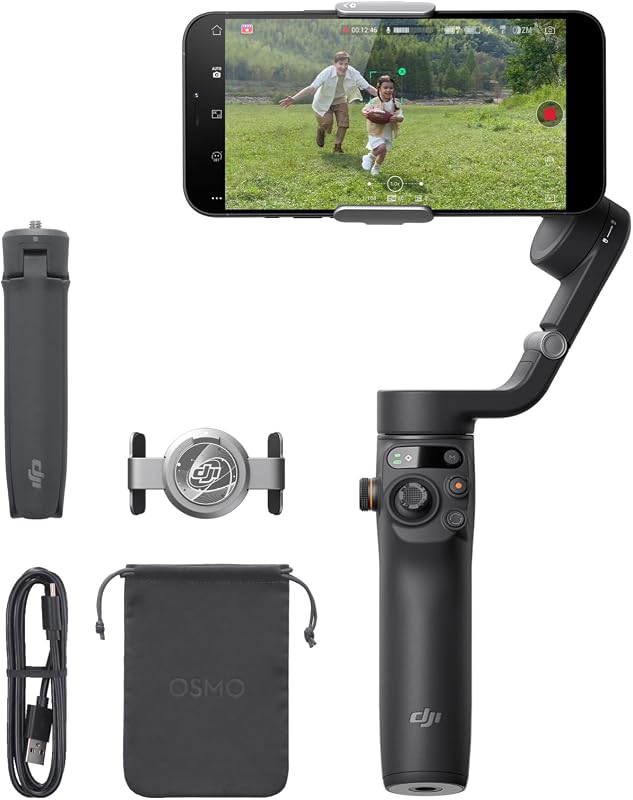
The DJI Osmo Mobile 7 Gimbal Stabilizer represents DJI’s streamlined seventh-generation handheld platform, designed around portability and baseline mechanical stabilization. Weighing 300 grams, this unit utilizes an ergonomic, anti-slip handle that houses a fold-out integrated tripod within the grip base. It provides 3-axis stabilization paired with DJI Mimo’s ActiveTrack 7.0 system. The tracking framework leverages dual-lens enhanced tracking by combining data from two smartphone lenses to maintain subject lock during close-up or erratic movements. The listing specifies up to 10 hours of operating time, alongside the ability to deliver pass-through power to an attached smartphone via its USB-C port. In the box, DJI supplies the gimbal, the Magnetic Phone Clamp 4, a 50-centimeter USB-C to USB-C power cable, and a protective storage pouch.
From a hardware reliability perspective, the physical architecture of the dji osmo mobile 7 prioritizes weight reduction over mechanical reach. It omits the telescoping extension rod found on premium sister models, which eliminates an internal friction-slide mechanism that could otherwise wear down or introduce flex under heavy payloads. However, motor strain remains a consideration when balancing larger iOS devices with heavy corner camera housings. Because the clamp relies on precise center placement to avoid overworking the roll and tilt motors, any offset introduced by bulky cases can force the stabilization algorithms to work harder, accelerating battery depletion. To maintain power delivery during prolonged shooting, users operating modern handsets often pair their gear with a syntech usb c to usb adapter pack of 2,usb c to usb3.0 female adapter compatible with iphone 15 macb for versatile charging cable connections.
This model suits mobile creators, tourists, and casual vloggers who want a stable platform without the added bulk or mechanical complexity of an internal telescoping pole. Because the listing notes that the DJI OM Multifunctional Module is not bundled and must be acquired separately via an optional tracking kit, users needing built-in lighting or direct wireless audio integration will find this entry-level variant insufficient, requiring an upgrade to the 7P series.
DJI Osmo Mobile 7P Gimbal Stabilizer for Integrated Audio and Lighting
Stepping up in capability, the DJI Osmo Mobile 7P Gimbal Stabilizer expands upon the base seventh-generation platform by incorporating an internal telescoping extension rod alongside the integrated tripod feet. The total weight increases to 368 grams, reflecting the additional mechanical hardware within the shaft. A core enhancement of this package is the inclusion of the Multifunctional Module. This add-on component combines native subject tracking, auxiliary lighting, and an integrated receiver compatible with the DJI Mic 2 and DJI Mic Mini transmitters. The stabilizer retains 3-axis stabilization, Dual-Lens Enhanced Tracking, a 10-hour operational battery life, and smartphone power bank functionality via USB-C.
For creators conducting a rigorous dji iphone stabilizer comparison, the 7P addresses common mobile production bottlenecks by centralizing lighting and audio reception onto the gimbal arm itself. The quick-launch functionality automatically powers on the stabilizer when unfolded and triggers a notification prompt on paired iPhones to open the DJI Mimo application. When assessing reliability, however, extending the built-in rod shifts the center of gravity further outward. This increased leverage exerts higher torque demands on the pitch and roll motors, particularly when stabilizing pro-tier iPhones that approach the physical limit of standard mobile clamps. Keeping the magnetic clamp meticulously aligned is essential to prevent motor shudder or axis shutdown during aggressive tracking sequences.
The dji osmo mobile 7p is tailored specifically for solo mobile journalists, event documentarians, and livestreamers who require illumination and wireless microphone integration without rigging external cold-shoe brackets. Shoppers who do not intend to use external microphone receivers or who prefer the absolute lightest pack weight should opt for the base model instead.
DJI Osmo Mobile 7P for Dedicated Wireless Microphone Setups
The bundled variant of the DJI Osmo Mobile 7P packages the complete stabilizer system together with an official DJI Mic Mini Transmitter finished in Infinity Black. Mechanically, the gimbal mirrors the standalone 7P configuration, featuring 3-axis motor stabilization, a built-in extension rod, an integrated tripod, and the Multifunctional Module. The included module acts directly as the receiver for the supplied Mic Mini transmitter, allowing creators to capture wireless audio straight into their recorded video files while utilizing the gimbal’s built-in fill lighting and native tracking functions.
Evaluating this complete kit requires inspecting the operational interplay between iOS hardware, peripheral hardware modules, and the DJI Mimo interface. Pairing an external wireless audio stream through a multifunctional receiver attached to a motorized stabilizer demands seamless data exchange. When recording high-framerate clips on an iPhone, running simultaneous Bluetooth stabilization commands, dual-lens tracking calculations, and digital audio reception can test the host phone’s thermal and processing boundaries. While the gimbal’s 10-hour battery can deliver top-off power to the attached smartphone, power delivery drops faster when the module simultaneously powers lighting and acts as an active receiver.
This all-in-one package is best suited for vloggers and interviewers who want a verified out-of-the-box wireless audio workflow without researching accessory compatibility. Buyers who already own alternative recording equipment or who prefer dedicated standalone audio recorders will be paying for redundant hardware and should bypass this specific combo.
DJI Osmo Mobile 6 Smartphone Gimbal for Manual Wheel Control
As the preceding sixth-generation flagship, the DJI Osmo Mobile 6 Smartphone Gimbal remains a prominent option within the stabilizer catalog. It features a foldable chassis weighing 305 grams, a built-in extension rod, and an integrated side control wheel dedicated to manual focus and zoom adjustments. Stabilization is driven by a 3-axis motor assembly running ActiveTrack 6.0. Software utilities include ShotGuides for automated scene identification, alongside an Apple Watch companion app integration that allows users to monitor camera framing and adjust gimbal angles directly from their wrist. When folded down, the unit measures 189 by 84.5 by 44 millimeters.
Examining dji osmo mobile compatibility iphone nuances reveals that the dji osmo mobile 6 relies heavily on the DJI Mimo environment to execute its signature hardware functions. The physical side wheel provides mechanical tactile control over optical blurs and Hitchcock zooms, but these features require an active software link within Mimo rather than functioning universally across third-party camera apps. In terms of hardware wear, the telescoping neck requires careful extension along its axis; twisting or forcing the segment can introduce looseness over prolonged use. While ActiveTrack 6.0 provides dependable subject locking, it lacks the dual-lens tracking integration found on subsequent iterations.
This model is ideal for mobile filmmakers and content producers who value tactile physical dials for pulling focus and controlling focal length manually on the fly. It yields ground to the 7-series and 8-series units for creators who prioritize advanced native audio module reception, higher tracking iterations, or full-circle panning.
DJI Osmo Mobile 8 Gimbal Stabilizer for Full 360-Degree Rotation
The DJI Osmo Mobile 8 Gimbal Stabilizer introduces substantial mechanical changes to DJI’s handheld smartphone lineup, highlighted by an unrestricted 360-degree continuous horizontal pan rotation axis. It incorporates a built-in extension rod and integrated tripod assembly, engineered with an ergonomic low-angle grip designed to reduce wrist fatigue when tracking subjects close to the floor. The system features AI Native Tracking with integrated audio reception and fill lighting capabilities, direct phone connection protocols for streamlined pairing, a 10-hour battery operating profile with phone charging support, and 3-axis motorized stabilization managed through onboard tutorials and One-Tap Edit software tools.
Continuous 360-degree panning fundamentally changes mechanical durability considerations. Unlike older stabilizers with rotational dead stops that force the pan motor to stop and reverse when reaching physical limits, the dji osmo mobile 8 can smoothly follow a circling subject indefinitely. However, unrestricted panning places higher demands on internal slip rings and tracking responsiveness. When capturing fast action, the AI tracking system must continuously calculate subject trajectories to prevent the camera from lagging behind. Furthermore, users operating the gimbal at extreme low angles with the extension rod deployed must be aware that downward tilt angles place asymmetric loads on the pitch motor, necessitating strict adherence to centered phone mounting.
This stabilizer is best suited for dynamic action videographers, pet documentarians, and skateboard filmmakers who rely extensively on low-angle tracking and uninterrupted circular panoramic movement. Users with basic static vlogging requirements may find the 360-degree rotational hardware unnecessary for everyday framing.
DJI Osmo Mobile 8 Standard Combo for Essential 360-Degree Tracking
The DJI Osmo Mobile 8 Standard Combo packages the continuous-rotation eighth-generation stabilizer in an accessible format focusing strictly on the core mechanical hardware. The listing indicates that this Standard Combo includes the gimbal unit, the standard Magnetic Phone Clamp, and essential accessories, while distinguishing it from the Advanced Tracking Combo that bundles the separate Multifunctional Module. The stabilizer retains 3-axis stabilization, complete 360-degree horizontal pan rotation, a built-in extension rod, an integrated tripod handle, direct phone connection tracking, and a 10-hour runtime battery capable of supplying power to an attached smartphone.
When assessing this baseline eighth-generation offering, buyers must clearly understand accessory limitations. While the stabilizer hardware supports AI native tracking workflows and 360-degree panning, the omission of the Multifunctional Module means that integrated hardware audio reception and built-in fill lighting are absent out of the box. The core mechanical benefits remain completely intact: the 3-axis stabilization cradle resists handshake, the low-angle grip configuration aids comfort during ground-skimming video runs, and the direct phone connection reduces software setup delays compared to legacy models.
This package is the recommended option for mobile videographers who want the freedom of 360-degree pan rotation and an integrated selfie-stick extension rod, but who already possess independent lighting and audio tools. It steps aside for the fully accessorized 8-series or 7P combos when integrated modular hardware is mandatory for solo productions.
How to Choose the Right DJI Phone Gimbal
Deciding which dji gimbal to buy requires weighing physical form factors against your specific production requirements. The primary mechanical distinction across the catalog centers on whether a stabilizer includes a built-in telescoping extension rod. The DJI Osmo Mobile 7 offers a rigid handle with a fold-out tripod, maximizing structural stability and keeping the unit at a lightweight 300 grams. Conversely, the Osmo Mobile 6, Osmo Mobile 7P, and Osmo Mobile 8 incorporate telescoping rods inside the handle. While this extension unlocks high-angle overhead perspectives and wide group selfies, it introduces an extra mechanical joint that users must handle with care to prevent play from developing over years of field operation.
Your audio and illumination strategy is the second critical factor. Content creators who capture talking-head vlogs or outdoor interviews must decide between a streamlined stabilizer and an integrated accessory platform. The 7P series and fully equipped 8-series units support or bundle a Multifunctional Module that consolidates tracking sensors, fill lighting, and direct receiver hardware for DJI wireless microphones. If you already capture audio through separate professional field recorders or wireless sets, investing in models that prioritize the module may yield little functional benefit. When expanding your production toolkit beyond mobile setups to dedicated aerial or compact cameras, comparing your mobile stabilizer against dedicated platforms like a dji mini camera can help determine whether a smartphone rig remains your best capture tool.
Finally, rotational range and subject tracking generation dictate long-term creative flexibility. The Osmo Mobile 6 operates on ActiveTrack 6.0 with physical side-wheel controls, making it a favorite for manual rack focus. The 7-series introduces ActiveTrack 7.0 alongside dual-lens enhanced tracking to keep rapid movements in sharp focus. For total tracking freedom, the Osmo Mobile 8 series provides continuous 360-degree pan rotation, eliminating rotational dead stops completely. To identify the best dji gimbal for iphone cinematography, balance your tolerance for weight and accessory complexity against the specific focal ranges and camera movements your projects demand.
FAQ
Do heavier iPhones cause motor strain on DJI gimbals
Heavier iPhone models, especially Pro Max variants with large camera arrays, require precise balance during initial setup. While DJI’s 3-axis motorized gimbals feature robust stabilization algorithms, positioning the magnetic clamp off-center forces the pitch and roll motors to exert continuous counter-torque. Over long recording sessions, an unbalanced setup increases motor heat, drains the stabilizer battery faster, and can lead to sudden axis shutdown if the payload exceeds motor torque limits.
Can I use my iPhone with a protective case inside the magnetic clamp
Standard slim and moderate protective cases generally fit within the DJI magnetic phone clamps supplied across the 6, 7, and 8 series. However, exceptionally thick, ruggedized, or wallet-style cases can prevent the clamp’s curved rubber grips from seating securely around the phone’s edges. A loose clamp fit risks phone slippage during sudden movements and alters the balance profile, creating unnecessary resistance for the stabilization motors.
How does the DJI Mimo application affect iPhone battery life and performance
The DJI Mimo app handles advanced functions like ActiveTrack, ShotGuides, and dual-lens computational tracking. Running these features concurrently with 4K video capture places heavy demands on your iPhone’s CPU and graphics processors. Users filming in warm environments should monitor device temperatures, as excessive heat can trigger iOS thermal throttling, which dims the screen and can cause dropped frames in recorded footage.
Can these DJI gimbals charge an iPhone while filming
The Osmo Mobile 7, 7P, and 8 models feature 10-hour operational batteries and include USB-C power bank capabilities to supply charge to an attached phone during use. While this feature prevents the phone battery from depleting during lengthy shoots, drawing charging power from the gimbal reduces the stabilizer’s total operating runtime. Users should balance their reliance on pass-through charging against their required shooting schedule.
What should I do if the gimbal loses subject tracking
Subject tracking can drop if a subject moves too quickly across the frame, if lighting levels fall dramatically, or if background visual clutter obscures outlines. The 7-series and 8-series combat this using dual-lens tracking and AI native tracking modules. If tracking disconnects frequently, verify that your smartphone camera lenses are clean, reposition the subject within the center of the frame, and ensure the companion software is updated to the latest firmware release.