
As Amazon Associates, we earn from qualifying purchases. This means we may receive a small commission at no extra cost to you if you click through and make a purchase.
The Roku television platform has earned widespread acclaim for its lightweight, exceptionally responsive smart operating system, which avoids the resource bloat and complicated menus found on competing interfaces. When shopping for a 55 4k roku display, buyers prioritize this clean architecture because it delivers swift application switching, unified home-screen navigation, and continuous automated software updates. Roku-powered televisions unite standardized software stability with diverse physical manufacturing standards, giving consumers predictable operation across a broad range of price-to-performance tiers without requiring separate external streaming media players.
Across this lineup, these four displays distinguish themselves through their underlying backlight engineering and panel refresh rates, spanning advanced Mini-LED local dimming arrays capable of high-frame-rate processing down to dependable direct-lit configurations built for standard everyday viewing.
Roku 55-inch 4K TVs Compared
| Model | Display Technology | Refresh Rate | Backlight Technology | HDR Formats |
|---|---|---|---|---|
| Roku Smart TV | Mini LED, QLED | 120 hertz | Mini-LED Full Array Local Dimming | Dolby Vision, HDR10, HDR10+, HLG |
| TCL 55-Inch Class R7D Series 4K | QLED | 60 hertz | LED | HDR10, HDR10+, HLG |
| Hisense 55″ Class E6SR Series Hi-QLED | Hi-QLED | 60 hertz | Direct LED LCD | Dolby Vision, HDR10, HLG |
| Roku Select Series 4K QLED Smart | QLED | 60 hertz | LED | Dolby Vision, HDR10+, HDR10, HLG |
Roku Smart TV for High-Performance Gaming and Premium Viewing
Best for: Fast action sports and console gaming
Pros
- Native 120Hz refresh rate
- Mini-LED local dimming
- Rechargeable backlit voice remote
Cons
- Custom mount sold separately
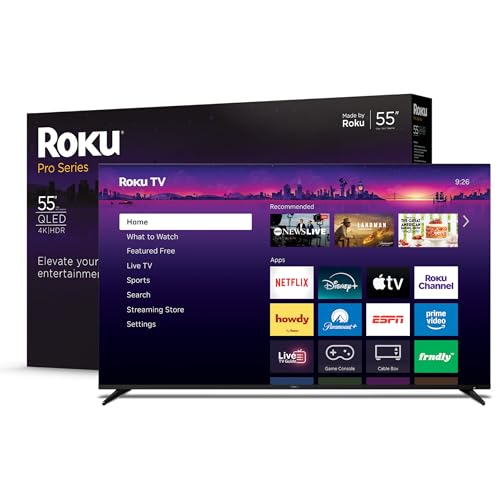
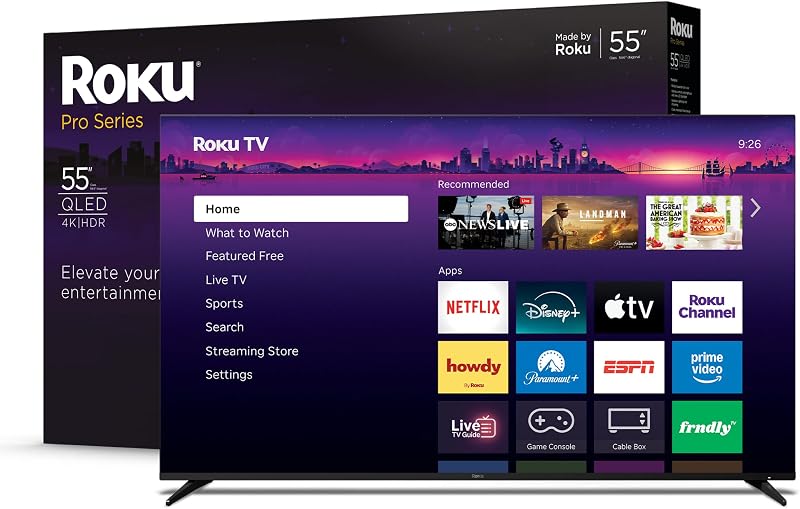
As the flagship performance tier within the ecosystem, the Roku Smart TV represents the premier roku pro series 55 inch engineering standard. Built with a combination of Quantum Dot color chemistry and an advanced Mini-LED backlight, this television employs thousands of miniature light-emitting diodes orchestrated by Full Array Local Dimming. Distributing backlighting across thousands of microscopic illumination points prevents excessive localized thermal concentration, a leading cause of premature LED degradation in standard edge-lit panels. The display achieves a static 5000:1 contrast ratio behind a sleek glossy screen finish, maximizing black levels and dynamic contrast when displaying demanding content formats including Dolby Vision IQ, HDR10, HDR10+, and standard HLG. Shoppers conducting a thorough 55 roku smart tv assessment will find that this high-density backlight architecture preserves visual depth in bright and dim viewing spaces alike.
Under the chassis, this model separates itself from typical streaming televisions by housing a true 120Hz native refresh rate panel supported by Roku Smart Picture Max. This artificial intelligence optimization engine actively filters incoming video feeds to refine sharpness, regulate color accuracy, and adjust parameters scene by scene. Dedicated gamers benefit from an expansive hardware feature set, including FreeSync Premium Pro, Variable Refresh Rate (VRR), and Auto Low Latency Mode (ALLM) to ensure tear-free high-frame-rate rendering on modern gaming rigs. Convenience hardware includes a fully rechargeable Roku Voice Remote Pro featuring backlit physical buttons and hands-free voice controls, eliminating the recurring expense and environmental waste of disposable alkaline cells. The structural design mounts flat against interior walls via an optional proprietary custom mount or any standard VESA universal wall bracket.
This premium display is uniquely engineered for console gamers, live sports enthusiasts, and home theater purists seeking an authentic roku smart tv 120hz 55 inch visual experience with precision contrast. It handles complex motion without the ghosting artifacts common to standard displays. However, casual viewers who primarily watch daytime broadcast talk shows or standard-definition programming may find its complex local dimming zones and high-end processing excessive compared to simpler 60Hz alternatives.
TCL 55-Inch Class R7D Series 4K for Seamless Smart Home Integration

Best for: Living room smart home integration
Pros
- Bezel-less metal frame
- Google Cast and AirPlay 2
- Motion Rate 240 with MEMC
Cons
- Native 60Hz panel limit
The TCL 55-Inch Class R7D Series 4K brings dependable manufacturing precision to the Roku OS environment, serving as a well-balanced residential television. Operating on a true 3840×2160 panel, this tcl 55 inch r7d roku tv leverages quantum dot technology to deliver wide color saturation across HDR10, HDR10+, HLG, and Open HDR mastering formats. To counteract the standard limitations of a native 60Hz refresh rate, TCL incorporates Motion Rate 240 processing driven by MEMC (Motion Estimation, Motion Compensation), which interpolates frames to smooth out fast-paced sports and frantic action sequences. The panel is enclosed within a FullView bezel-less design that uses a clean metal rim to secure the internal panel assembly, reducing structural chassis torsion and modernizing the aesthetic profile of any entertainment console.
Connectivity remains an essential element of long-term utility, and this unit integrates three high-speed HDMI inputs, including an ARC/eARC channel capable of bitstreaming uncompressed audio to outboard soundbars or multichannel receivers. Legacy inputs include a USB multimedia port and an optical digital audio output, with internal hardware decoding configured for Dolby Digital+ passthrough. Smart home interoperability is broad, featuring native compatibility with Apple HomeKit, Apple AirPlay 2, Google Home, Google Cast, and Amazon Alexa. In evaluations of wider tcl 55 qled 4k architectures, TCL backs the physical hardware with an included manufacturer limited warranty, standard remote control, and quick start setup documentation.
This television is an outstanding match for households that rely heavily on Apple or Google casting ecosystems and desire a clean, modern living room centerpiece without excessive weight or thermal output. However, serious competitive gamers demanding native 120-frame-per-second console output or home cinema fans seeking dark-room Mini-LED local dimming will find this 60Hz display yields performance ground to higher-tier hardware.
Hisense 55" Class E6SR Series Hi-QLED for Superior Sound Processing and Upscaling
Best for: Built-in surround sound and upscaled cable
Pros
- DTS Virtual:X audio processing
- Direct LED array illumination
- AI 4K upscaling engine
Cons
- Omits HDR10+ support
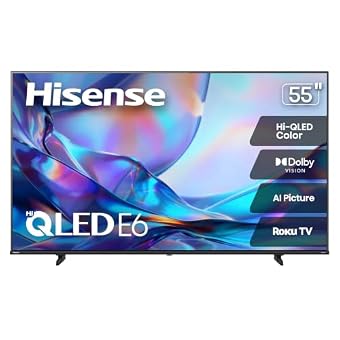
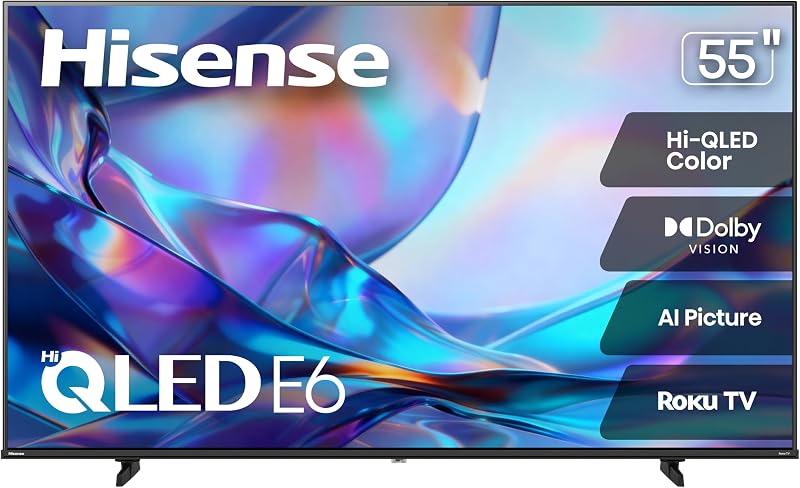
Centering its hardware strategy on balanced signal reproduction, the Hisense 55″ Class E6SR Series Hi-QLED pairs an LCD panel with Direct LED backlighting. Unlike perimeter edge-lighting arrays that concentrate thermal stress along the bottom frame, a Direct LED layout positions light-emitting diodes directly across the rear plane of the panel behind the diffuser layers. This geometry distributes thermal load uniformly across the chassis backplate, directly supporting long-term 55 inch roku tv reliability. Known formally as the hisense 55e6sr roku tv, it employs Hi-QLED Wide Color Gamut chemistry alongside dynamic Dolby Vision, standard HDR10, and HLG compatibility to deliver natural, lifelike tonal gradations across high-contrast video signals.
Signal processing is directed by an integrated AI Picture engine featuring an AI 4K Upscaler and active digital Noise Reduction. This hardware pipeline is particularly valuable for cleaning up legacy compressed cable broadcasts, sub-1080p feeds, and noisy digital streams, upscaling them to match the 3840×2160 screen resolution. Audio reproduction is driven by integrated DTS Virtual:X sound processing, which produces clearer dialogue intelligibility and virtualized surround sound without mandating an immediate soundbar purchase. Connected hardware features Game Mode Plus, VRR, ALLM, Apple AirPlay, and voice control compatibility with Amazon Alexa and Google Assistant across English, French, and Spanish interface languages.
Viewers who split their time between streaming movies, broadcast cable, and vintage television programming will appreciate the strong onboard audio and intelligent upscaling performance of this model. On the other hand, cinephiles seeking dynamic HDR10+ metadata processing or buyers looking for a native 120Hz display refresh rate will find the Roku Pro Series better suited to their demands.
Roku Select Series 4K QLED Smart for Comprehensive Hardware Warranty Coverage

Best for: Buyers seeking bundled hardware warranty coverage
Pros
- Included 12-Month CPS Protection Plan
- Dolby Atmos audio decoding
- Quantum Dot color with Dolby Vision
Cons
- Heavy 60-pound build weight
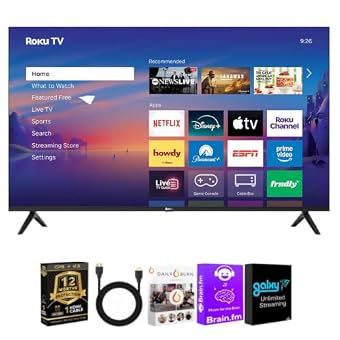
The Roku Select Series 4K QLED Smart bundle provides an all-in-one hardware package designed to eliminate uncertainty regarding installation accessories and operational protection. Operating at a native 3840×2160 Ultra HD resolution, this roku select series 4k qled model incorporates Quantum Dot enhancement layers over an energy-efficient LED backlight matrix. HDR compliance is comprehensive, decoding Dolby Vision, HDR10+, HDR10, and HLG content to maintain peak highlight details and deep color depth. For buyers researching a dependable roku 55 inch tv 4k purchase, this package is distinguished by the inclusion of a 12-Month CPS Protection Plan, a bundled premium high-speed HDMI cable, and specialized streaming service vouchers.
On the audio and gaming fronts, the unit features built-in Dolby Atmos decoding alongside Dolby Audio, enabling immersive multidimensional audio pass-through to compatible speaker systems. Gamers can rely on Auto Low Latency Mode (ALLM), Variable Refresh Rate (VRR), and an optimized Game Mode to keep input latency minimal during console sessions. Physical inputs include multiple HDMI connections, Ethernet for stable wired networking, USB connectivity, and digital audio outputs, with dual-band Wi-Fi and Bluetooth wireless radios handling accessory pairing. Integration with Apple AirPlay 2, Apple Home, and Roku Voice Search ensures fast, convenient control from handheld smart devices.
This bundled configuration is the ideal choice for cautious purchasers who prioritize extended hardware peace of mind through a dedicated third-party warranty plan and bundled installation cables. Its substantial 60-pound build weight and standard 60Hz panel mean it yields to lighter frames for lightweight mounting and steps aside for the Roku Pro Series when 120Hz native motion is non-negotiable.
How to Choose the Right Roku 55-inch 4K TV
Choosing which roku tv to buy requires balancing backlight hardware design, panel refresh capabilities, input specifications, and long-term warranty provisions. While every model runs the identical, user-friendly Roku operating system, the underlying electronics govern thermal stress, overall durability, and visual performance over years of operation.
Backlight architecture is the most critical factor affecting physical television longevity. High-end displays like the Roku Pro Series employ thousands of miniature light-emitting diodes under Full Array Local Dimming. This dense matrix avoids the localized hot spots found in traditional designs, maintaining consistent operational temperatures across the LCD substrate. Direct LED arrays, such as the system inside the Hisense E6SR, place standard LEDs evenly behind the screen. This approach provides better thermal distribution and lower individual component strain than edge-mounted strips, ensuring uniform diffusion and reducing premature backlight failures over extended daily viewing sessions.
Motion handling and native panel refresh rates separate general viewing screens from dedicated sports and gaming monitors. A true 120Hz panel updates its physical pixel state 120 times every second, providing pristine motion clarity for fast-moving sports and next-gen gaming consoles. While models featuring Motion Rate 240 with MEMC use smart software frame interpolation to reduce perceived judder on a 60Hz panel, competitive gamers should prioritize native 120Hz hardware with FreeSync Premium Pro and VRR support. Those evaluating screen dimensions against available space should also explore how compact alternatives like a 50 in roku tv perform when 55-inch frames exceed smaller bedroom footprints.
HDR format support and internal audio decoding dictate how well a screen interfaces with modern media streams. Dolby Vision and HDR10+ utilize dynamic metadata to adjust brightness and contrast frame by frame, preserving shadow detail that static HDR10 can occasionally clip. Buyers seeking immersive home cinema should confirm whether a screen supports Dolby Atmos and Dolby Vision decoding out of the box, ensuring compatibility with major streaming services. Furthermore, exploring comprehensive product packages that bundle certified HDMI cables and extended protection plans can safeguard your investment against motherboard failures, power supply issues, or unexpected panel defects.
FAQ
How does Mini-LED backlighting affect panel lifespan compared to standard LED?
Mini-LED backlighting utilizes thousands of microscopic diodes spread across hundreds of individual dimming zones, whereas standard LED arrays rely on dozens of larger diodes. By spreading the illumination task across an extensive surface area, each individual diode operates with reduced current and heat output. Lower thermal stress across the panel chassis helps prevent localized heat build-up, which is the primary cause of premature backlight burn-out and optical diffuser yellowing over time.
Can all 55-inch 4K Roku TVs run gaming consoles at native 120Hz?
No, not all Roku 55-inch models support native 120Hz playback. Standard models operate with 60Hz native refresh rates, often using software interpolation technologies like MEMC or Motion Rate processing to smooth standard motion. To achieve authentic 120 frames per second at 4K resolution, you must select a model specifically equipped with a native 120Hz panel, such as the Roku Pro Series.
What is the benefit of an included CPS protection plan on Roku televisions?
An included Consumer Priority Service (CPS) protection plan extends hardware coverage beyond basic limited manufacturer warranties. These plans typically cover internal component failures, power surges, mainboard defects, and hardware malfunctions that occur after standard introductory coverage expires. For risk-averse buyers, this bundled coverage eliminates unexpected out-of-pocket repair bills during the initial ownership period.
Why does dynamic HDR format support matter on Roku smart TVs?
Dynamic HDR formats like Dolby Vision, Dolby Vision IQ, and HDR10+ transmit continuous frame-by-frame metadata to the television processing engine. Unlike static HDR10, which applies a single fixed brightness profile across an entire movie, dynamic formats continually adjust tone curves based on specific lighting conditions in each scene. This ensures that dark corridors retain shadow detail without washing out bright outdoor skies.
How does the Roku operating system maintain long-term performance?
The Roku OS is intentionally engineered with a lightweight footprint that prioritizes minimal background resource usage. By avoiding resource-intensive visual overlays, intrusive system telemetry, and heavy multi-layered menus, Roku televisions experience far less software degradation over years of service. Automatic firmware updates arrive periodically to patch vulnerabilities, optimize decoding libraries, and preserve channel compatibility across all connected hardware.