As Amazon Associates, we earn from qualifying purchases. This means we may receive a small commission at no extra cost to you if you click through and make a purchase.
Play-Doh has served as the baseline standard for water-based modeling dough since its initial household rollout in 1956, relying on a simple, non-toxic formulation of wheat flour, water, and salt to create a pliable sensory medium. In the modeling compound sector, Hasbro positions the brand as a dependable arts-and-crafts staple across preschool classrooms, daycare centers, and family playrooms. Because Play-Doh relies on ambient moisture to retain its smooth elasticity, long-term performance hinges heavily on packaging design, rim tolerances, and lid retention. Consumers routinely battle premature hardening caused by loose closures or compound migration into can grooves, making container integrity just as critical as the squishy material inside.
While the Play-Doh 9 Pack Favorite Color delivers an asymmetrical mix of seven high-volume tubs and two smaller accent shades, the Play-Doh Pastel Colors Bulk 12-Pack prioritizes uniform four-ounce cans for large-scale creative work, and the Play Doh Modeling Compound 10-Pack Case focuses strictly on two-ounce mini portions designed to limit compound waste during short play sessions.
Play-Doh Modeling Compounds Compared
| Product Name | Total Net Weight | Can Sizes Included | Stated Age Range | Included Color Assortment |
|---|---|---|---|---|
| Play-Doh 9 Pack Favorite Color | 32 oz (2 lb / 907 g) | 7x 4 oz cans, 2x 2 oz cans | Toddler (Ages 2+) | Red, orange, yellow, green, blue, purple, pink, black, white |
| Play-Doh Pastel Colors Bulk 12-Pack | 48 oz (3 lb / 1.36 kg) | 12x 4 oz cans | Kid (Ages 2+) | Spring shades: blue, purple, green, orange, pink, yellow, white |
| Play Doh Modeling Compound 10-Pack Case | 20 oz (1.25 lb / 567 g) | 10x 2 oz cans | Ages 2+ | Red, orange, yellow, green, teal, blue, purple, pink, black, white |
Play-Doh 9 Pack Favorite Color for Mixed-Scale Projects
Best for: Mixed-scale modeling with dedicated detailing shades
Pros
- Balanced 4 oz and 2 oz mix
- Includes black and white detail shades
- Full rainbow assortment
Cons
- 2 oz detail cans dry out quickly
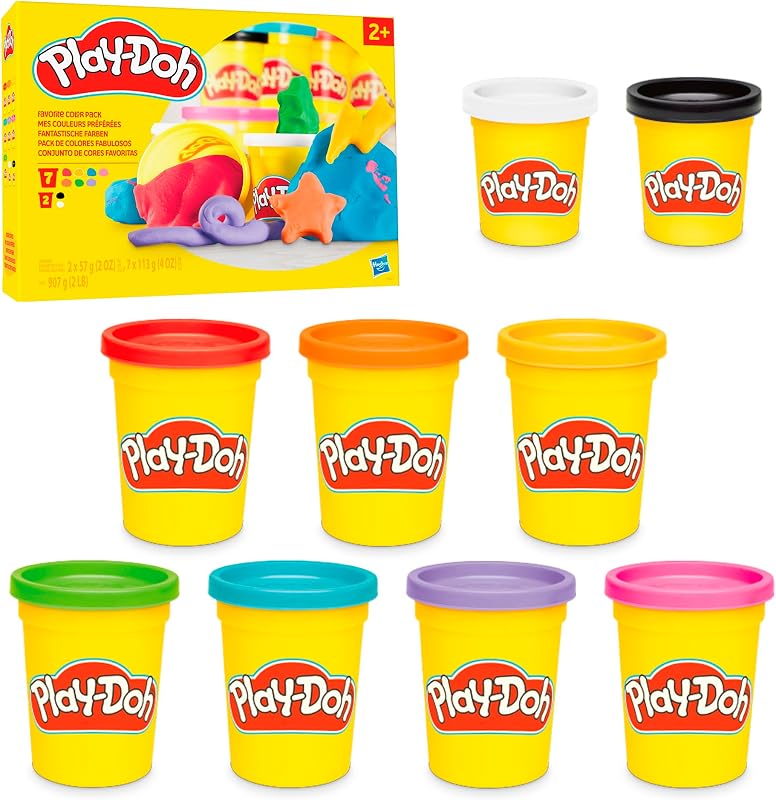
The Play-Doh 9 Pack Favorite Color is packaged under model number F9821 and includes a net weight of two pounds (907 grams) of modeling dough divided unevenly across nine individual plastic containers. The primary lineup consists of seven large four-ounce (113-gram) cans featuring a classic rainbow spectrum: red, orange, yellow, green, blue, purple, and pink. To support fine-line modeling and structural details, Hasbro supplements this set with two standard two-ounce (56-gram) cans dedicated to black and white. This configuration reflects practical crafting habits, recognizing that foundational base sculptures consume substantial material, while facial features, pupils, borders, and color-mixing experiments demand much smaller portions.
From an editorial reliability standpoint, this split-volume layout presents distinct dry-out characteristics. The four-ounce tubs maintain a favorable surface-area-to-volume ratio, which preserves internal moisture longer when toddlers leave containers uncapped on the activity table. Conversely, the two-ounce cans of black and white possess a higher relative surface exposure and will desiccate much faster if neglected. Rigorously tested for safety, the compound is produced primarily with flour, water, and salt, though guardians must note that it contains wheat. Much like maintaining storage reliability for sensitive materials such as polaroid camera film, keeping these dough containers tightly sealed when not in use is essential to prevent moisture evaporation and salt crystallization along the container walls.
We consider this set the best play doh pack for toddlers who need enough substance to press into molds and cutters without instantly depleting each tub. The inclusion of full-size four-ounce cans gives younger children the tactile mass required to develop motor coordination and hand strength through squishing, rolling, and stacking. However, because the detailing shades are restricted to smaller two-ounce sizes, households engaged in elaborate sculpture work may find the black and white reserves run dry far ahead of the colorful primary bases, eventually requiring standalone color replacements.
Play-Doh Pastel Colors Bulk 12-Pack for High-Volume Group Play

Best for: Large group play and classroom project refills
Pros
- Twelve large 4 oz containers
- Higher desiccation resistance during play
- Fully recyclable cans and packaging
Cons
- Pastel tones lack bold primary shades
Designed for larger group projects and comprehensive material replenishment, the Play-Doh Pastel Colors Bulk 12-Pack (model number E4831) contains a substantial 48 ounces of compound divided evenly across a dozen four-ounce containers. The color palette deviates from primary bold tones, offering spring-inspired pastel hues including soft shades of blue, purple, green, orange, pink, yellow, and white. Hasbro packages this collection in a simple, frustration-free recyclable cardboard box, and both the cans and lids are fully recyclable. By focusing entirely on uniform four-ounce vessels, the set eliminates portion discrepancies and ensures that every participant in a preschool or party setting has access to identical working volumes.
In terms of component durability and longevity, four-ounce containers offer superior protection against ambient desiccation during extended play sessions. When children work with modeling tools, extruders, and tabletop rollers, dough remains exposed to circulating air for prolonged stretches. The larger mass inside a four-ounce container retains core humidity significantly better than miniature alternatives, resisting early crusting and crumb formation. Much like preserving durable toys such as a blue angels toy plane across repeated rough sessions, container resilience matters here: the wide plastic lids on these 48-ounce sets feature deep sealing lips that cleanly snap into place, though users must regularly clear dried compound crusts from the lid ridges to maintain a true airtight barrier.
This set shines as an all-purpose play doh bulk refill pack for classrooms, multi-child playdates, and holiday craft stations where children share tools and build sizable figures like animals, flowers, and seasonal decorations. It provides a distinct aesthetic alternative to standard primary sets, making it particularly appealing for decorative modeling. The main trade-off is storage footprint and desiccation risk: opening all twelve four-ounce tubs simultaneously introduces three full pounds of compound to open air, meaning supervision is required to ensure lids are re-seated before surface stiffening begins.
Play Doh Modeling Compound 10-Pack Case for Waste-Minimizing Starter Sets

Best for: Minimizing dry-out waste in short play sessions
Pros
- Ten distinct colors for variety
- Limits compound loss if left uncapped
- Compact storage footprint
Cons
- Low volume depletes quickly with extruders
The Play Doh Modeling Compound 10-Pack Case, listed under item part number 29413F01, offers a balanced collection of ten distinct shades housed exclusively in compact two-ounce containers. Totaling 20 ounces of compound, this set supplies red, orange, yellow, green, teal, blue, purple, pink, black, and white. The listing notes that this item carries no manufacturer warranty, which is standard across consumable modeling compounds. First introduced in this format as an Amazon exclusive, the set serves as a targeted entry-level kit or supplemental refill for mechanical play sets that feature small extruding nozzles, stampers, and decorative press molds.
The primary engineering and buyer advantage of this ten-piece case is loss mitigation. Two-ounce tubs contain just enough compound for a single, focused craft session without stranding excess dough out on the table. When a young child forgets to recap a container overnight, losing a single two-ounce tub represents minimal material waste compared to losing half of an extra-large container. Much like packing compact electronic accessories such as a syntech usb c to usb adapter pack of 2 into organized storage slots, these smaller containers take up minimal shelf space and fit neatly inside standard desktop supply organizers or travel bags.
This compact case is ideal for solo play, quick travel sessions, classroom party favors, and tabletop tasks where color diversity takes precedence over sheer compound mass. Children can execute complex color-blending routines and detailed figurines without overwhelming the workspace. However, it yields quickly to the larger four-ounce sets whenever children engage in heavy extruding work or build large-scale structures, as running two or three continuous extruder presses can exhaust an entire two-ounce tub in minutes.
How to Choose the Right Play-Doh Modeling Compounds
Selecting the right dough set requires understanding how container volume directly impacts waste, shelf stability, and project utility. When shoppers evaluate a play-doh modeling compound comparison, the debate usually centers around play doh 4 oz cans vs 2 oz options. A four-ounce tub provides roughly double the material by weight, which is essential for rolling out flat sheets, pressing into deep shape molds, or feeding motorized extruder tools. However, if your household frequently experiences lost lids or abandoned half-finished projects, smaller two-ounce tubs significantly limit the volume of compound that ends up dried into brittle crusts on the playroom rug.
Can seal integrity is the primary mechanical factor governing play doh shelf life and storage. Play-Doh cans rely on a friction-fit plastic rim that requires a firm downward press until a faint pop or snap is felt. Over weeks of active play, tiny dough fragments inevitably cling to the upper lip of the can. If these dried remnants are not wiped away, they create microscopic gaps that allow ambient air to penetrate the sealed tub, gradually dehydrating the salt-and-flour emulsion even while the lid appears closed. Inspecting and wiping the container rim before closing will extend compound viability by months.
Color variety versus portion size represents another key strategic choice. While many parents instinctively search for an entry-level 4 pack of play doh, basic four-can sets frequently leave young creators short on accent tones like black, white, and teal, sparking immediate frustration during creative sessions. Larger variety bundles solve this by delivering wide spectrums, but buyers must evaluate how those colors will be consumed. If sculpting human figures, animals, or complex objects, sets that include black and white are essential for detailing. For abstract rolling and cutting, monochromatic or pastel themes provide plenty of material without creating murky, over-blended brown mixtures too early in the product lifecycle.
Allergen safety and household environment must also guide which play-doh pack to buy. All authentic Play-Doh compounds are non-toxic and rigorously tested against child safety benchmarks, but they are primarily composed of wheat flour, water, and sodium chloride. As a result, households with wheat allergies or celiac disease must avoid these sets entirely to eliminate ingestion and cross-contamination hazards. For households cleared for wheat, the classic formula provides an unmatched squishy texture and elasticity that synthetic or silicone-based doughs rarely replicate.
FAQ
How long does unopened Play-Doh compound last on the shelf?
When stored in an unopened, factory-sealed plastic can in a cool, dry room away from direct sunlight, Play-Doh modeling compound can remain pliable and fresh for over a year. The water-and-salt solution stays stable inside the non-porous plastic housing until air penetrates the seal. Extreme heat or freezing temperatures can disrupt the compound structure, causing moisture separation or salt sweating inside the container.
Can dried-out Play-Doh modeling compound be restored?
If the compound has only begun to form an outer crust, it can often be revitalized by adding water one drop at a time and kneading it thoroughly into the dough until the moisture redistributes evenly through the wheat matrix. Another proven technique involves wrapping the stiffened compound in a damp paper towel, returning it to its plastic can, snapping the lid tight, and letting it absorb the ambient humidity overnight. If the dough has completely hardened into a chalky solid, the salt crystallization is permanent and the compound must be replaced.
What is the difference between 2-ounce and 4-ounce Play-Doh cans in terms of longevity?
Four-ounce cans hold twice the physical mass of compound, which creates a lower surface-to-volume ratio that naturally resists ambient desiccation longer during extended open-air play. Two-ounce cans dry out considerably faster when left exposed on tables, making them best suited for quick single-session projects. However, when unsealed cans are accidentally abandoned overnight, a dried-out two-ounce can results in only half as much wasted compound as a ruined four-ounce can.
Are Play-Doh cans and lids airtight enough for long-term storage?
The standard polypropylene cans and push-on lids provide an effective barrier against evaporation, but they are not fully hermetic long-term storage solutions. Any dried bits of dough lodged along the rim will compromise the closure and let dry air enter. For maximum compound preservation across several months of disuse, many families wipe the can rims clean and store the sealed tubs inside a secondary heavy-duty zip-top freezer bag or airtight plastic storage tote.
Does Hasbro offer a manufacturer warranty on Play-Doh replacement cans?
Hasbro does not provide a formal commercial warranty on Play-Doh modeling compound cans, listing them with no warranty coverage due to their consumable, perishable nature. Because dough desiccation depends entirely on household storage habits, ambient humidity, and user compliance with recapping instructions, dried-out cans are considered normal wear and tear rather than manufacturing defects.
Is Play-Doh compound safe for children with wheat or gluten allergies?
No, Play-Doh modeling compound is not gluten-free. The core binding ingredient in authentic Play-Doh is wheat flour mixed with water and salt. Children who have celiac disease or severe wheat sensitivities risk allergic reactions through accidental ingestion, hand-to-mouth contact, or skin absorption during tactile play. Caregivers must select alternative, certified gluten-free modeling compounds for children with diagnosed wheat intolerances.